ART
BEAUTY & WELLNESS
CRAFT
CULTURE & HISTORY
ENTERTAINMENT
ENVIRONMENT
FOOD & DRINKS
REVERSE ENGINEERING
SCIENCES
SPORTS
TECHNOLOGY
WEARABLES
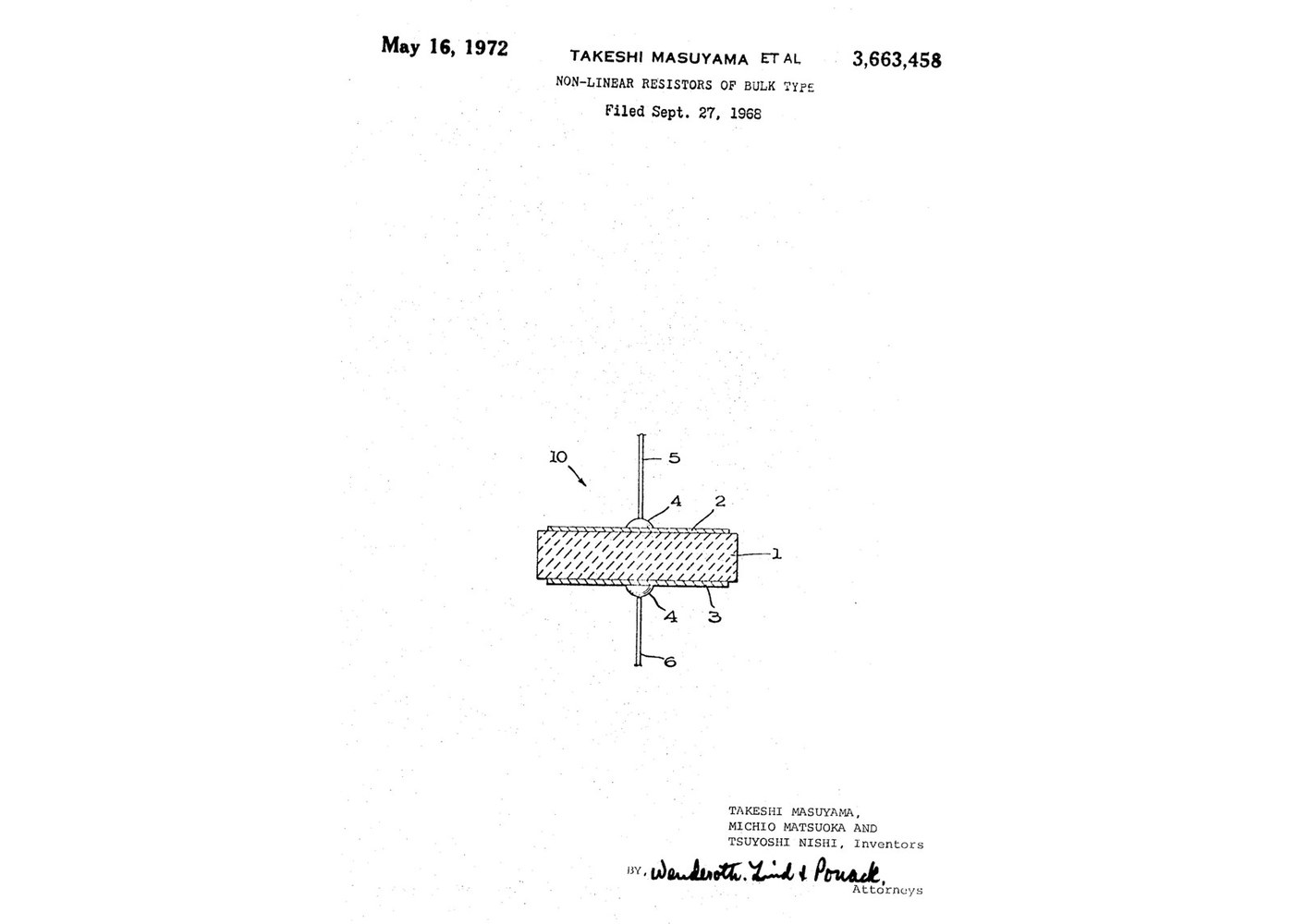


Metal Oxide Varistor: Pure Zinc Oxide at 1350 °C, Bismuth Oxide Paste Fired at 600 °C (Masuyama 1972, Ex. 4)
A varistor made the other way round: a disc of pure zinc oxide, sintered, with bismuth oxide fired into its faces from a paste instead of mixed in. Sintered at 1350 °C and fired with the paste at 600 °C, the disc measured a C-value of 13 at 1 mA and a nonlinearity exponent n of 4.2. Masuyama found that firing on the bismuth oxide paste raises n a great deal over mixing it in.
Source: T. Masuyama, M. Matsuoka and T. Nishi (Matsushita), US 3,663,458 (1972), Example 4. Unknown: how the aluminium is sprayed on, what the silver paint is, and how strong the epoxy solution of the paste is. The 10 g batch is our arithmetic. Picture: the patent's drawing.
Advanced
2 days
Instructions
1
1
Press pure zinc oxide at 340 kg/cm²
Press pure zinc oxide at 340 kg/cm²
Press zinc oxide powder at 340 kg/cm². Example 4 gives no disc size; ours: discs 13 mm across and 2.5 mm thick in the mould of Example 1.
Materials for this step:
 Zinc Oxide Powder1 as required
Tools needed:
 Balance Scale
 Hydraulic Press
 Disc Pressing Die
 Vernier Caliper
2
2
Sinter 1 hour at 1350 °C and cool
Sinter 1 hour at 1350 °C and cool
Heat the pressed disc for 1 hour at 1350 °C, then let it cool to room temperature.
Tools needed:
 Muffle Furnace
3
3
Lap both faces
Lap both faces
Lap both faces with silicon carbide abrasive. Example 4 gives no thickness.
Tools needed:
 Silicon Carbide GritVernier Caliper
4
4
Coat with bismuth oxide paste and fire at 600 °C
Coat with bismuth oxide paste and fire at 600 °C
Coat both lapped faces with a paste of 50 % by weight bismuth oxide in a solution of epoxy resin in butyl alcohol, and fire it in air at 600 °C for 30 minutes. The bismuth oxide diffuses into the zinc oxide. Not given: how much paste, or the strength of the epoxy solution.
Materials for this step:
 Bismuth Oxide1 as required
Tools needed:
 Epoxy Resin
 n-ButanolMuffle Furnace
5
5
Spray aluminium electrodes and attach leads
Spray aluminium electrodes and attach leads
Spray a metallised film of aluminium on both faces. Attach a lead wire to each with conductive silver paint, as in Example 1. Unknown: the spraying method and the paint.
Materials for this step:
 Aluminium Ingot1 as required
 Silver Conductive Paint1 as required
 Copper Wire2 pieces
Tools needed:
 Unknown Metal Spraying MethodVernier Caliper
Materials
5- 1 as requiredPlaceholder
- 1 as requiredPlaceholder
- 1 as requiredPlaceholder
- 1 as requiredPlaceholder
- 2 piecesPlaceholder
Tools Required
9- Placeholder
- Placeholder
- Placeholder
- Placeholder
- Placeholder
- Placeholder
- Placeholder
- Placeholder
- Placeholder
This blueprint makes

Related Blueprints
These blueprints share knowledge with this one — techniques, materials, or principles that connect them in the learning graph.

CC0 Public Domain
This blueprint is released under CC0. You are free to copy, modify, distribute, and use this work for any purpose, without asking permission.
Support the Maker by purchasing products through their Blueprint where they earn a Maker Commission set by Vendors, or create a new iteration of this Blueprint and include it as a connection in your own Blueprint to share revenue.