

Using a Drop Spindle to Spin Wool — Hand Spinning Yarn
Hướng dẫn
Prepare the Wool
Prepare the Wool
Start with clean, washed wool that has been dried and picked free of debris, burrs, and matted clumps. Card the wool by pulling it through teasel heads or between two boards studded with small wire hooks (hand carders), producing a fluffy, aligned batt called a rolag. Carding aligns the individual wool fibers roughly parallel, making them much easier to spin. Ancient spinners also used simple hand-combing with thorny plants to achieve a similar effect. Prepare several rolags before beginning to spin, as stopping to card wool interrupts the spinning rhythm.
Vật liệu cho bước này:
 Lông cừu thô100-200 g g
 Con quay xe sợi1, 3-5 cm diameter with centre hole cm
 Que khô thẳng (trục xoay)1 stick, 25-35 cm long, 8-10 mm diameter cm
Công cụ cần thiết:
 Dao đá lửa
 Bàn chải chải len
Assemble the Drop Spindle
Assemble the Drop Spindle
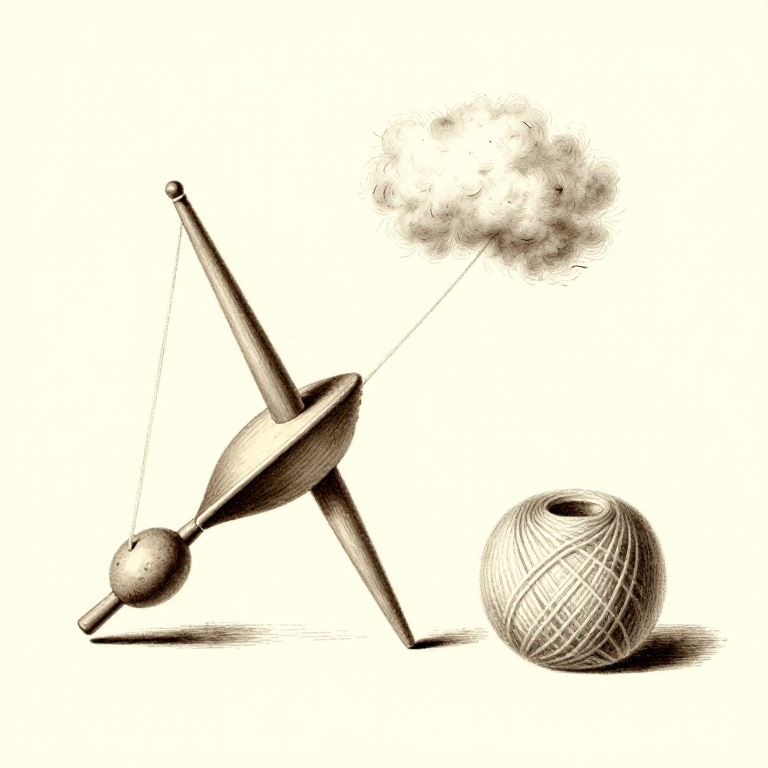
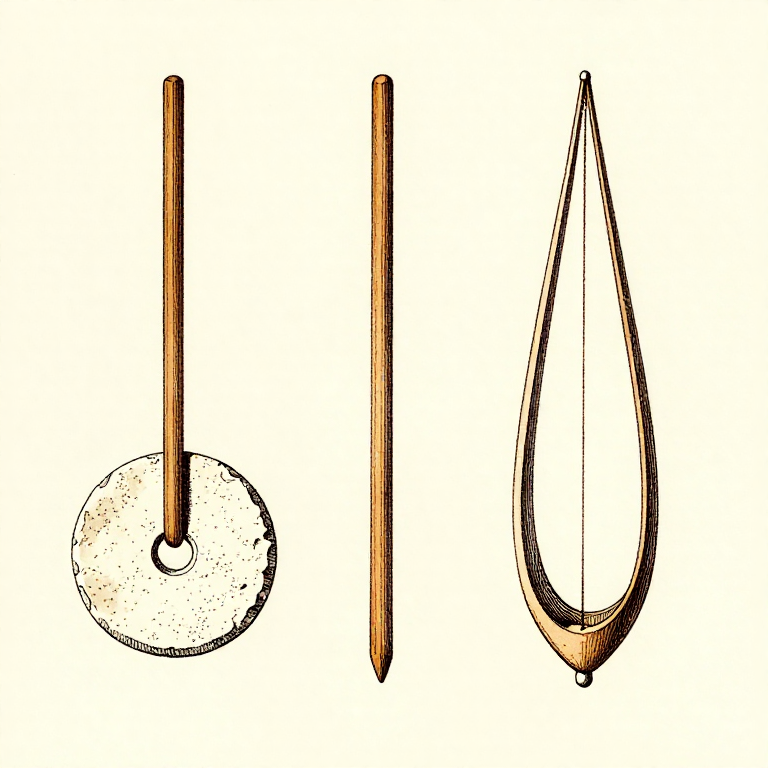
The drop spindle consists of a shaft (a straight wooden stick) and a whorl (a weighted disc). The whorl provides rotational inertia — its mass keeps the spindle spinning, which continuously twists the fibers into yarn. Push the shaft through the centre hole of the whorl. The whorl can be positioned near the bottom (low whorl, more common in the ancient Near East) or near the top (high whorl, common in medieval Europe). Low-whorl spindles are more stable for beginners. Carve a small notch or hook at the top of the shaft to hold the forming yarn in place. The total spindle weight should be 30-60 g — heavier spindles produce thicker yarn, lighter ones produce finer yarn.
Attach a Leader and Begin Spinning
Attach a Leader and Begin Spinning
Tie a 30-cm length of existing yarn (the leader) to the spindle shaft near the whorl. Wind it up the shaft and secure it in the top notch. Pull a thin wisp of fiber from the rolag and overlap it with the end of the leader, pinching the junction between thumb and forefinger. Give the spindle a firm clockwise twist to set it spinning, then release it to hang freely. The spinning motion twists the overlapping fibers together with the leader, creating a continuous yarn. As the twist travels up the fiber draft, pinch above the twist zone and gently pull (draft) more fiber from the rolag to thin and extend the forming yarn.
Draft, Twist, and Wind On
Draft, Twist, and Wind On
The spinning cycle is: draft fibers out to the desired thickness, allow twist to run up into the drafted section, then wind the finished yarn onto the spindle shaft below the whorl. When the spindle reaches the ground (or your twist stalls), unhook the yarn from the notch, wind it onto the shaft, re-hook it, give the spindle another twist, and continue. The key to even yarn is consistent drafting — pull the same amount of fiber each time. Thick spots have too much fiber; thin spots have too little. If the yarn breaks, overlap the broken end with new fiber, add twist, and continue. Thicker yarn is easier for beginners; fine yarn requires more practice.
Finish and Ply the Yarn
Finish and Ply the Yarn
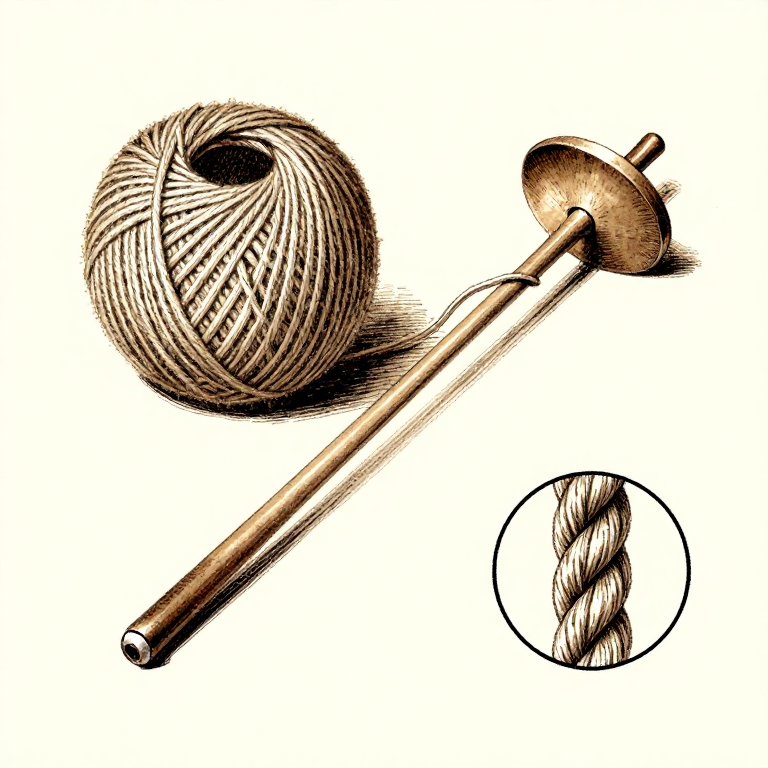
When the spindle is full, wind the yarn off into a ball or skein. Single-ply yarn (one strand) is useful but tends to twist back on itself. For stronger, more balanced yarn, ply two singles together by spinning two strands in the opposite direction (counterclockwise if the singles were spun clockwise). Thread two full spindles of singles through the same top notch of an empty spindle and spin them together. The opposing twist directions cancel out, producing a stable, round, two-ply yarn suitable for weaving or knitting. Ancient textiles from Mesopotamian and Egyptian sites show both single-ply and two-ply construction, with the finest linen yarns achieving thread counts comparable to modern fabrics.
Vật liệu
5- 1, 3-5 cm diameter with centre hole cmTạm thời
- 1 stick, 25-35 cm long, 8-10 mm diameter cmTạm thời
- 100-200 g cáiTạm thời
- 1 stick, 25-35 cm long, 8-10 mm diameter cáiTạm thời
- 1, 3-5 cm diameter with centre hole cáiTạm thời
Công cụ yêu cầu
3- Tạm thời
- Tạm thời
- Tạm thời
Bản thiết kế này làm ra

CC0 Phạm vi công cộng
Bản thiết kế này được phát hành theo CC0. Bạn tự do sao chép, sửa đổi, phân phối và sử dụng cho bất kỳ mục đích nào mà không cần xin phép.
Hỗ trợ nhà sáng tạo bằng cách mua sản phẩm qua bản thiết kế, nơi họ nhận Hoa hồng nhà sáng tạo do nhà bán hàng đặt, hoặc tạo phiên bản mới và kết nối trong bản thiết kế riêng để chia sẻ doanh thu.