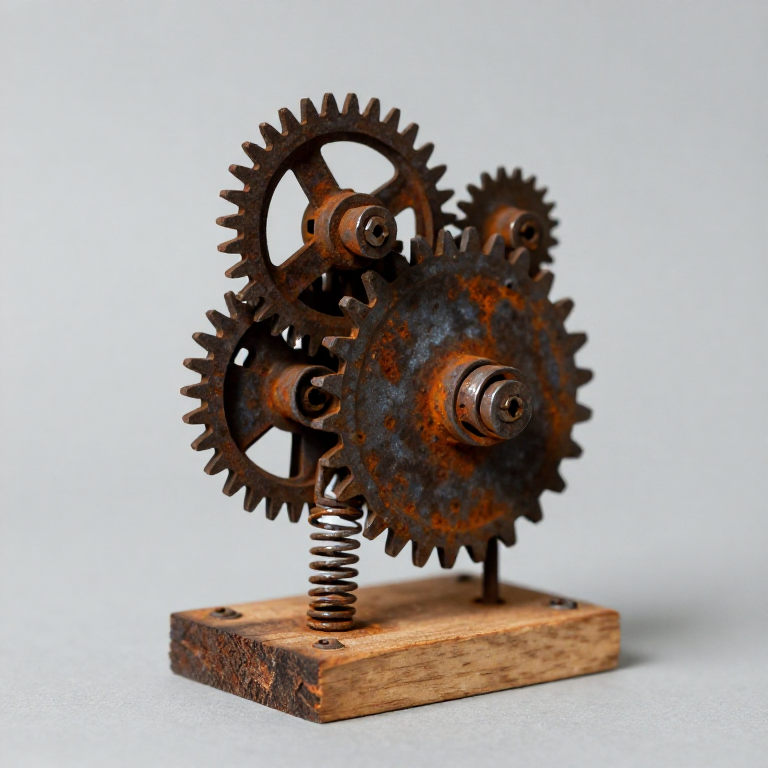


Assemblage from Found Objects
Assemblage is sculpture made from things that already existed and were made for something else. A gear, a doll's arm, a rusted hinge, a length of type. The maker's contribution is not fabrication — it is selection and juxtaposition.
That sounds like it removes the craft. It does the opposite. Because you did not make the parts, every decision you can still make carries more weight: which objects, in what relation, at what scale, and — the one beginners neglect — how they are joined. An assemblage held together with hot glue reads as a pile; the same objects mechanically fixed with visible, considered fastenings read as a made thing.
There is also a real materials problem hiding in it. Found objects arrive with histories: active rust, old paint that may contain lead, oil, salts, adhesives, and wildly different rates of expansion. A steel plate epoxied rigidly to a piece of wood will crack itself apart over a year of humidity changes. Conservation is not an afterthought here, it is a design input.
The word is Jean Dubuffet's, who used it for his own work in 1953; the exhibition that established it was The Art of Assemblage at MoMA in 1961, curated by William Seitz.
Collect, sort, compose, join properly, and write down what everything is.
Hướng dẫn
Collect without a plan
Collect without a plan
Gather thirty to fifty small objects over several sessions, from skips, charity shops, beaches, workshops and broken appliances. Take things because they are interesting, not because you know what they are for.
Record where each came from as you collect it, not later.
Provenance is the one piece of information that is free at the moment of collection and impossible to recover afterwards.
Vật liệu cho bước này:
 Hộp vật liệu nghệ thuật từ đồ tìm được1 bộ
Công cụ cần thiết:
 Sổ tay thực địa mọi thời tiết
Sort by property, not by what it was
Sort by property, not by what it was
Lay everything out and sort it three separate times: once by material, once by form (round, linear, planar), once by surface (matt, glossy, corroded).
Photograph each sort.
Expect groupings that cut across the objects' original identities.
Sorting by what a thing was keeps you making illustrations of it. Sorting by property is how you start seeing a doorknob as a sphere.
Stabilise before you commit
Stabilise before you commit
Clean off loose dirt. Wire-brush and neutralise active rust, or seal it deliberately if the rust is the point. Degrease anything that will be glued.
Set aside anything with flaking old paint.
Active rust does not stop when you build with it, and pre-1978 paint may contain lead — do not sand or heat unknown painted metal, and wash hands after handling it.
Compose loose, and live with it
Compose loose, and live with it
Arrange without fixing anything. Photograph each arrangement from a fixed camera position, then walk away and come back.
Try at least six arrangements before choosing.
Photograph rather than remember. A camera flattens the composition to the two dimensions most viewers will actually judge it in, and arrangements that look balanced in the round frequently collapse in a photograph.
Join mechanically wherever you can
Join mechanically wherever you can
Prefer bolts, rivets, wire, pins and sockets. Use epoxy only where a mechanical joint is impossible.
Where two materials with very different expansion meet — metal to wood, metal to ceramic — use a fixing that allows a little movement, such as a bolt through a slightly oversize hole.
A rigid bond between materials that move at different rates is a crack waiting for a season to change.
Vật liệu cho bước này:
 Phụ kiện nghệ thuật lắp ghép1 bộ
 Keo epoxy 5 phút1 cái
Công cụ cần thiết:
 Máy khoan pin
Solve the base and the balance
Solve the base and the balance
Work out how it stands. Weigh the finished piece, find its centre of mass by balancing it on an edge, and make a base wide enough that a modest push does not topple it.
Test it on a slightly uneven surface.
Assemblages are top-heavy by nature — the interesting objects are usually the ones you want high up — and a sculpture that falls over destroys itself and possibly a foot.
Công cụ cần thiết:
 Cân nhà bếp điện tử
History & Context
History & Context
The word is more recent than the practice. Picasso and Braque were gluing rope, oilcloth and newspaper into pictures from around 1912, and the Dadaists made objects from junk immediately after; Marcel Duchamp's readymades from 1913 onwards posed the harder question of whether selection alone could constitute the work. But it was Jean Dubuffet who applied the term assemblage to his own constructions in 1953 — he wanted collage reserved for the 1910-20 Cubist and Dada works — and the 1961 MoMA exhibition The Art of Assemblage, curated by William Seitz, that fixed it as a recognised category. Seitz described the assembler as working "like a beachcomber, a collector, or a scavenger wandering among ruins", discovering order as well as materials by accident.
Why found material carries meaning that new material does not. A new sheet of steel has no history to read; a worn one has wear patterns, tool marks, corrosion and paint that record a working life. That is genuine information, and it is why assemblage so often reads as elegiac even when the maker did not intend it. The risk is the mirror image: a merely nostalgic object can do the work for you, and the piece becomes about the objects rather than about anything you did with them.
Related traditions with different logics. Arte povera in 1960s Italy used poor and everyday materials as a political position. Nouveau Réalisme, and César's compressions, treated industrial waste as raw stock. The recycled-material sculpture of many African and South Asian workshops is driven by cost and availability rather than by art-historical argument, and produces work that is often more inventive for it. Assemblage is not one movement; it is what happens whenever making from available things is easier than making from bought things.
Conservation is a genuine open problem. Museums struggle with assemblage precisely because it contains materials never intended to last — cellulose acetate, rubber, unstable plastics, salvaged wood with old infestation, adhesives that yellow and fail. Documenting exactly what each component is, at the time you build, is the single most useful thing a maker can do for the piece's future, and it takes ten minutes.
Practical and safe handling. Sharp edges and rusty punctures are the everyday hazard — gloves, and know your tetanus status. Do not sand or heat unidentified painted metal (lead), old brake or building components (asbestos in some), or anything from an unknown industrial source. Do not collect from private property or protected sites, and treat beach-combed material as potentially contaminated. Wash your hands before you eat: the commonest real harm from this craft is what gets transferred from a dirty object to a mouth.
Vật liệu
3- Tạm thời
- Tạm thời
- 1 cáiTạm thời
Công cụ yêu cầu
3- Tạm thời
- 1 vendor sell this, none ship to you yetTạm thời
- Tạm thời
Vật liệu bản thiết kế liên kết
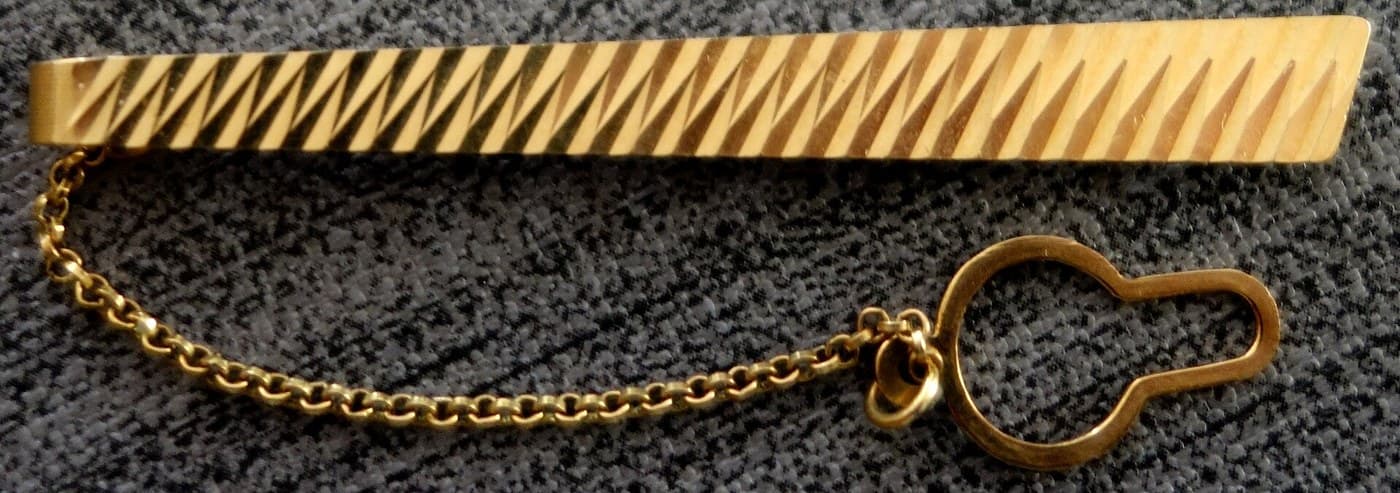

Blueprint liên quan
Các blueprint này chia sẻ kiến thức — kỹ thuật, vật liệu hoặc nguyên tắc

CC0 Phạm vi công cộng
Bản thiết kế này được phát hành theo CC0. Bạn tự do sao chép, sửa đổi, phân phối và sử dụng cho bất kỳ mục đích nào mà không cần xin phép.
Hỗ trợ nhà sáng tạo bằng cách mua sản phẩm qua bản thiết kế, nơi họ nhận Hoa hồng nhà sáng tạo do nhà bán hàng đặt, hoặc tạo phiên bản mới và kết nối trong bản thiết kế riêng để chia sẻ doanh thu.