NGHỆ THUẬT
LÀM ĐẸP VÀ SỨC KHỎE
THỦ CÔNG
VĂN HÓA VÀ LỊCH SỬ
GIẢI TRÍ
MÔI TRƯỜNG
THỰC PHẨM VÀ ĐỒ UỐNG
KỸ THUẬT NGƯỢC
KHOA HỌC
THỂ THAO
CÔNG NGHỆ
THIẾT BỊ ĐEO
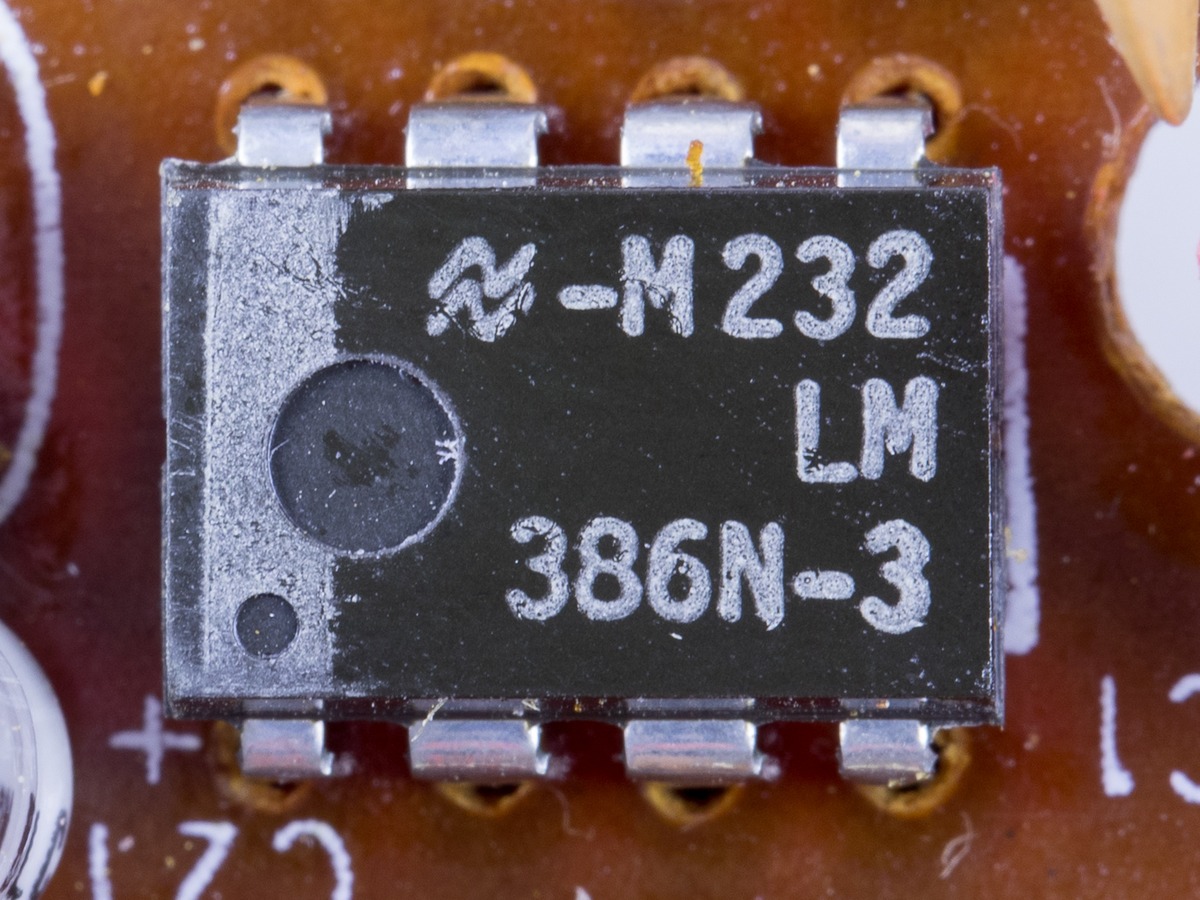

Audio Amplifier: an LM386 with Gain 20 and the Fewest Parts, on a 9 V Battery
A small loudspeaker amplifier for a phone, a microphone preamp or a guitar, built around the LM386 chip. Its gain of 20 is set inside the chip, so it needs only a volume control, two capacitors and a resistor, as in the datasheet's minimum part circuit. It runs from a 9 V battery and drives an 8 ohm speaker.
Cơ bản
About 2 hours
Hướng dẫn
1
1
An LM386 amplifier working
An LM386 amplifier working
An LM386 amplifier on a 9 V battery and an 8 ohm speaker (Tyro Mix).
2
2
The circuit
The circuit
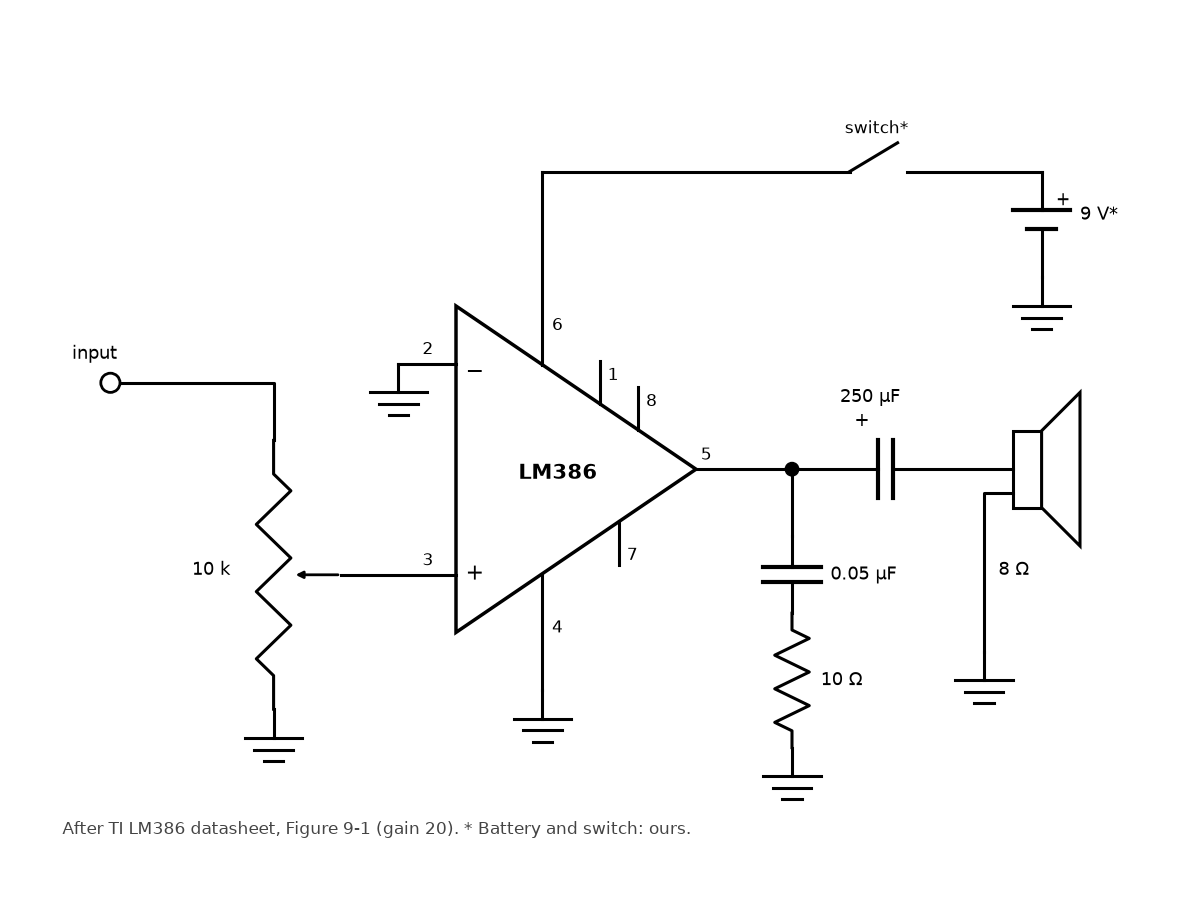
From the TI datasheet, Figure 9-1: the input goes across a 10 k potentiometer whose wiper feeds pin 3; pins 2 and 4 go to ground and pin 6 to the supply. Pin 5 drives the speaker through a 250 uF capacitor, with 0.05 uF and 10 ohm in series from pin 5 to ground. Pins 1, 7 and 8 stay open: "its gain is internally set to 20". The battery and switch are ours.
3
3
Bass, gain and battery
Bass, gain and battery
Đang tải sổ tay Jupyter…
4
4
Build it on stripboard
Build it on stripboard
Place the chip across the middle of a small piece of stripboard and cut the copper strips between its two rows of pins with a drill bit turned by hand. Solder the chip, then the 10 ohm resistor and 0.05 uF capacitor (47 nF is the nearest stock value) in series from pin 5 to a ground strip, and the 250 uF capacitor (220 uF is the nearest stock value) from pin 5 with its + lead at pin 5. Link pins 2 and 4 to ground. Use an LM386N-3 for a 9 V battery.
Vật liệu cho bước này:
 IC khuếch đại công suất âm thanh1 piece (LM386N-3)
 Điện trở1 piece (10 ohm)
 Bộ tụ gốm1 piece (0.05 uF / 47 nF)
 Tụ điện hóa1 piece (250 uF / 220 uF, 16 V or more)
 Bo mạch dải đồng1 piece (about 10 x 10 holes)
 Dây thiếc hàn1 m
Công cụ cần thiết:
 Mỏ hàn
 Kìm cắt sát
 Bộ mũi khoan
5
5
Wire the controls, speaker and battery
Wire the controls, speaker and battery
Wire the input jack's tip to one end of the 10 k potentiometer and its sleeve to the other end and to ground; the wiper goes to pin 3. Wire the speaker from the 250 uF capacitor's free lead to ground. Wire the battery's + lead through the switch to pin 6 and its - lead to ground.
Vật liệu cho bước này:
 Chiết áp1 piece (10 k)
 Giắc cắm cái1 piece (3.5 mm)
 Loa1 piece (8 ohm)
 Công tắc gạt1 cái
 Pin 9 V có dây giắc tròn1 cái
 Dây đấu nối1 m
Công cụ cần thiết:
Mỏ hàn Kìm tuốt dâyKìm cắt sát
6
6
Test it
Test it
With the volume down, switch on and measure pin 5 to ground: the datasheet says the output "automatically biases to one-half the supply voltage", so expect about 4.5 V from a fresh 9 V battery. Plug in a phone, start quietly and turn the volume up.
Công cụ cần thiết:
 Đồng hồ vạn năng số — tự chọn thang, True RMS
7
7
Troubleshooting
Troubleshooting
Amplifier problems and fixes.
Flow
Loading...
8
8
History and honest limits
History and honest limits
The LM386 is a low-voltage audio power amplifier, sold today by Texas Instruments (the chip on the cover carries National Semiconductor's logo); this is its datasheet's minimum part circuit (SNAS545D, Figure 9-1). The battery, switch, stripboard layout and stock values are ours. The datasheet gives 700 mW typical for the LM386N-3 at 9 V into 8 ohm at 10 % distortion: enough for a room, not a hall. Keep to 4-12 V. The cover photo shows an LM386N on a board (Raimond Spekking, CC BY-SA 4.0, Wikimedia Commons). Not made by us yet.
Vật liệu
12- 1 piece (LM386N-3)Tạm thời
- 1 piece (10 ohm)Tạm thời
- 1 piece (0.05 uF / 47 nF)Tạm thời
- 1 piece (250 uF / 220 uF, 16 V or more)Tạm thời
- 1 piece (about 10 x 10 holes)Tạm thời
- Tạm thời
- Tạm thời
- Tạm thời
- Tạm thời
- Tạm thời
- Tạm thời
- Tạm thời
Công cụ yêu cầu
5- 2 vendors sell this, none ship to you yetTạm thời
- Tạm thời
- Tạm thời
- Tạm thời
Bản thiết kế này làm ra
CC0 Phạm vi công cộng
Bản thiết kế này được phát hành theo CC0. Bạn tự do sao chép, sửa đổi, phân phối và sử dụng cho bất kỳ mục đích nào mà không cần xin phép.
Hỗ trợ nhà sáng tạo bằng cách mua sản phẩm qua bản thiết kế, nơi họ nhận Hoa hồng nhà sáng tạo do nhà bán hàng đặt, hoặc tạo phiên bản mới và kết nối trong bản thiết kế riêng để chia sẻ doanh thu.