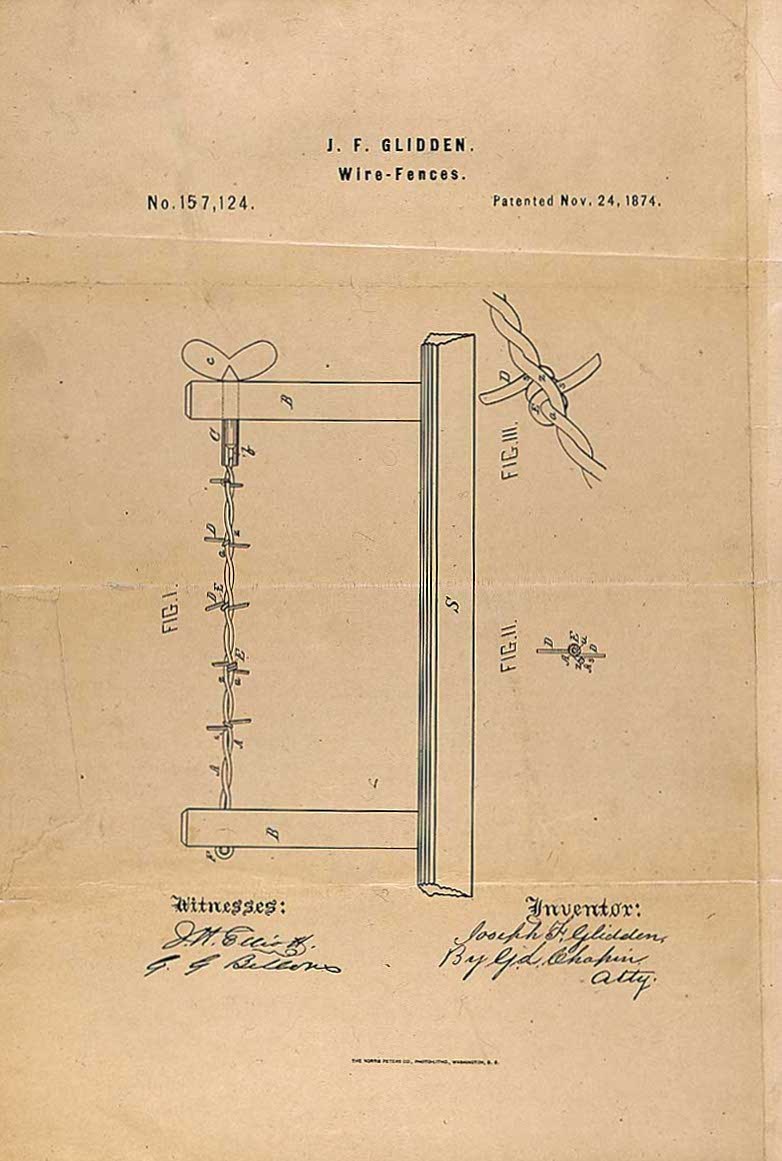


Barbed Wire
The Great Plains had no timber and no stone. A farmer could plough a field but could not fence it, and unfenced crops were eaten. Smooth wire snapped or was simply walked through; hedges took years to grow. The whole agricultural settlement of the American West was stalled on a fencing problem.
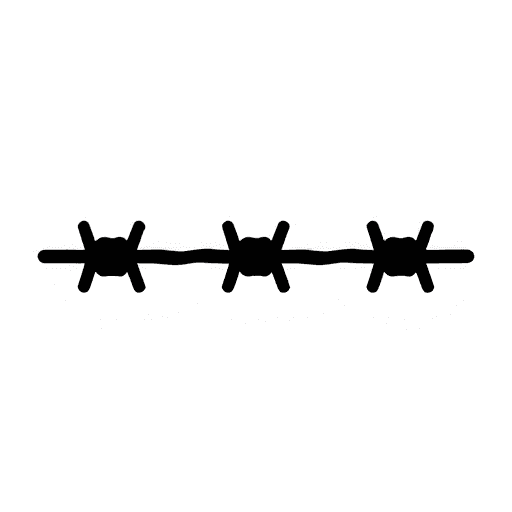
Joseph Glidden's solution was to coil a short barb around one wire, then twist a second wire alongside it to lock every barb in place. That second strand is the entire invention — without it barbs slide along the wire and bunch up, which is why earlier attempts failed.
This blueprint makes a length of two-strand Glidden wire with hand tools. It is also, unavoidably, a blueprint about what fencing the commons did to the people already living there.
Hướng dẫn
Wear gloves and goggles throughout
Wear gloves and goggles throughout
Every stage of this produces sharp points under tension. Heavy gloves, goggles, and never let a tensioned wire go — a released wire whips back with real force.
Công cụ cần thiết:
 Kính bảo hộ chống mờ
Cut two line wires of equal length
Cut two line wires of equal length
Cut two lengths of 2.5 mm soft galvanised steel wire, each about 1.5 m for a 1.2 m finished run. Twisting shortens the pair noticeably.
Vật liệu cho bước này:
 Dây thép mạ kẽm3 mét
Cut the barb blanks
Cut the barb blanks
Cut short pieces of thinner wire, about 1.6 mm, each 60 mm long. One per barb. Cut them all before you start winding.
Sharpen both ends of every blank
Sharpen both ends of every blank
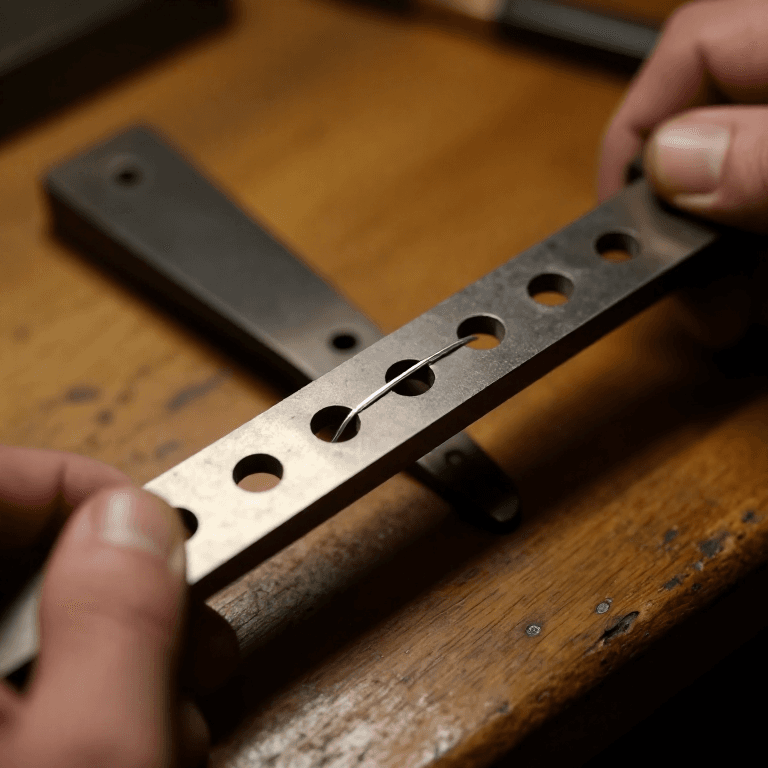
File each end of each blank to a short chisel point. Sharpen now, while the blank is loose and easy to hold — you cannot do it once it is wound on.
Công cụ cần thiết:
 Giũa (giũa tay)
Clamp one line wire in a vice
Clamp one line wire in a vice
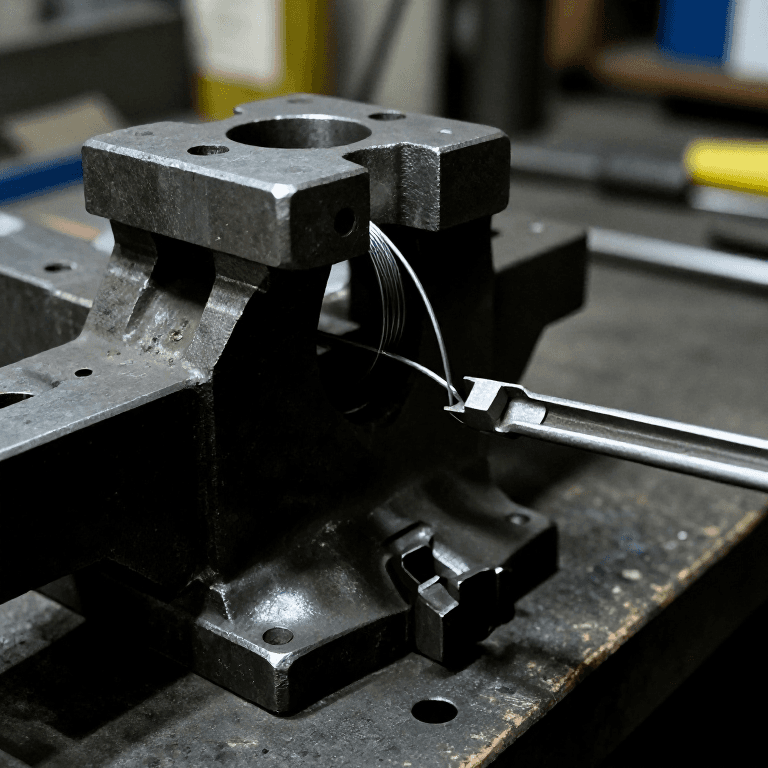
Secure the first line wire under light tension along the bench. This is the wire the barbs wind onto.
Mark barb spacing every 100 mm
Mark barb spacing every 100 mm
Mark the barb positions along the wire. Even spacing is what makes the fence work uniformly; Glidden's own spacing was in this range.
Công cụ cần thiết:
 Thước kẻ
Wind each barb twice around the line wire
Wind each barb twice around the line wire
Centre a blank on a mark and wrap it twice tightly around the line wire with pliers, leaving the two sharpened ends projecting at opposite angles.
Công cụ cần thiết:
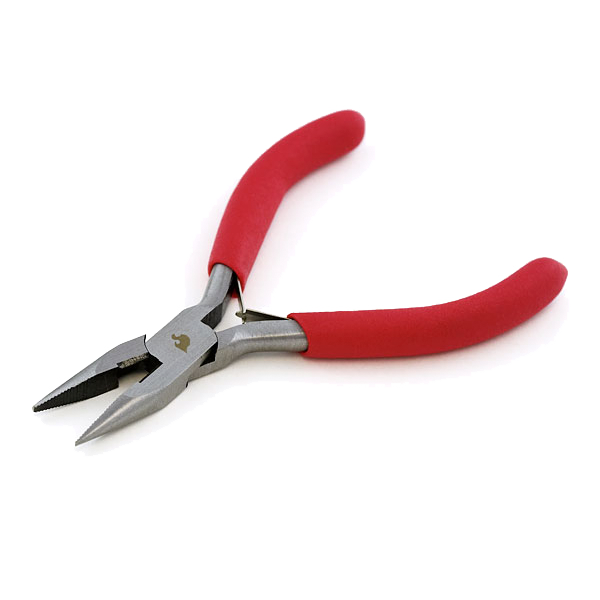 Needle Nose Pliers
Keep every barb wound the same way
Keep every barb wound the same way
Wind all barbs in the same direction with the points splayed alike. Mixed directions look wrong and, more to the point, catch unevenly.
Lay the second line wire alongside
Lay the second line wire alongside
Bring the second wire up parallel to the first, running past all the barbs. Clamp both ends together.
Twist the pair together along the full length
Twist the pair together along the full length
Grip both wires at the free end and rotate steadily, letting the twist run down the length. This is Glidden's actual claim — the second strand traps every barb so it cannot slide.
Keep the twist even, about one turn per 25 mm
Keep the twist even, about one turn per 25 mm
Aim for a regular pitch. Over-twisting work-hardens the wire until it snaps; under-twisting lets the barbs creep.
Check every barb for movement
Check every barb for movement
Try to slide each barb along by hand. None should move. Any that does needs the twist tightening at that point.
Set the barb points to stand out from the plane
Set the barb points to stand out from the plane
Adjust each pair of points so they project away from the wire rather than lying along it. A flattened barb does nothing at all.
Finish the ends with a loop
Finish the ends with a loop
Bend each end back into a closed loop and wrap the tail down. Never leave a cut end exposed on wire meant to be handled or strained.
History & Context — the wire that closed the range
History & Context — the wire that closed the range
The patent, and the fight over it. Joseph Farwell Glidden, a farmer in DeKalb, Illinois, applied on 27 October 1873 and was granted US Patent 157,124 on 24 November 1874 for an improvement in wire fences. He was not alone — Henry Rose had exhibited a barbed strip at the DeKalb county fair in 1873, and Jacob Haish and Isaac Ellwood were working the same problem in the same town at the same time. The resulting priority fight ran for years and was settled only by the US Supreme Court in the Barbed Wire Patent Case of 1892, which upheld Glidden. That so many people converged on it at once tells you how badly the problem needed solving.
Why the second wire matters. A barb wound on a single strand can rotate and slide; cattle pressing a fence will bunch the barbs together and open a clear gap. Twisting a second wire alongside locks each barb mechanically between the strands. The twist also gives the fence a little elasticity, so it takes an impact and springs back rather than snapping — an unintended benefit that made it practical on posts set far apart.
What it actually did. Barbed wire made the Plains farmable, and in doing so it ended the open range. Cattle drives were cut off from water, free grazing disappeared, and the fence-cutting wars of the 1880s followed. It was also used to enclose land under treaty to Native nations, and it fenced the bison ranges. The technology is trivially simple and its consequences were enormous and largely violent — which is the honest reason to know how it is made.
The engineering point. This is a rare invention whose value is entirely in a manufacturing detail rather than a concept. Everyone wanted a sharp fence; the person who won was the one who worked out how to stop the sharp bits moving. Glidden's other contribution was designing machinery to make it by the mile — the patent describes the wire, but the factory is what changed a continent.
Vật liệu
1- 3 métTạm thời
Công cụ yêu cầu
4- Tạm thời
- Tạm thời
- Tạm thời
- Needle Nose PliersHoa hồng 10%$2.52
Vật liệu bản thiết kế liên kết
Bản thiết kế này làm ra
Blueprint liên quan
Các blueprint này chia sẻ kiến thức — kỹ thuật, vật liệu hoặc nguyên tắc
CC0 Phạm vi công cộng
Bản thiết kế này được phát hành theo CC0. Bạn tự do sao chép, sửa đổi, phân phối và sử dụng cho bất kỳ mục đích nào mà không cần xin phép.
Hỗ trợ nhà sáng tạo bằng cách mua sản phẩm qua bản thiết kế, nơi họ nhận Hoa hồng nhà sáng tạo do nhà bán hàng đặt, hoặc tạo phiên bản mới và kết nối trong bản thiết kế riêng để chia sẻ doanh thu.