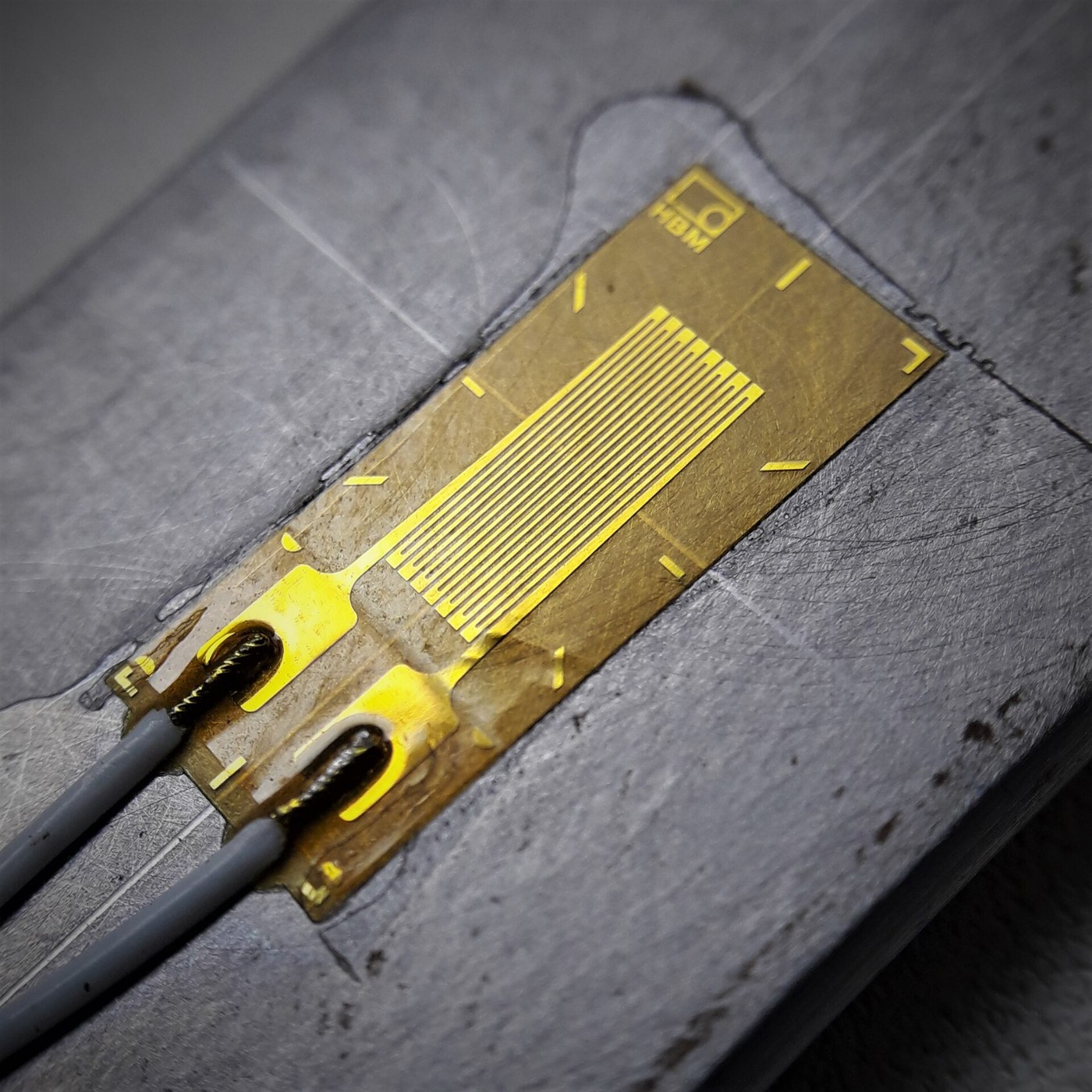


Bonded Strain Gauge
Hướng dẫn
Make a gauge with a long folded grid
Make a gauge with a long folded grid
Maximum wire length in minimum area, all of it aligned one way.
- On a thin paper or plastic backing, lay out fine wire in a zig-zag: many long parallel runs joined by tight turns at each end.
- Keep every long run parallel to what will be the measuring direction.
- Make the end turns as short and tight as possible.
- Fix the wire to the backing with a thin, hard adhesive.
- Bring two leads out from the ends.
The grid pattern maximises sensitivity in one direction and minimises it in the other. Only the long runs contribute usefully; the end turns lie crosswise and respond to strain at right angles, which is unwanted. Commercial gauges make those turns wide and thick so their resistance is negligible — a small detail that makes the gauge directional, which is exactly what you want when measuring stress in a structure.
The adhesive must be hard and thin. A soft or thick glue line lets the gauge slip relative to the surface, so it reads less strain than is really there — creep, and it is the classic bonded gauge failure.Vật liệu cho bước này:
 Dây đồng tráng men1 cuộn
 Bộ giấy bìa nhiều màu1 gói
 Băng dính trong1 cuộn
Công cụ cần thiết:
 Đồng hồ vạn năng số cấp phòng thí nghiệm
 Thước cặp điện tử 6 inch
 Bộ giũa
Bond it to a cantilever beam
Bond it to a cantilever beam
Surface preparation decides whether the gauge measures the beam or measures the glue.
- Cut a cantilever from aluminium flat bar and clamp one end in the vise.
- Abrade the top surface where the gauge will sit, then clean it thoroughly.
- Bond the gauge with its grid running ALONG the beam, near the clamped end where bending stress is highest.
- Press it down firmly and let the adhesive cure fully.
- Measure its resistance unloaded.
Position matters as much as bonding. A cantilever's bending stress is greatest at the clamped root and zero at the free end, so a gauge near the tip reads almost nothing. Knowing where the strain is before you place the gauge is half of experimental stress analysis.
Cure fully before loading. A partly cured bond creeps under the first load and the gauge never reads the same again.Vật liệu cho bước này:
 Thanh nhôm dẹt1 cái
Công cụ cần thiết:
 Ê tô bàn nguộiBộ giũaĐồng hồ vạn năng số cấp phòng thí nghiệmThước cặp điện tử 6 inch
 Thước ke tổ hợp
Read it with a bridge and find the gauge factor
Read it with a bridge and find the gauge factor
The change is far too small for a meter, so null it out.
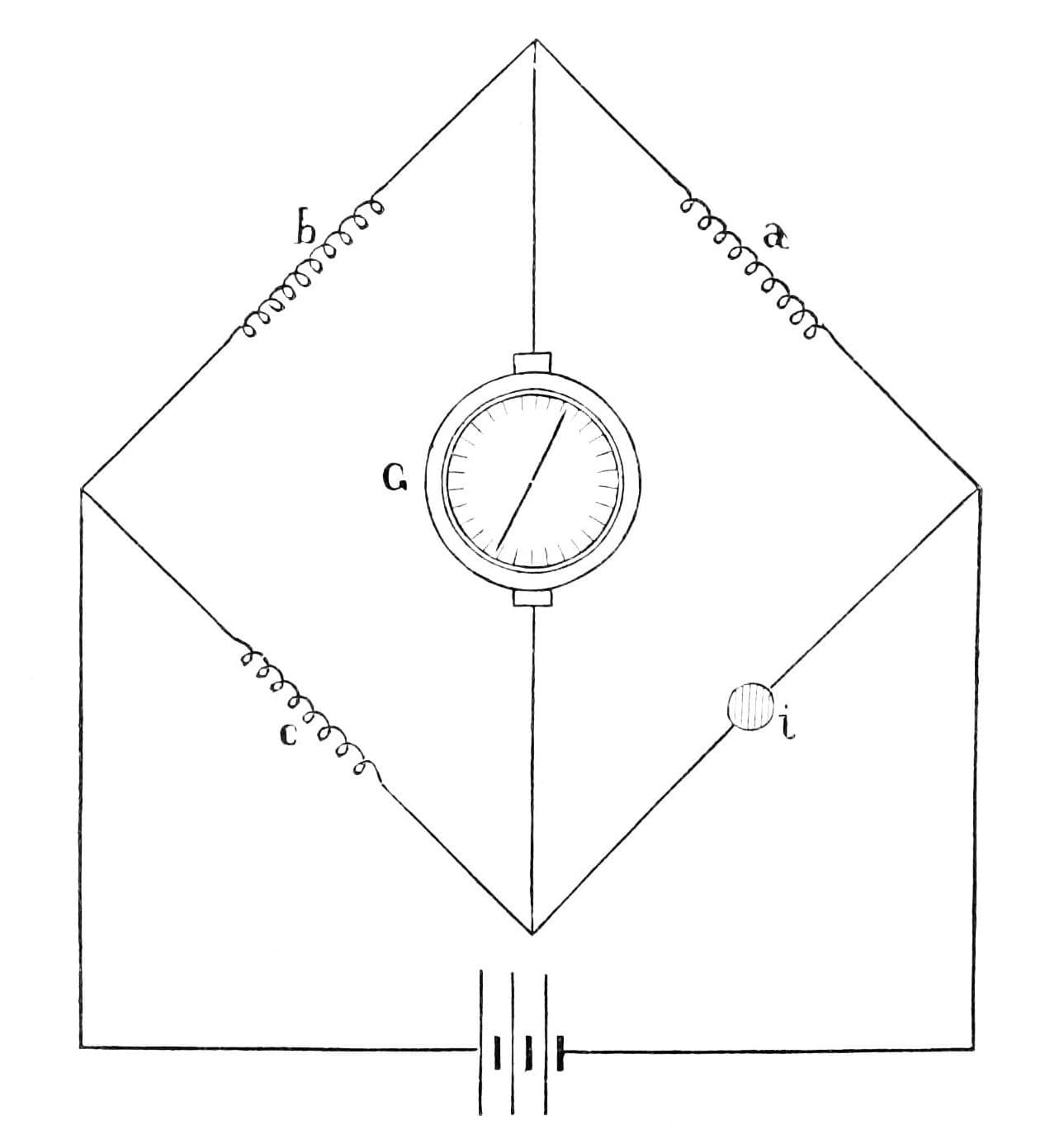
- Put the gauge in one arm of a Wheatstone bridge with three fixed resistors.
- Balance the bridge with the beam unloaded.
- Hang a known weight on the beam's free end and record the bridge output.
- Measure the beam's tip deflection with the caliper and compute the strain at the gauge.
- Divide the fractional resistance change by the strain — that ratio is the gauge factor.
Vật liệu cho bước này:
 Bộ điện trở 1/4 W1 bộ
 Nguồn điện bàn điều chỉnh được1 cái
 Giấy kẻ ô ly1 pad
Công cụ cần thiết:
Đồng hồ vạn năng số cấp phòng thí nghiệmThước cặp điện tử 6 inch Cân nhà bếp điện tử
Defeat the temperature problem with a second gauge
Defeat the temperature problem with a second gauge
The gauge cannot tell strain from warmth — unless you give it a companion.
- With the beam unloaded, warm the gauge gently with a hair dryer and watch the bridge output drift.
- Now bond an identical second gauge to the UNDERSIDE of the beam, or to an unstressed offcut of the same material.
- Put it in the adjacent bridge arm.
- Warm both together and observe the output.
- Load the beam again and confirm it still reads strain.
Vật liệu cho bước này:
Dây đồng tráng men1 cuộnBộ giấy bìa nhiều màu1 góiCông cụ cần thiết:
Đồng hồ vạn năng số cấp phòng thí nghiệmThước cặp điện tử 6 inch Đồng hồ bấm giờ
Seeing stress inside a structure, and history
Seeing stress inside a structure, and history
Edward E. Simmons at Caltech and Arthur C. Ruge at MIT developed the bonded wire strain gauge independently in 1938. Ruge was studying how model structures behaved on a shaking table and needed to measure strain in small members; Simmons was working on impact testing. Both realised that a wire glued to the surface is forced to share its strain, and both institutions ended up sharing the patent rights.
It made stress visible for the first time. Before it, engineers calculated stresses and hoped, or used brittle lacquers and photoelastic models that only worked on transparent replicas. The bonded gauge measures the real structure, in service, at whatever point you choose — aircraft wings in flight, bridge girders under traffic, engine mounts running. Experimental stress analysis as a discipline begins here.
Its most familiar descendant is the load cell. Take a metal element designed to deflect predictably, bond four gauges to it in a full bridge, and the output is proportional to force. Every electronic scale, from a kitchen worktop to a weighbridge, works exactly this way — and the four-gauge arrangement cancels temperature while quadrupling the signal, which is the step-4 trick taken to its conclusion.
How it closes this batch: the Wheatstone bridge has now appeared three times — measuring temperature in the resistance thermometer, airflow in the hot wire, and force here. One circuit, three physical quantities, because each sensor converts its quantity into a resistance change. That convergence is the deep lesson of instrumentation: find a way to turn what you cannot measure into something you can, and a small number of well-understood circuits will read almost anything.
Vật liệu
7- 1 cuộnTạm thời
- Tạm thời
- 1 cuộnTạm thời
- 1 cáiTạm thời
- Tạm thời
- Tạm thời
- 1 padTạm thời
Blueprint liên quan
Các blueprint này chia sẻ kiến thức — kỹ thuật, vật liệu hoặc nguyên tắc
CC0 Phạm vi công cộng
Bản thiết kế này được phát hành theo CC0. Bạn tự do sao chép, sửa đổi, phân phối và sử dụng cho bất kỳ mục đích nào mà không cần xin phép.
Hỗ trợ nhà sáng tạo bằng cách mua sản phẩm qua bản thiết kế, nơi họ nhận Hoa hồng nhà sáng tạo do nhà bán hàng đặt, hoặc tạo phiên bản mới và kết nối trong bản thiết kế riêng để chia sẻ doanh thu.