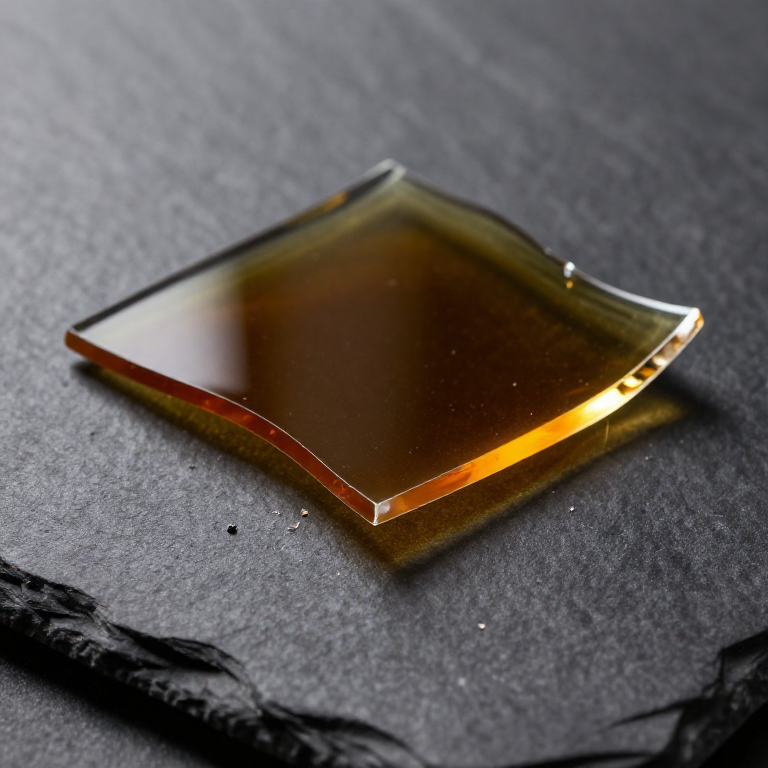


Breakaway Sugar Glass
Somebody has to be hit with a bottle, and it has to shatter, and nobody can be hurt. The answer film and theatre reached is to make a material that looks like glass and fails like biscuit.
Sugar glass is exactly that. Sugar dissolved in water and boiled past the hard crack stage — 149-154 °C — has almost no water left in it, and if you cool it fast enough the molecules never get the chance to line up into crystals. The result is a genuine amorphous solid: a glass, in the physicist's sense, made of sugar instead of silica.
Its whole usefulness is that it is brittle without being sharp. Real glass fails along cracks that run to a knife edge; sugar glass fractures into blunt, crumbly chunks that lose energy fast and dissolve harmlessly. It is also weak enough that a person can break it, which real glass emphatically is not.
One ingredient does the essential work and it is not the sugar. Glucose or corn syrup is what stops recrystallisation — its different molecules get in the way of the orderly packing that would otherwise turn your clear sheet into an opaque white slab. Leave it out and you get fudge.
Boil it, cast it, break it, and measure how much force it actually takes.
Hướng dẫn
Dissolve completely before it boils
Dissolve completely before it boils
Combine 2 parts sugar, 1 part water and about a fifth part golden syrup by mass in a heavy pan. Stir over low heat until you cannot feel a single grain against the base.
Only then raise the heat, and stop stirring.
One undissolved crystal is a seed. Stirring a boiling syrup drags crystals off the pan wall into the mix, and the whole batch goes cloudy from that one point outwards.
Vật liệu cho bước này:
 Đường trắng400 g
 Mật mía vàng80 g
Công cụ cần thiết:
 Nồi quánh thành cao
 Cân nhà bếp điện tử
Wash the walls and boil to hard crack
Wash the walls and boil to hard crack
Brush the inside of the pan above the syrup with a wet brush to dissolve any crystals clinging there. Boil without stirring to 149-154 °C.
Watch the thermometer, not the clock.
The temperature is a direct readout of how much water is left — at hard crack the syrup is about 99 % sugar, and a few degrees short leaves enough water to make a sheet that bends and goes sticky instead of breaking.
Công cụ cần thiết:
 Nhiệt kế làm kẹo
Cast thin and let it cool undisturbed
Cast thin and let it cool undisturbed
Pour immediately onto a silicone mat, tilting to spread it to an even 3-5 mm. Do not scrape the last of the pan in — that portion is the most likely to be crystallised.
Leave it completely alone until cold.
Thickness sets breaking force, and evenness sets where it breaks. A sheet with a thick ridge will always fail everywhere except the ridge.
Công cụ cần thiết:
 Tấm lót nướng silicon
Measure the breaking force
Measure the breaking force
Cut or snap the sheet into equal strips. Support each across two blocks a fixed distance apart and hang weight from the centre until it fails. Record the load.
Repeat for two or three thicknesses.
Expect breaking load to climb steeply with thickness, and expect a wide scatter between nominally identical strips.
That scatter is the real characteristic of brittle materials — they fail from the worst flaw present, and flaws vary.
Công cụ cần thiết:
 Lực kế (cân lò xo)
 Thước cặp điện tử 6 inch
Look at the fracture, and compare with the real thing
Look at the fracture, and compare with the real thing
Examine your broken edges under a loupe, then compare with a commercially made breakaway sheet.
Expect blunt, crumbly, slightly conchoidal edges — nothing you could cut yourself on.
That is the safety case, and it is a materials property rather than a precaution: the sheet is safe because of how it fractures, not because it is thin.
Vật liệu cho bước này:
 Tấm kính đường1 tờ
Công cụ cần thiết:
 Kính lúp thợ kim hoàn
Find out how it fails in storage
Find out how it fails in storage
Leave sample strips in three places for a week: a sealed box with a desiccant, open air in a normal room, and a humid bathroom. Test each.
Expect the humid one to go tacky, cloudy and bendy, and the desiccated one to stay clear and brittle.
Sugar glass is hygroscopic. It pulls water from the air, the water plasticises it, and a prop cast a week early can be useless on the day — which is why film props are made close to the shoot and kept sealed.
Compendium — the material, and the honest safety limits
Compendium — the material, and the honest safety limits
It is a glass in the technical sense. A glass is not defined by what it is made of but by how it solidifies: cooled fast enough that the molecules are frozen in a disordered, liquid-like arrangement instead of a crystal lattice. Window glass does this with silica; sugar glass does it with sucrose. Both are transparent for the same reason — no crystal boundaries to scatter light — and both are brittle because a disordered solid has no planes along which to deform.
Isomalt is what professionals mostly use now. It is a sugar alcohol made from sucrose, it is far less hygroscopic, it resists yellowing, and it can be remelted repeatedly without browning — all of which matter when a production needs a dozen identical bottles that survive a week of shooting. Sucrose is cheaper and edible, and is the right thing to learn on.
Why it does not look quite right on camera. Sugar glass has a different refractive index from silica glass and slightly rounded, softened edges, so it reads as almost glass. Productions compensate with lighting, with dressing the shot so the material is only briefly seen, and by shooting the break at high frame rate where the crumbly fracture actually helps sell it.
🔴 The safety, stated plainly, because this is the one genuinely dangerous step. Boiling sugar syrup reaches over 150 °C and it sticks — a splash does not run off, it holds against skin and keeps burning, which is why sugar burns are worse than boiling-water burns. Long sleeves, covered feet, no children at the stove, no water anywhere near the hot pan, and a bowl of cold water ready for a splash. Never move a pan of hot syrup across a room. And the finished sheet, although far safer than glass, is still a hard object: never aim a breakaway prop at anyone's face, never use it near eyes, and never assume a home-made sheet has the consistency of a commercial one — test every batch, because step 4 will show you they are not the same.
Vật liệu
3- 400 gTạm thời
- 80 gTạm thời
- 1 tờTạm thời
Công cụ yêu cầu
7- Tạm thời
- Tạm thời
- Tạm thời
- Tạm thời
- Tạm thời
- Tạm thời
- Tạm thời
Vật liệu bản thiết kế liên kết

Bản thiết kế này làm ra
Blueprint liên quan
Các blueprint này chia sẻ kiến thức — kỹ thuật, vật liệu hoặc nguyên tắc
CC0 Phạm vi công cộng
Bản thiết kế này được phát hành theo CC0. Bạn tự do sao chép, sửa đổi, phân phối và sử dụng cho bất kỳ mục đích nào mà không cần xin phép.
Hỗ trợ nhà sáng tạo bằng cách mua sản phẩm qua bản thiết kế, nơi họ nhận Hoa hồng nhà sáng tạo do nhà bán hàng đặt, hoặc tạo phiên bản mới và kết nối trong bản thiết kế riêng để chia sẻ doanh thu.