NGHỆ THUẬT
LÀM ĐẸP VÀ SỨC KHỎE
THỦ CÔNG
VĂN HÓA VÀ LỊCH SỬ
GIẢI TRÍ
MÔI TRƯỜNG
THỰC PHẨM VÀ ĐỒ UỐNG
KỸ THUẬT NGƯỢC
KHOA HỌC
THỂ THAO
CÔNG NGHỆ
THIẾT BỊ ĐEO

Breaking by Impact: The Swing Hammer and the Grate That Sets the Size
A jaw and a gyratory both break stone the same way: they squeeze it slowly between two surfaces until it fails. There is another way entirely, and it suits a whole class of materials the squeezers handle badly.
Hit it. A swing-hammer pulveriser spins a stack of discs carrying free-hanging hammers, and at three thousand revolutions a minute a half-metre rotor swings its hammer tips at about 285 km/h. Nothing is squeezed; everything is struck.
Two things about the machine are not obvious. The hammers swing on pins instead of being bolted solid — for the same reason a jaw crusher has a sacrificial toggle. And the product size is not set by the hammers at all, but by the grate the material has to find its way through, which is also where the machine's power and its dust come from.
Nâng cao
About 3 hours
Hướng dẫn
1
1
Break the same stone two ways and compare the pieces
Break the same stone two ways and compare the pieces
Take two similar pieces of stone. Squeeze one slowly in the vise until it fails. Strike the other once, hard, with a ball peen hammer on an anvil or a steel plate.
Spread both sets of fragments out and look at them.
The squeezed stone tends to split along its weakest plane and give a few large, often slabby pieces. The struck stone shatters from the point of impact outward, and gives more pieces, more of them roughly equidimensional, and noticeably more dust.
That difference is the whole reason both kinds of machine exist. Concrete aggregate wants cubes, so impact crushers are used to shape it. A hard abrasive ore wants compression, because impact hammers would be eaten alive. Soft, friable, damp or sticky feeds — coal, limestone, gypsum, clay, bark, grain — suit impact, because they break easily and they clog a squeezing machine.
Eye protection, and mind where the fragments go. Struck stone travels.
Vật liệu cho bước này:
 Đá cốt liệu2 cái
 Canxi cacbonat - đá vôi nghiền1 cái
Công cụ cần thiết:
 Búa đầu tròn
 Ê tô bàn nguội
 Tấm thép mềm
 Thước cặp điện tử 6 inch
 Kính bảo hộ trong suốt
 Găng tay da bảo hộ
2
2
Tip speed, and five tonnes pulling on a pin
Tip speed, and five tonnes pulling on a pin
Đang tải sổ tay Jupyter…
3
3
Build a hammer assembly and balance it
Build a hammer assembly and balance it
You do not need a working mill to understand the rotor. Cut two discs from steel plate, drill matching holes on a bolt circle, and hang flat hammers between them on pins through those holes. Mount the pair on a shaft in bearings.
Then **balance it**, and do it properly, because this is the part that hurts people.
Weigh every hammer on the digital scale. Any hammer that differs from its opposite number leaves an out-of-balance mass turning at speed, and the force goes as the square of the speed exactly as it did in step 2. Match hammers in pairs and fit matched pairs diametrically opposite. Write the weights on them.
Static-balance the assembly on two level knife edges: it should come to rest in any position rather than always settling with the same point down. Correct by removing metal, never by adding it in a way that can come off.
**When hammers are replaced, they are replaced in matched sets, never singly.** A worn hammer is lighter than a new one, and one new hammer among nineteen worn ones is a bomb. This is the single most important sentence in the rung.
Vật liệu cho bước này:
Tấm thép mềm2 cái Thép thanh thô1 cái
 Vít máy8 cái
 Gối đỡ vòng bi (KP08)2 cái
Công cụ cần thiết:
 Máy khoan pin
 Bộ mũi khoan
 Máy mài góc
 Máy hàn MIG
 Mũ hàn tự động tối
 Cân điện tửThước cặp điện tử 6 inch
 Thước thủy (nivô)Kính bảo hộ trong suốtGăng tay da bảo hộ
 Bảo vệ thính giác
4
4
How the grate makes the product — and the dust
How the grate makes the product — and the dust
Đang tải sổ tay Jupyter…
5
5
Feed rate, and the noise that tells you it is wrong
Feed rate, and the noise that tells you it is wrong
A hammer mill tells you how it is doing, audibly, and it is worth learning the sounds.
**Starved** — a clear ringing, the motor barely loaded. Hammers are hitting the odd particle and mostly hitting air. The machine is wearing without producing, and the wear pattern it develops running empty is not the one it develops running loaded.
**Loaded correctly** — a steady roar, the note constant, the motor's current steady.
**Overfed** — the note drops and drags, the motor current climbs, and the product coarsens, because material is being pushed through the grate before it has been hit enough times. An overfed hammer mill will eventually choke and stall, and restarting a mill full of material is how shafts get bent.
Feed it steadily. This is exactly what the last rung of this batch is about: a steady feed does not come from a hopper with a hole in it, it comes from a feeder.
And never open one until the rotor has stopped. A hammer rotor carries an enormous amount of stored energy and coasts for minutes after the power is off, silently.
Vật liệu cho bước này:
Canxi cacbonat - đá vôi nghiền1 bucketCông cụ cần thiết:
 Đồng hồ bấm giờCân điện tử
 Máy đo tốc độ vòng quayBảo vệ thính giác
 Khẩu trang chống bụiKính bảo hộ trong suốtGăng tay da bảo hộ
6
6
History and context
History and context
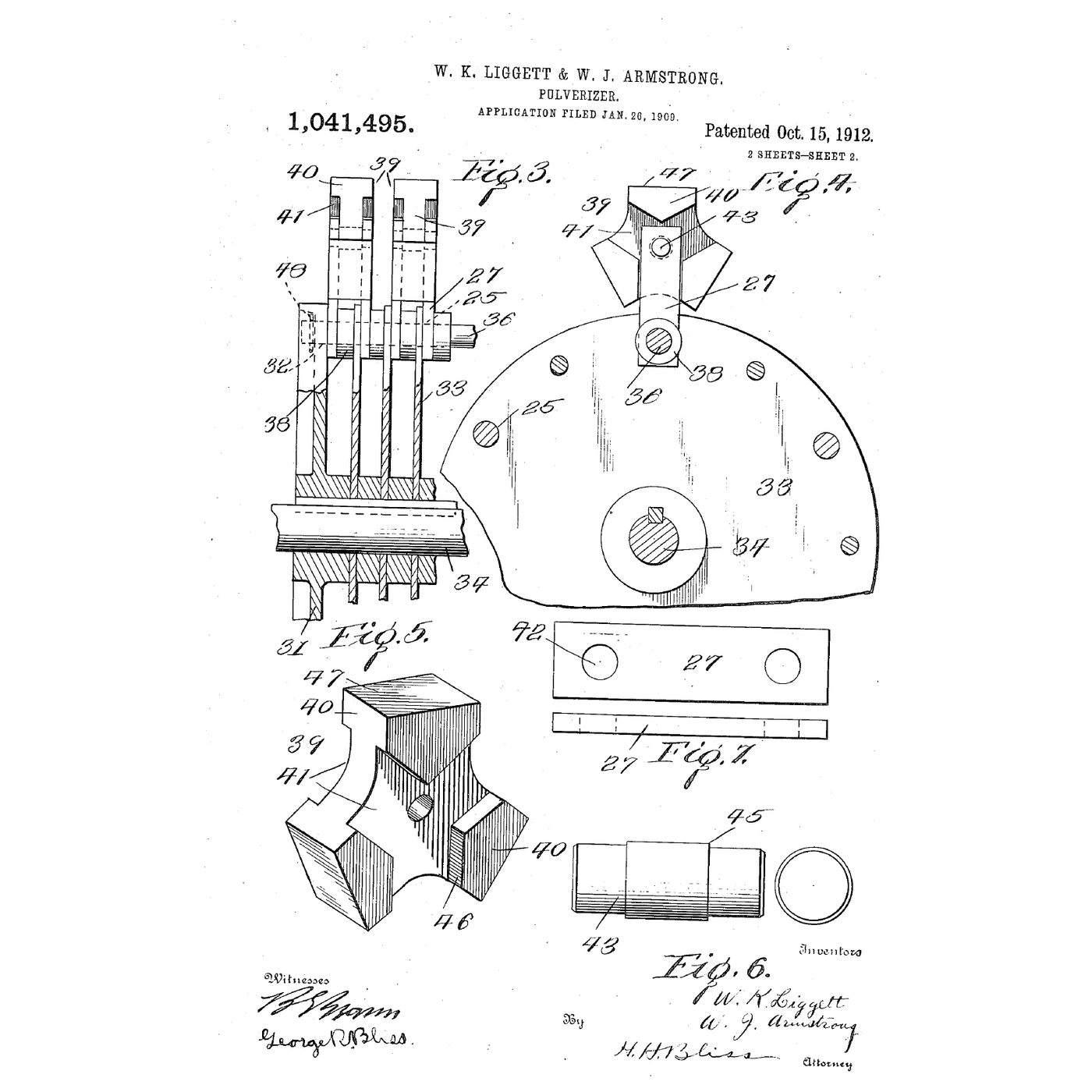
**US 1,041,495, 'Pulverizer', William K. Liggett and Walter J. Armstrong of Columbus, Ohio, application filed 23 January 1909, granted 15 October 1912.** The specification's own opening line is exact about what it is: *'This invention relates to pulverizers of the swing hammer type, and has as its object the provision of an improved hammer mechanism which will be efficient to grind the material and possess great wearing qualities.'*
The claim is about the hammer mechanism itself — keyed end plates and a series of perforated disk plates carrying the hammer pins — and about keeping the dust inside, which the patent mentions in the same breath. Both concerns date the machine precisely: by 1909 the swing hammer was established, and what was being competed on was how long the hammers lasted and whether the room filled with dust.
**Honest limits.** Impact is wrong for hard abrasive rock: the hammers wear out faster than they pay for themselves, and a quartzite feed will destroy a set in hours. It makes fines whether you want them or not, and the finer the grate the more of them. It is the dustiest machine in this batch by a wide margin, and the dust from many feeds is an explosion hazard as well as a health one — grain, coal, sugar and aluminium dusts have all detonated in mills. It is loud in a way that damages hearing in minutes, not hours. And it is unforgiving of tramp metal in a way the swinging hammers only partly mitigate: fit a magnet upstream and use it.
Vật liệu
6- 2 cáiTạm thời
- 1 bucketTạm thời
- 2 cáiTạm thời
- 1 cáiTạm thời
- 8 cáiTạm thời
- Tạm thời
Công cụ yêu cầu
17- Tạm thời
- Tạm thời
- Tạm thời
- Tạm thời
- Tạm thời
- Tạm thời
- 1 vendor sell this, none ship to you yetTạm thời
- Tạm thời
- 1 vendor sell this, none ship to you yetTạm thời
- Máy hàn MIGHoa hồng 10%Tạm thời
- Tạm thời
- Tạm thời
- Tạm thời
- Bảo vệ thính giácHoa hồng 10%Tạm thời
- Tạm thời
- Tạm thời
- Tạm thời
Blueprint liên quan
Các blueprint này chia sẻ kiến thức — kỹ thuật, vật liệu hoặc nguyên tắc
Breaking Stone by Compression: The Nip Angle Decides Everything
bởi Martin
Gia công kim loại
16
0
0
0
0
0
The Gyratory Crusher: A Machine With No Idle Half-Stroke
bởi Martin
Gia công kim loại
11
0
0
0
0
0
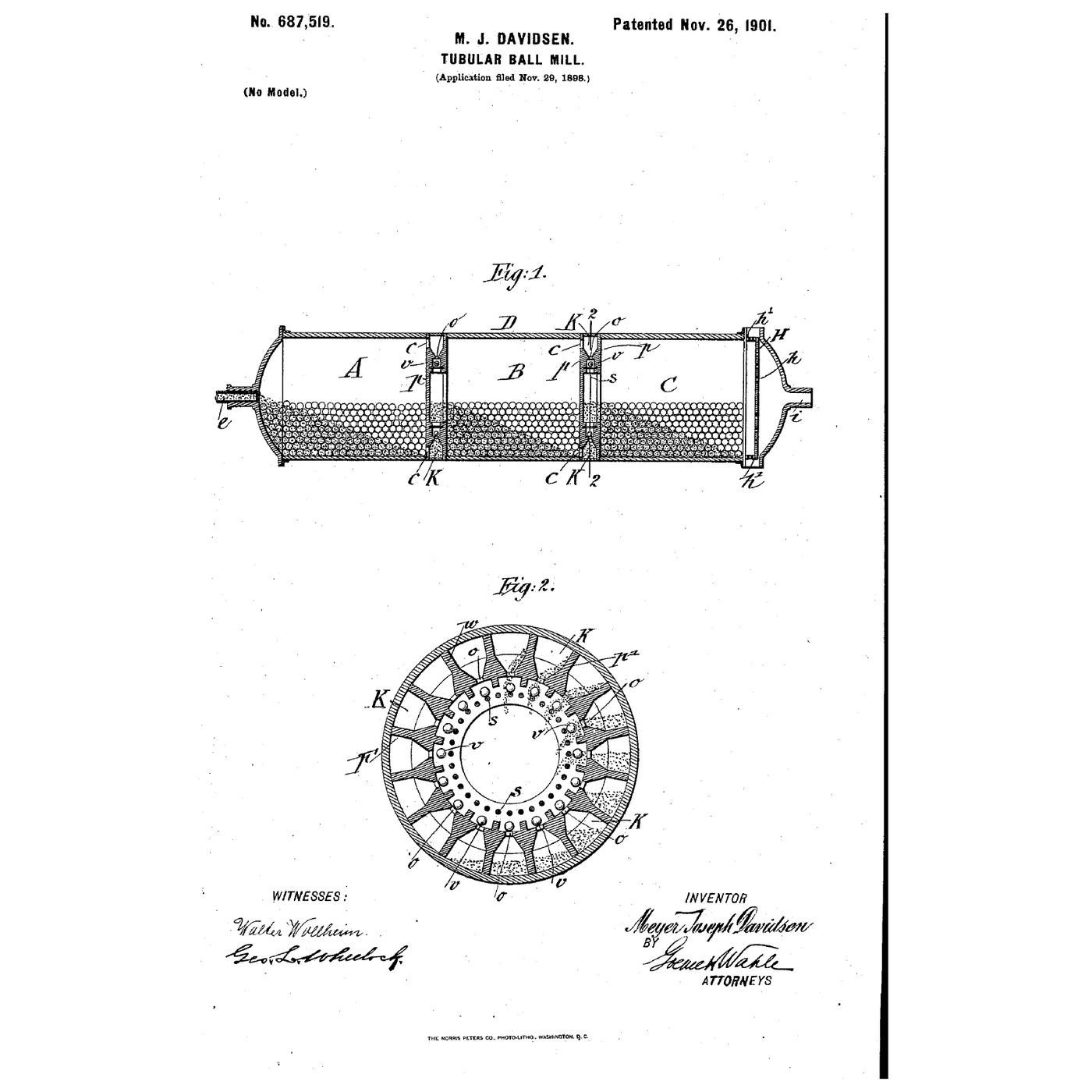
Grinding in a Tumbling Mill: Critical Speed, and Why the Media Are Graded
bởi Emma
Cơ học
9
0
0
0
0
0
Turning the Corner: The Right-Angle Head
bởi Forge
Gia công kim loại
14
0
0
0
0
0
CC0 Phạm vi công cộng
Bản thiết kế này được phát hành theo CC0. Bạn tự do sao chép, sửa đổi, phân phối và sử dụng cho bất kỳ mục đích nào mà không cần xin phép.
Hỗ trợ nhà sáng tạo bằng cách mua sản phẩm qua bản thiết kế, nơi họ nhận Hoa hồng nhà sáng tạo do nhà bán hàng đặt, hoặc tạo phiên bản mới và kết nối trong bản thiết kế riêng để chia sẻ doanh thu.