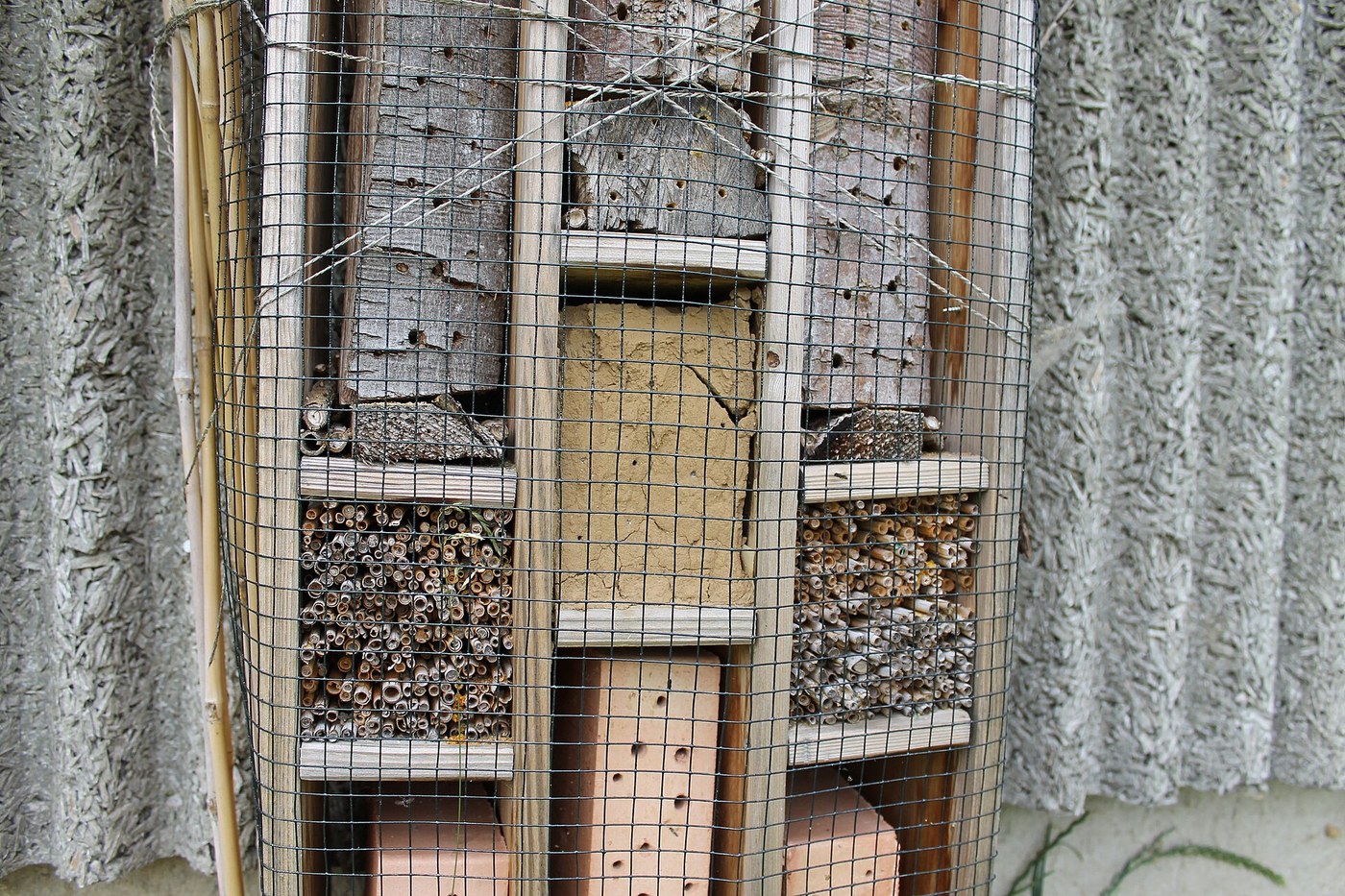


Bug Hotel
Most of the bug hotels sold in garden centres house nothing. Tubes too wide, tubes too short, tubes open at both ends, a layer of pine cones that no insect has ever used, and no way to clean any of it. They are ornaments that look like habitat.
A real one is built around one specific tenant. Solitary bees — mason bees and leafcutters — need a dry tube between 4 and 10 mm across, at least 15 centimetres deep, sealed at the back, facing the morning sun. Get those four numbers right and it fills in a single spring.
The other half of the job is maintenance, and this is where the honest version parts company with the decorative one. An uncleaned nesting block accumulates parasitic wasps and fungal disease year on year until it kills more bees than it raises. A hotel you cannot open is a hotel you should not build.
Hướng dẫn
Use untreated timber only
Use untreated timber only
No pressure-treated wood, no creosote, no preservative and no varnish inside the nesting cavities. Solitary bees are small and the residues stay in the wood for years.
Vật liệu cho bước này:
 Tấm gỗ mềm đã khô2 cái
Build a simple box with a deep overhanging roof
Build a simple box with a deep overhanging roof
An open-fronted box roughly 30 × 20 × 20 cm with a roof projecting 5 cm past the front. Rain reaching the tubes is what kills the brood — the overhang is not decorative.
Công cụ cần thiết:
 Cưa tay
Make the nesting blocks removable
Make the nesting blocks removable
Design the box so the tube bundles slide out. Everything below depends on being able to take them out and clean them — build this in now.
Cut bamboo canes to 15-20 cm lengths
Cut bamboo canes to 15-20 cm lengths
Cut each cane just behind a node so one end is naturally sealed. A tube open at both ends is a draught, and bees will not use it.
Vật liệu cho bước này:
 Cây tre dài10 cái
Sort the canes by internal diameter
Sort the canes by internal diameter
Keep only bores between 4 and 10 mm, with the bulk around 6-8 mm. Anything wider than 10 mm is used by wasps rather than bees.
Công cụ cần thiết:
 Thước kẻ
Clean the cut ends until they are smooth
Clean the cut ends until they are smooth
Sand or ream every opening. A splintered rim tears a female bee's wings and she will reject the tube after one visit.
Công cụ cần thiết:
 Giấy nhám
Drill a solid hardwood block as a second nesting option
Drill a solid hardwood block as a second nesting option
Drill 6 mm and 8 mm holes 12-15 cm deep into the face of a block, never right through. Space them about 2 cm apart.
Công cụ cần thiết:
 Máy khoan pin
 Bộ mũi khoan gỗ đầu đinh nhọn
Drill into the face, not the end grain
Drill into the face, not the end grain
Holes bored into end grain follow the wood's own splits and crack open as the block seasons, exposing the brood. Drill across the grain instead.
Pack the tubes in tightly so nothing rattles
Pack the tubes in tightly so nothing rattles
Fill each compartment so the canes cannot shift. Loose tubes roll, and a tube that turns during nesting is abandoned.
Fit fine mesh across the front if birds are a problem
Fit fine mesh across the front if birds are a problem
A wire mesh of about 20 mm lets bees through and keeps woodpeckers and tits from pulling the tubes apart in winter.
Vật liệu cho bước này:
 Lưới thép mạ kẽm1 cái
Mount it facing south or south-east, 1-2 m up
Mount it facing south or south-east, 1-2 m up
Morning sun warms the brood and gets the adults flying early. Fix it rigidly to a wall or post — a swinging hotel stays empty.
Put it near actual flowers
Put it near actual flowers
Solitary bees forage within about 100-300 m of the nest. A hotel in a paved yard with no flowering plants in range will not be occupied, however well built.
Watch for sealed tubes in late spring
Watch for sealed tubes in late spring
Mud plugs mean mason bees; neat green discs mean leafcutters. Record which diameters filled first and make more of those next year.
Clean or replace the tubes every autumn
Clean or replace the tubes every autumn
Once the brood has emerged, discard used canes and scrub the block. This is not optional — an uncleaned hotel accumulates mites, parasitic wasps and chalkbrood fungus until it does more harm than good.
History & Context — habitat, or an ornament shaped like habitat
History & Context — habitat, or an ornament shaped like habitat
Who actually moves in. The tenants are solitary bees, not honeybees or bumblebees. In Europe that mostly means red mason bees (Osmia bicornis), which seal their cells with mud, and leafcutter bees (Megachile species), which cut neat semicircles from rose and lilac leaves to line theirs. A female works alone: she provisions a cell with pollen and nectar, lays one egg, walls it off, and repeats along the tube. She never meets her offspring. Roughly 90 % of the world's twenty-thousand-odd bee species are solitary, and a large share of them are far more efficient pollinators per individual than honeybees.
The dimensions are not arbitrary. Tube diameter selects the species and even the sex of the brood — larger bores tend to be provisioned with female eggs at the back and males at the front. Depth matters for the same reason: a tube shorter than about 10 cm yields mostly males, because the female places the female-destined cells deepest where they are safest. A tube open at both ends provides no defensible dead end and is simply ignored. These are measured findings from orchard-pollination research, not rules of thumb.
Why cleaning is the real work. Nesting aggregations concentrate hosts, and parasites follow. Pollen mites (Chaetodactylus), cuckoo wasps, Monodontomerus parasitoids and the chalkbrood fungus Ascosphaera all build up in reused tubes. Field studies of unmanaged bee hotels have found parasitism rates high enough that some installations function as population sinks — they attract more bees than they successfully raise. Replacing cane liners annually, or harvesting and washing cocoons over winter, is what turns the structure from a trap into an asset. A sealed decorative box that cannot be opened has no way to break that cycle.
What the pine cones are for. Nothing. The multi-storey hotels stacked with pine cones, straw, bark and broken pots are aimed at people rather than insects; almost none of those layers has a documented occupant, and loose straw in particular holds damp. Ladybirds and lacewings do overwinter in dry crevices, so a tightly packed layer of hollow stems or corrugated card in a rain-proof compartment earns its place — but it is a different tenant with different needs, and it should be built deliberately rather than as filler.
Vật liệu
3- 2 cáiTạm thời
- 10 cáiTạm thời
- 1 cáiTạm thời
Blueprint liên quan
Các blueprint này chia sẻ kiến thức — kỹ thuật, vật liệu hoặc nguyên tắc


CC0 Phạm vi công cộng
Bản thiết kế này được phát hành theo CC0. Bạn tự do sao chép, sửa đổi, phân phối và sử dụng cho bất kỳ mục đích nào mà không cần xin phép.
Hỗ trợ nhà sáng tạo bằng cách mua sản phẩm qua bản thiết kế, nơi họ nhận Hoa hồng nhà sáng tạo do nhà bán hàng đặt, hoặc tạo phiên bản mới và kết nối trong bản thiết kế riêng để chia sẻ doanh thu.