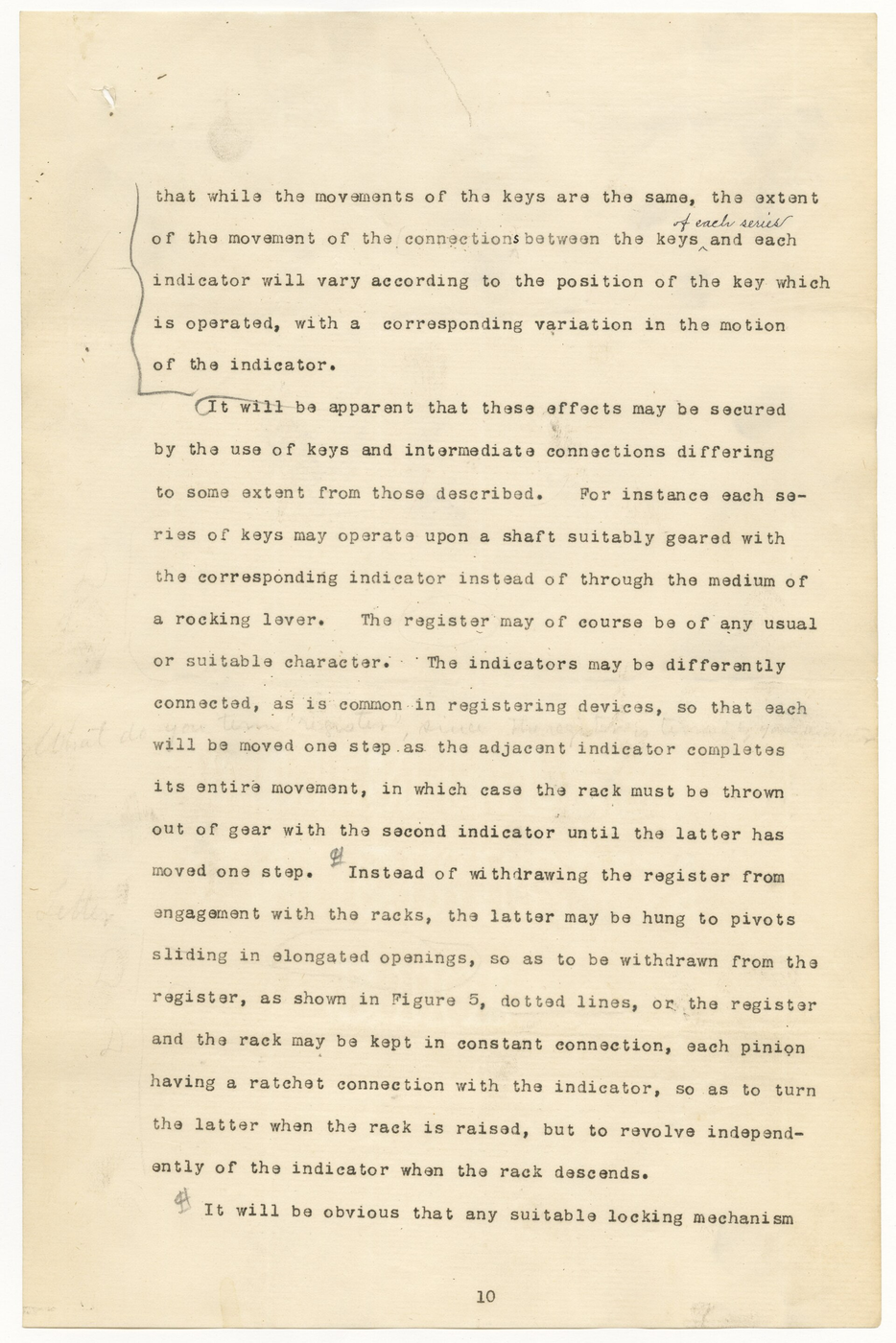


Burroughs Calculating Machine
William Burroughs was a bank clerk in Auburn, New York, adding columns of figures by hand for long days, and he understood the actual problem: not that addition is hard, but that a clerk who is right 999 times out of 1000 still produces a wrong ledger every day.
His machine does not merely add — it prints. Earlier calculators showed a result on dials that the operator then copied down, reintroducing exactly the transcription error the machine was meant to eliminate. A printing machine leaves a tape: the entries, the total, and evidence you can check.
The hard part is nothing to do with arithmetic. It is that a human hand hits keys at wildly varying speed and force, and a mechanism driven directly by that is unrepeatable. US Patent 388,116, "Calculating machine", granted 21 August 1888.
Hướng dẫn
Read US 388,116 and note that it PRINTS
Read US 388,116 and note that it PRINTS
Burroughs claims a machine that registers sums and prints results. Printing, not displaying — that distinction is the commercial value of the whole device.
Measure the real error rate first
Measure the real error rate first
Add a hundred four-digit numbers by hand, twice, and compare. The errors are the product — a machine that is merely faster solves the wrong problem.
Build one numbered wheel with a detent
Build one numbered wheel with a detent
Make a ten-position wheel held by a spring pawl so it cannot rest between digits. An ambiguous digit is worse than no machine at all.
Vật liệu cho bước này:
 Ván ép bạch dương Baltic1 tờ
 Bộ lò xo nén1 cái
Công cụ cần thiết:
 Cưa tay
Give each key a proportional throw
Give each key a proportional throw
Link keys 1 to 9 to levers of increasing travel, so pressing 7 advances the wheel seven steps. The key IS the number.
Vật liệu cho bước này:
 Thanh thép mềm1 cái
Now discover the real problem
Now discover the real problem
Press a key hard, then gently, then very fast. The wheel overshoots, undershoots and bounces. Human hands are not a repeatable actuator.
Fit a dashpot to govern the stroke
Fit a dashpot to govern the stroke
Add a fluid or air damper so the mechanism always completes at one speed regardless of how the key was hit. This is Burroughs's decisive addition and it took him years.
Verify the result no longer depends on the operator
Verify the result no longer depends on the operator
Repeat the hard-soft-fast test. The registered value must be identical every time. Only now is the machine trustworthy.
Add a second wheel and a carry tooth
Add a second wheel and a carry tooth
Fit a single long tooth that advances the tens wheel once per units revolution. Carry is one tooth, and it is where every mechanical calculator gets hard.
Solve the cascading carry at 999
Solve the cascading carry at 999
Adding 1 to 999 must move four wheels from one key press. Store the carry on a spring and release it in sequence rather than driving it all directly.
Build a column of type wheels for printing
Build a column of type wheels for printing
Fit each register wheel with raised digits on its rim. The number is stored and printed by the same part — nothing is transcribed.
Vật liệu cho bước này:
 Tấm đồng thau 260, cỡ 241 tờ
Công cụ cần thiết:
 Giũa kim loại
Add an inked ribbon and a platen
Add an inked ribbon and a platen
Press paper against the type wheels through a ribbon on the crank stroke. Each entry is printed as it is made, building an audit trail line by line.
Vật liệu cho bước này:
 Mực viết20 ml
Interlock the keys against each other
Interlock the keys against each other
Arrange the key bars so two cannot be depressed at once. An operator hitting 4 and 5 together must get a jam, not a silently wrong entry.
Enter a hundred figures and check the tape
Enter a hundred figures and check the tape
Run a real column through it and compare the printed tape against your hand sums. Any mismatch can be traced to a specific line — which is exactly the point.
Deliberately mis-key and find it on the tape
Deliberately mis-key and find it on the tape
Enter a wrong figure on purpose, then locate it from the printout alone. A machine you can audit beats a faster machine you cannot.
Compendium — the operator was the problem
Compendium — the operator was the problem
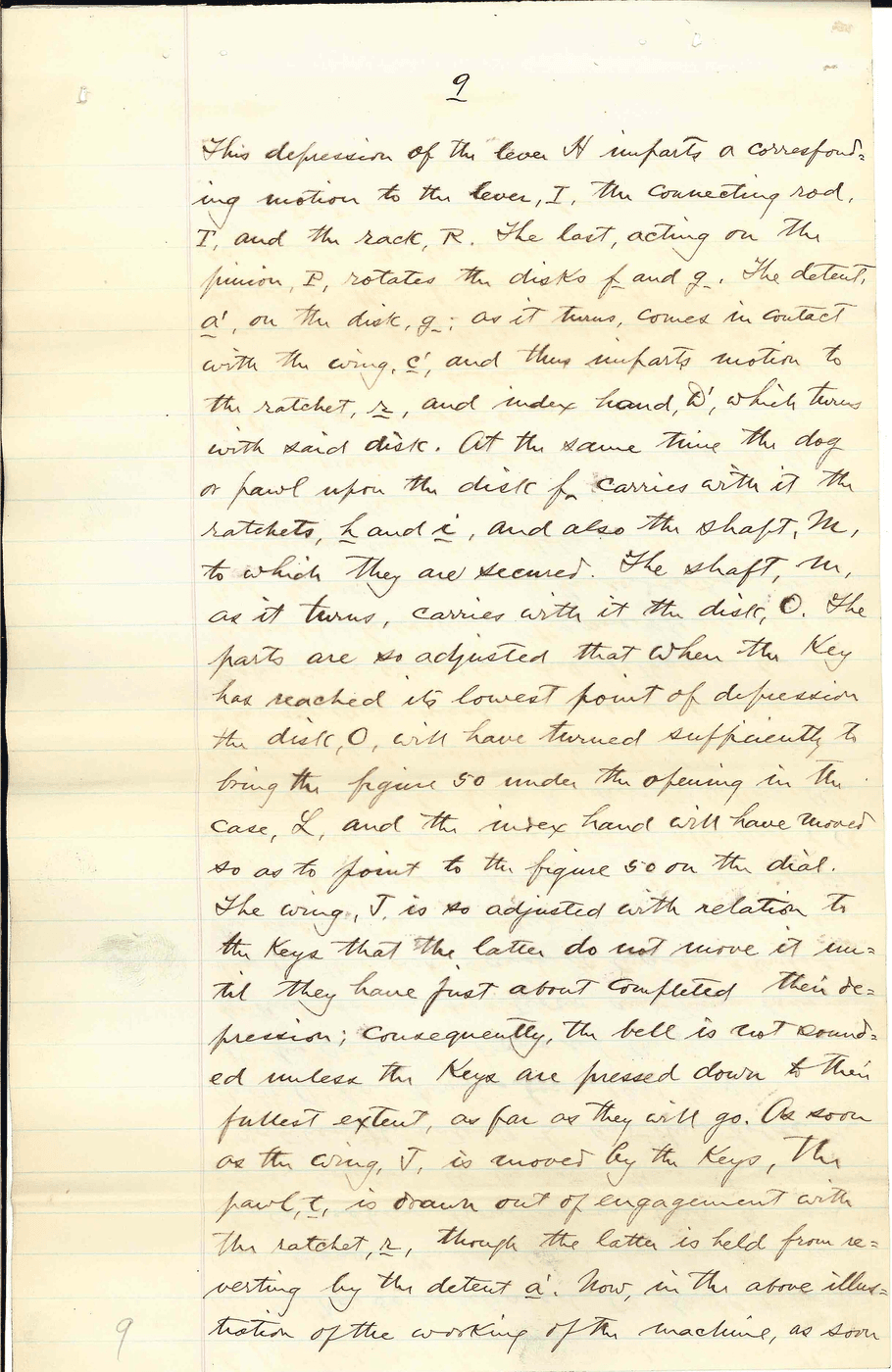
The patent. US 388,116, "Calculating machine", granted 21 August 1888 to William Seward Burroughs of St Louis, formerly a bank clerk in Auburn, New York. He filed his first applications in 1885 and spent years on refinement. The founding story is well attested and instructive: the first fifty machines sold were returned, because results depended on how hard the operator pulled the crank. Burroughs is said to have thrown them out of a window and started again — and the fix was the dashpot governor, which makes the stroke rate independent of the hand driving it.
Printing is the invention, not adding. Mechanical calculators existed long before — Pascal's Pascaline of 1642, Leibniz's stepped reckoner, Thomas de Colmar's Arithmomètre in production from 1851. All of them displayed a result on dials, which a clerk then copied into a ledger, reintroducing exactly the transcription errors the machine was supposed to remove. Printing the entries and the total produces a tape that can be re-checked against the source documents, so an error can be located rather than merely suspected. The machine's real product is auditability, and that is why banks bought it.
The carry is always the hard part. Any wheel-based register is trivial until a digit passes nine. Then one key press must advance two wheels, and at 999 it must advance four — all from the energy of a single finger. The general solution is to STORE the carry on a spring as each wheel passes zero and release the stored carries in sequence, rather than trying to drive the whole cascade directly. Pascal faced this in 1642 and it is still the limiting mechanism in the last mechanical calculators of the 1960s.
What became of it. The American Arithmometer Company, founded to make it, was renamed the Burroughs Adding Machine Company after his death in 1898 and became one of the largest office-equipment firms in the world; it eventually merged with Sperry — whose gyrocompass appears elsewhere in this batch — to form Unisys in 1986. Burroughs died at 41, of tuberculosis, shortly before the machine made the company's fortune. His grandson, the writer William S. Burroughs, was named for him.
Vật liệu
5- Tạm thời
- 1 cáiTạm thời
- 1 cáiTạm thời
- Tạm thời
- 20 mlTạm thời
Blueprint liên quan
Các blueprint này chia sẻ kiến thức — kỹ thuật, vật liệu hoặc nguyên tắc

CC0 Phạm vi công cộng
Bản thiết kế này được phát hành theo CC0. Bạn tự do sao chép, sửa đổi, phân phối và sử dụng cho bất kỳ mục đích nào mà không cần xin phép.
Hỗ trợ nhà sáng tạo bằng cách mua sản phẩm qua bản thiết kế, nơi họ nhận Hoa hồng nhà sáng tạo do nhà bán hàng đặt, hoặc tạo phiên bản mới và kết nối trong bản thiết kế riêng để chia sẻ doanh thu.