NGHỆ THUẬT
LÀM ĐẸP VÀ SỨC KHỎE
THỦ CÔNG
VĂN HÓA VÀ LỊCH SỬ
GIẢI TRÍ
MÔI TRƯỜNG
THỰC PHẨM VÀ ĐỒ UỐNG
KỸ THUẬT NGƯỢC
KHOA HỌC
THỂ THAO
CÔNG NGHỆ
THIẾT BỊ ĐEO


Centre Distance and Backlash: The Gap That Has to Be There
Where the two shafts go follows from the module and the tooth counts and nothing else: the centre distance is half the module times the sum of the tooth counts.
**Backlash** is the small clearance between the teeth, and it is deliberate. Without it the pair jams as soon as anything expands, deflects, or carries a film of oil. With too much of it, a positioning drive loses motion every time it reverses.
The useful fact is that the two are linked: opening the centres slightly produces backlash, and by a known amount. That is the adjustment available after the gears exist, and it is how a real gearbox is set.
Trung cấp
3 hours
Hướng dẫn
1
1
Setting the centres
Setting the centres
**Calculate it from the module and the tooth counts**, then bore the housing to that distance. It is very rarely a round number, which is the reason gear sets and housings are designed together rather than one after the other.
**Parallelism matters more than the distance.** Two shafts at the right distance but not parallel put all the load on one end of the tooth, and the tooth then carries several times the stress it was designed for. The shaft alignment blueprint covers the measurement.
**Check the mesh with engineer's blue.** Coat a few teeth thinly, run the pair under a light load, and look at the contact pattern transferred to the mating gear. A good pattern is centred on the tooth, covering most of the face width and most of the tooth height, and the same on both flanks.
A pattern **at one end of the face** is misalignment. **At the tip** is centres too far apart. **At the root** is centres too close. **Narrow and central** is usually a crowned tooth, which is deliberate.
That contact pattern is the single most informative check available, it takes five minutes, and it is the same technique used for scraping a flat surface.
Vật liệu cho bước này:
 Bộ bánh răng trụ (thép, 20 răng)2 cái
 Bột đánh dấu màu xanh1 cái
 Trục thép 30 mm2 cái
Công cụ cần thiết:
 Thước cặp điện tử 6 inch
 Đồng hồ so
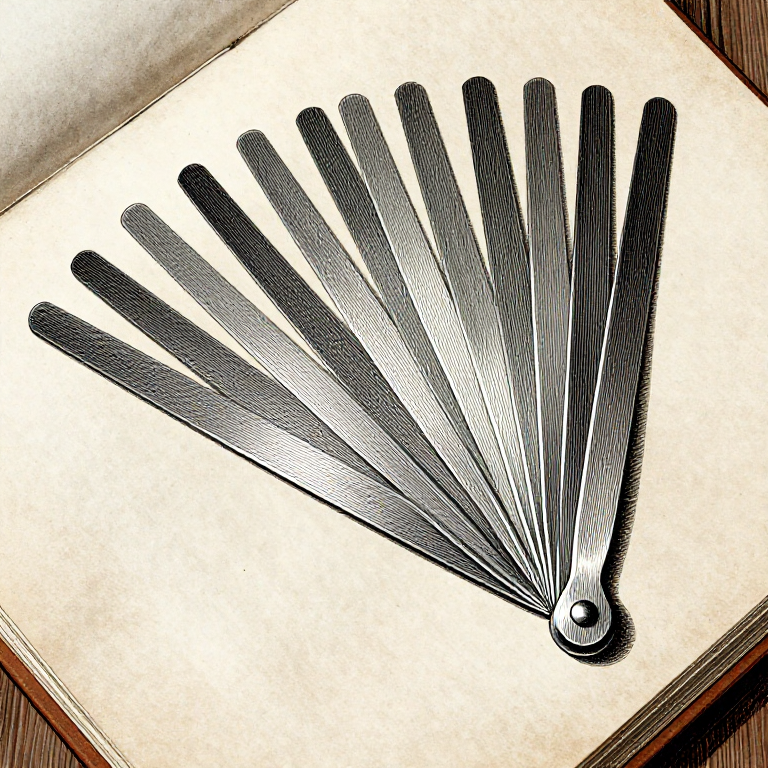
 Bộ căn lá
2
2
The arithmetic of centres and backlash
The arithmetic of centres and backlash
Đang tải sổ tay Jupyter…
Công cụ cần thiết:
 Máy tính để bàn
3
3
Measuring backlash
Measuring backlash
**With a dial indicator.** Lock one gear. Put the indicator tip against a tooth of the other, at the pitch radius and tangentially. Rock the free gear back and forth against the locked one and read the total movement. That is the backlash at that position.
**Measure at several positions round the gear**, at least four. Backlash that varies with position means the gear is eccentric on its shaft, or out of round, or the shaft is bent — and the minimum value is the one that matters, because that is where it will jam.
**With feeler gauges**, for a coarse gear: slide a leaf into the gap between the non-driving flanks. Quick and less accurate.
**By feel** is how most people do it and it is genuinely informative for a yes/no: a pair with no perceptible backlash anywhere is too tight, and one that rattles is too loose.
**Record where it was measured.** Backlash quoted without a position means the maximum, which is the useless end of the range.
**Then watch it over time.** Backlash that grows is wear, and the rate of growth is the most useful early warning a gearbox gives.
Vật liệu cho bước này:
Bộ bánh răng trụ (thép, 20 răng)2 cáiTrục thép 30 mm1 cáiCông cụ cần thiết:
Đồng hồ soBộ căn lá4
4
When backlash has to be removed
When backlash has to be removed
Backlash is lost motion, and on anything that positions rather than drives it is the dominant error: a machine table does not move at all until the reversal has been taken up.
Four standard answers, in increasing order of cost:
**Approach from one direction only.** Always move up to a position, never down to it. Costs nothing and is what every careful machinist already does.
**A split, spring-loaded gear.** Two halves side by side on the same hub, sprung apart so that between them they fill the tooth space of the mate. Genuinely zero backlash, and it can only carry the load the spring can hold.
**An adjustable centre distance.** One shaft on an eccentric or a slide, set close and locked. Simple, effective, and it must be reset as the gears wear.
**A preloaded dual path.** Two complete gear trains driving the same output, wound against each other. Expensive, used in machine tool and instrument drives.
**Or design it out.** A ball screw, a belt, a harmonic drive or a direct drive removes the question. Anti-backlash gearing is a solution to a problem that is sometimes better avoided — and on a power drive, where the load is always in one direction, backlash does not matter at all.
Vật liệu cho bước này:
Bộ bánh răng trụ (thép, 20 răng)2 cái Vòng bi2 cái
Công cụ cần thiết:
Đồng hồ soThước cặp điện tử 6 inchVật liệu
4- Tạm thời
- Tạm thời
- 2 cáiTạm thời
- Tạm thời
Blueprint liên quan
Các blueprint này chia sẻ kiến thức — kỹ thuật, vật liệu hoặc nguyên tắc

CC0 Phạm vi công cộng
Bản thiết kế này được phát hành theo CC0. Bạn tự do sao chép, sửa đổi, phân phối và sử dụng cho bất kỳ mục đích nào mà không cần xin phép.
Hỗ trợ nhà sáng tạo bằng cách mua sản phẩm qua bản thiết kế, nơi họ nhận Hoa hồng nhà sáng tạo do nhà bán hàng đặt, hoặc tạo phiên bản mới và kết nối trong bản thiết kế riêng để chia sẻ doanh thu.