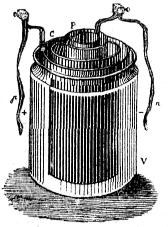


Daniell Cell
Hướng dẫn
Mix the two solutions
Mix the two solutions
Two half-cells, two different solutions. That separation is the whole invention.
- Dissolve copper sulfate in warm water until no more will go in — a saturated solution, deep blue.
- Dissolve zinc sulfate in water separately. This one is colourless.
- Label both. They look nothing alike, but only while the copper one is fresh.
Vật liệu cho bước này:
 Đồng sunfat (cấp phòng thí nghiệm)1 container
 Kẽm sulfat1 container
Set up the porous barrier
Set up the porous barrier
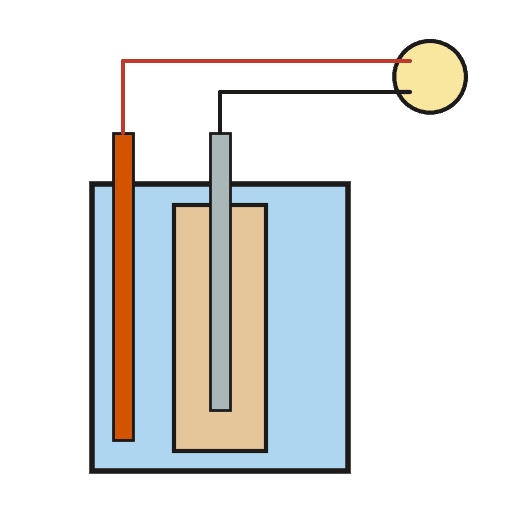
Stand an unglazed porous pot inside a larger glass jar. The pot holds one solution, the jar the other, and the unglazed wall lets ions through while keeping the liquids from mixing.
- Put the zinc sulfate solution inside the porous pot.
- Put the copper sulfate solution in the outer jar, to roughly the same level.
Vật liệu cho bước này:
 Bộ ống thủy tinh1 bộ
Add the electrodes
Add the electrodes
Each metal goes into the solution of its own salt — that pairing is what makes it a half-cell.
- Zinc into the zinc sulfate, inside the porous pot. This is the negative terminal.
- Copper into the copper sulfate, in the outer jar. This is the positive terminal.
- Clean both metals to bright before use; oxide films add resistance.
Vật liệu cho bước này:
 Thỏi kẽm 99,9 % nặng 1 lb1 cái
 Tấm đồng đỏ1 tờ
Measure it
Measure it
Connect a multimeter across the two electrodes, copper to the positive lead.
- Expect roughly 1.1 V on open circuit.
- Leave it connected to a small load and read again after an hour.
Công cụ cần thiết:
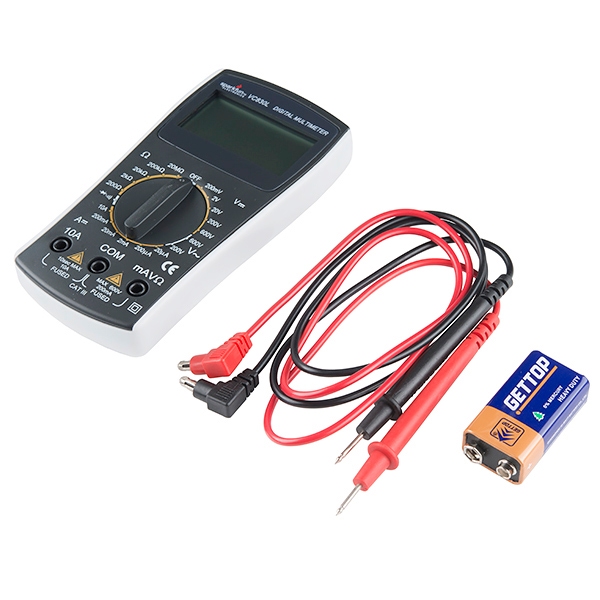 Digital Multimeter - Basic
Watch the electrodes change
Watch the electrodes change
Leave the cell working for a day and look at both metals.
- The copper has grown a fresh layer, plated out of the blue solution.
- The zinc is pitted where it has dissolved away.
- The blue of the copper sulfate has faded slightly.
History and context
History and context
John Frederic Daniell, professor of chemistry at King's College London, published this cell in 1836. Its value was reliability rather than power: a steady, predictable source at a moment when every electrical experiment was fighting a battery that faded as you watched.
That steadiness made it the working supply of the telegraph age, and its predictability made it a standard — for decades the Daniell cell was a reference against which other sources were compared, before purpose-built standard cells replaced it.
It is also the diagram in every electrochemistry textbook. Two half-cells, a barrier, and the convention that reduction happens at the cathode were all made legible by this arrangement.
Worth being accurate about: Daniell did not discover that dissimilar metals in electrolyte make current — Volta had that in 1800. What he solved was polarisation, and he solved it by separation rather than by any new chemistry.
Vật liệu
5- 1 containerTạm thời
- 1 containerTạm thời
- 1 bộTạm thời
- Tạm thời
- 1 tờTạm thời
Công cụ yêu cầu
1- Digital Multimeter - BasicHoa hồng 10%$14.37
Vật liệu bản thiết kế liên kết


Bản thiết kế này làm ra
Blueprint liên quan
Các blueprint này chia sẻ kiến thức — kỹ thuật, vật liệu hoặc nguyên tắc

CC0 Phạm vi công cộng
Bản thiết kế này được phát hành theo CC0. Bạn tự do sao chép, sửa đổi, phân phối và sử dụng cho bất kỳ mục đích nào mà không cần xin phép.
Hỗ trợ nhà sáng tạo bằng cách mua sản phẩm qua bản thiết kế, nơi họ nhận Hoa hồng nhà sáng tạo do nhà bán hàng đặt, hoặc tạo phiên bản mới và kết nối trong bản thiết kế riêng để chia sẻ doanh thu.