NGHỆ THUẬT
LÀM ĐẸP VÀ SỨC KHỎE
THỦ CÔNG
VĂN HÓA VÀ LỊCH SỬ
GIẢI TRÍ
MÔI TRƯỜNG
THỰC PHẨM VÀ ĐỒ UỐNG
KỸ THUẬT NGƯỢC
KHOA HỌC
THỂ THAO
CÔNG NGHỆ
THIẾT BỊ ĐEO

Depth of Field: Only One Distance Is Actually in Focus
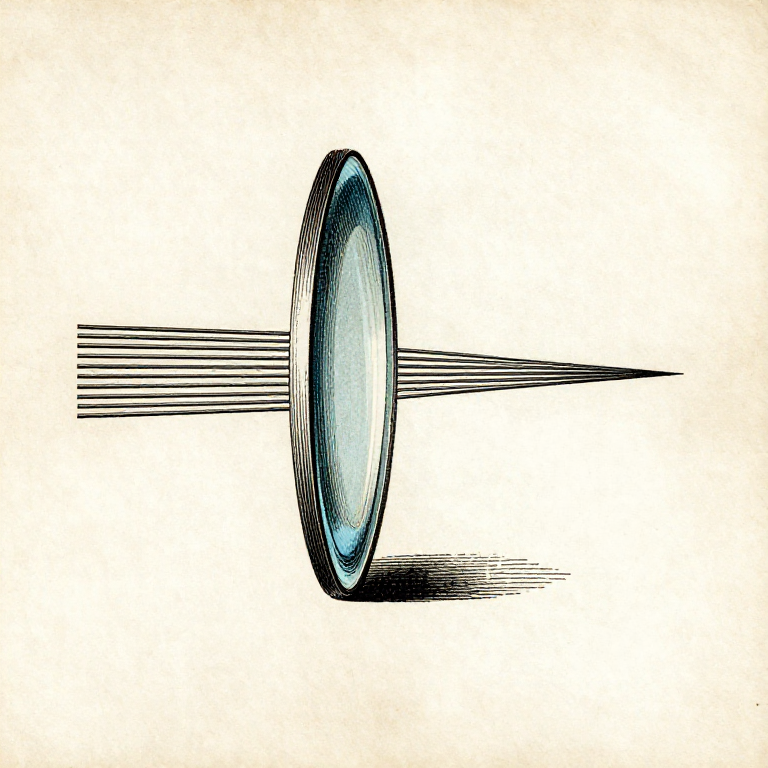
A lens brings exactly one distance to a true focus. Everything nearer or further is a small disc rather than a point, and it looks sharp only because the disc is too small for the eye to notice in the finished print.
So "depth of field" is not a property of the lens. It depends on how big the print is, how close it is viewed, and how good the eye is — and it is quoted against a convention about all three, the **circle of confusion**.
Three things control it: the aperture, the focal length, and the subject distance. The third matters far more than the other two, which is the part most people never work out.
Trung cấp
3 hours
Hướng dẫn
1
1
The circle of confusion is a decision, not a measurement
The circle of confusion is a decision, not a measurement
Every depth of field figure ever printed rests on an assumption about how big the final picture is and how closely it is examined.
The 35 mm convention is a circle of about **0.03 mm** on the negative. That comes from an enlargement to roughly a 20 by 25 cm print, viewed at about 25 cm, by an eye that resolves about 0.2 mm at that distance.
Three consequences follow, and all three surprise people:
**A bigger print has less depth of field.** The same negative enlarged more magnifies the blur circles too. Depth of field scales on a lens barrel are optimistic for a large print.
**A smaller format has more depth of field at the same framing**, because it uses a shorter lens for the same angle of view. This is why a phone camera has to simulate background blur and a large format camera has to fight for any depth at all.
**Looking at a screen at 100% is not a fair test.** That is an enormous enlargement, and almost nothing is sharp by that standard.
So the number is a convention that has proved useful, not a fact about optics.
Công cụ cần thiết:
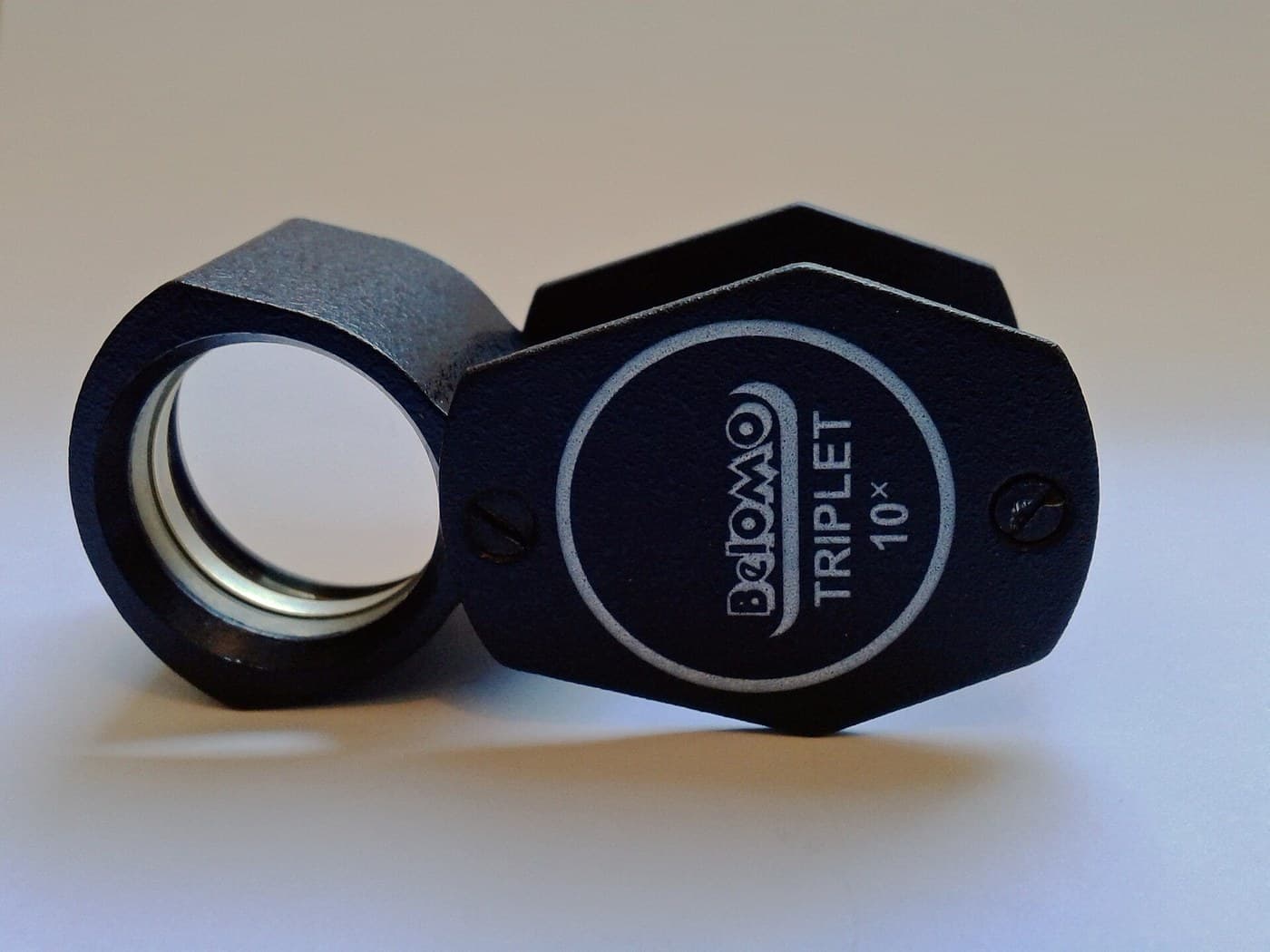
 Kính lúp thợ kim hoàn
2
2
Hyperfocal distance and what changes the depth
Hyperfocal distance and what changes the depth
Đang tải sổ tay Jupyter…
Công cụ cần thiết:
 Máy tính để bàn
3
3
Using it deliberately
Using it deliberately
**For a landscape**, focus at the hyperfocal distance rather than at infinity. Focusing at infinity throws away everything from half the hyperfocal distance to infinity that you could have had for nothing.
**For a portrait**, work wide open and close in. Both increase the blur behind the subject, and the notebook shows how quickly the depth collapses at short distances.
**For a close-up**, expect almost nothing. At very close distances the depth of field is millimetres even at f/16, which is why macro work is focus-stacked or shot at an angle chosen so the subject lies in the plane of focus.
**The depth extends further behind the subject than in front**, and increasingly so with distance. Close up it is about even; at a few metres it is roughly one third in front and two thirds behind. So focus slightly in front of the middle of what must be sharp, not on the middle.
**Use the depth of field scale on the lens** where there is one: set the near and far marks on the two ends of what must be sharp, and read off the aperture between them. That is what those engraved scales are for, and it is faster than any calculation.
Vật liệu cho bước này:
 Phim chụp ảnh1 cái
Công cụ cần thiết:
 Máy ảnh số
 Chân máy ảnh
4
4
Sharpness is not only depth of field
Sharpness is not only depth of field
A picture can be unsharp for several reasons and only one of them is depth of field. Diagnosing the wrong one wastes a great deal of time.
**Camera shake.** Everything is unsharp in the same direction. The old rule is to keep the shutter faster than one over the focal length in millimetres — 1/50 s for a 50 mm lens — and it is a minimum rather than a target. A tripod removes the question entirely.
**Subject movement.** The subject is unsharp and the background is not.
**Missed focus.** Something else in the frame is sharp. Look for what is, and the error is measurable.
**Diffraction.** Everything is slightly soft, and it gets worse the further the lens is stopped down. This is the limit that stops depth of field being free: past about f/11 on 35 mm the whole image begins to soften, so the sharpest compromise for a deep scene is usually f/8 to f/11 rather than f/22.
**The lens itself.** Most lenses are softest wide open and best two or three stops down.
Between diffraction at one end and lens softness at the other, there is an optimum aperture for every lens, and it is usually nearer the middle of the scale than either extreme.
Vật liệu cho bước này:
Phim chụp ảnh1 cáiCông cụ cần thiết:
Máy ảnh sốChân máy ảnhKính lúp thợ kim hoànVật liệu
1- 1 cáiTạm thời
Công cụ yêu cầu
4- Tạm thời
- Tạm thời
- Tạm thời
- Tạm thời
Blueprint liên quan
Các blueprint này chia sẻ kiến thức — kỹ thuật, vật liệu hoặc nguyên tắc

CC0 Phạm vi công cộng
Bản thiết kế này được phát hành theo CC0. Bạn tự do sao chép, sửa đổi, phân phối và sử dụng cho bất kỳ mục đích nào mà không cần xin phép.
Hỗ trợ nhà sáng tạo bằng cách mua sản phẩm qua bản thiết kế, nơi họ nhận Hoa hồng nhà sáng tạo do nhà bán hàng đặt, hoặc tạo phiên bản mới và kết nối trong bản thiết kế riêng để chia sẻ doanh thu.