

Egyptian Limestone Cutting — Cutting Limestone Blocks with Copper Saws
Hướng dẫn
Prepare the Limestone Block and Mark Cut Lines
Prepare the Limestone Block and Mark Cut Lines
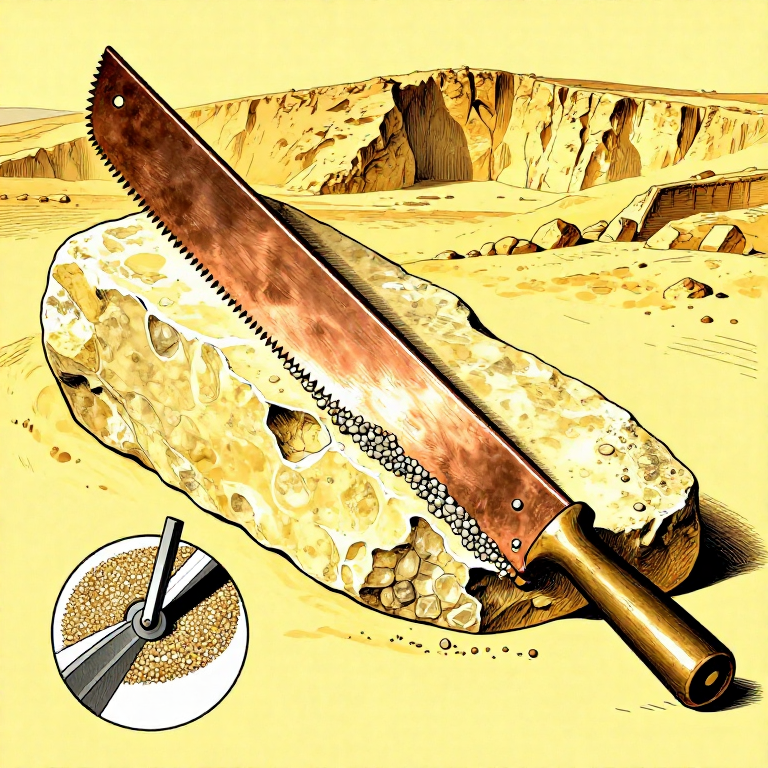
Select a block of soft nummulitic limestone, the same type quarried at Giza and Tura in ancient Egypt. This sedimentary stone has a Mohs hardness of 3-4, making it workable with copper tools assisted by abrasive sand. Using a copper scriber or charcoal stick, mark your intended cut line on all visible faces of the block. Score a shallow starting groove along the marked line using a copper chisel — this groove will guide the saw blade and prevent it from wandering during the initial strokes. Secure the block firmly so it cannot shift during cutting.
Vật liệu cho bước này:
 Khối đá vôi1 block, approx 30x20x15 cm for practice cái
 Cát mịn2-3 kg kg
 Nướccontinuous supply for lubrication cái
Công cụ cần thiết:
 Lưỡi cưa vòng
 Phôi gỗ cứng làm cán
 Vồ gỗ
Vồ gỗ Kính bảo hộ kín
Set Up the Copper Saw with Abrasive Feed
Set Up the Copper Saw with Abrasive Feed
Mount the copper saw blade in its wooden frame. The blade should be flat copper sheet approximately 3-5 mm thick, as archaeological evidence from Giza and experimental archaeology by Denys Stocks confirms. Pure copper is too soft to cut limestone alone (Mohs 2.5-3 for copper versus 3-4 for limestone), so the actual cutting is performed by quartz sand particles (Mohs 7) trapped between the copper blade and the stone. Prepare a slurry of sharp quartz sand and water in a container near the work area. The sand grains must be angular, not rounded, to cut effectively.
Begin Cutting with Sand and Water Lubrication
Begin Cutting with Sand and Water Lubrication
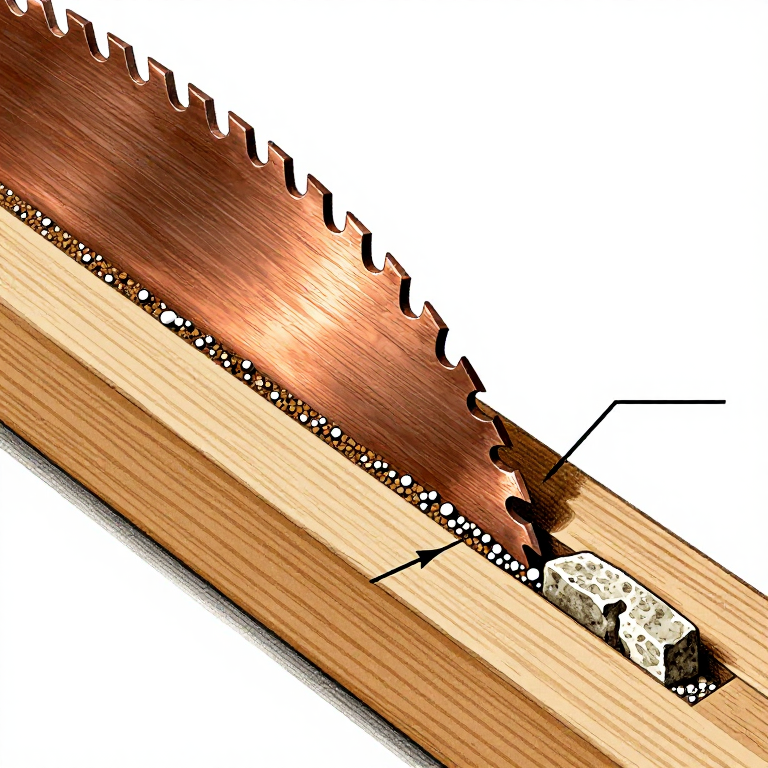
Pour a generous amount of sand-water slurry into the scored groove on the limestone. Begin sawing with long, steady strokes, applying moderate downward pressure. The copper blade carries the quartz sand grains into the cut, where they abrade the limestone. Add more slurry frequently to keep the cut saturated — dry cutting causes the sand to clog and the copper to overheat. The characteristic green-grey copper residue found in ancient saw cuts at Giza confirms this abrasive technique. Expect a cutting rate of approximately 1-2 cm depth per hour in soft limestone, depending on sand quality and pressure applied.
Deepen the Cut and Maintain the Kerf
Deepen the Cut and Maintain the Kerf
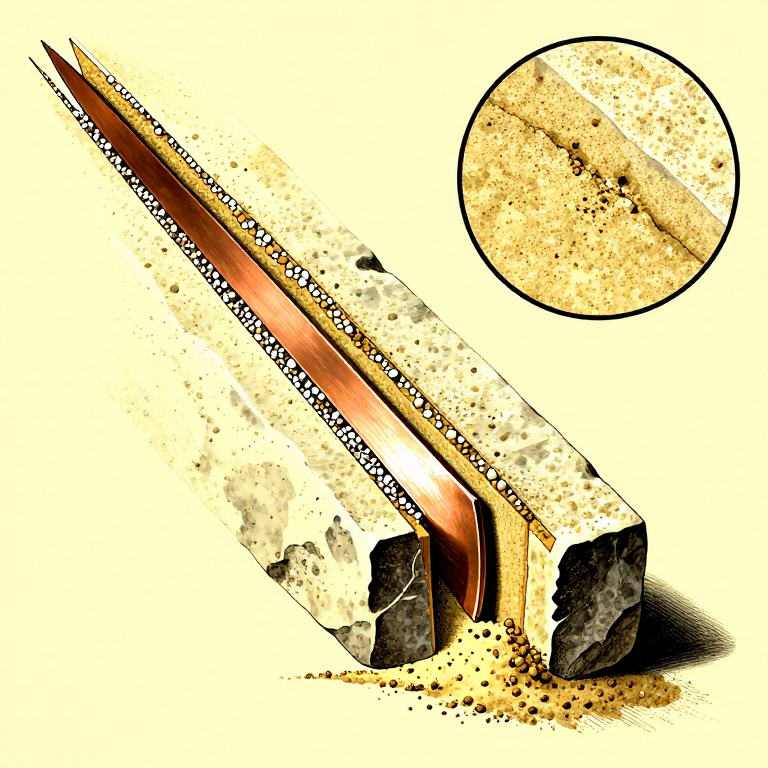
As the cut deepens, continue feeding sand slurry from both sides to ensure abrasive reaches the bottom of the kerf. The saw kerf will be slightly wider than the blade thickness due to the sand particles on either side — typically 6-10 mm wide for a 4 mm blade. Periodically withdraw the saw and flush the cut with water to remove accumulated stone dust and spent sand. Add fresh angular sand to maintain cutting speed. The copper blade will wear slowly during cutting but is consumed far less than the stone, as the quartz sand does the actual abrasive work. Ancient Egyptian quarry marks show saw cuts up to 2 meters long on granite sarcophagi.
Complete the Cut and Finish the Surface
Complete the Cut and Finish the Surface
Once the saw cut reaches the desired depth, the block can be split along the cut using wooden wedges driven into the kerf. Insert dry wooden wedges at intervals along the cut and soak them with water — as the wood swells it exerts enormous lateral pressure that splits the stone cleanly along the weakened plane. This wedge-splitting technique left characteristic slot marks visible on blocks at Giza, Saqqara, and Aswan quarries. The sawn surface will show fine parallel striations from the sand abrasive. For a finished architectural surface, the Egyptians smoothed these marks using flat sandstone rubbing stones with progressively finer grit, achieving surfaces flat to within fractions of a millimeter on the casing stones of the Great Pyramid.
Vật liệu
3- 1 block, approx 30x20x15 cm for practice cáiTạm thời
- 2-3 kg kgTạm thời
- continuous supply for lubrication cáiTạm thời
Công cụ yêu cầu
7- Tạm thời
- Tạm thời
- Copper chisels
- Tạm thời
- Tạm thời
- Tạm thời
- Tạm thời
Bản thiết kế này làm ra
CC0 Phạm vi công cộng
Bản thiết kế này được phát hành theo CC0. Bạn tự do sao chép, sửa đổi, phân phối và sử dụng cho bất kỳ mục đích nào mà không cần xin phép.
Hỗ trợ nhà sáng tạo bằng cách mua sản phẩm qua bản thiết kế, nơi họ nhận Hoa hồng nhà sáng tạo do nhà bán hàng đặt, hoặc tạo phiên bản mới và kết nối trong bản thiết kế riêng để chia sẻ doanh thu.