

Electrophotography
Every copying method before 1938 was wet. Photostat, blueprint, mimeograph, carbon paper — all needed chemicals, baths, special coated stock, or a master prepared in advance. Copying an ordinary page you already had was, in practice, retyping it.
Chester Carlson's process uses no liquid at all. Charge a photoconductive plate in the dark, project the page onto it, and the light discharges the plate everywhere the page was white — leaving an invisible pattern of charge in the shape of the dark marks. Dust it with a charged powder, and the powder sticks only where the charge remains.
The image is electrostatic before it is visible. US Patent 2,297,691, "Electrophotography", filed 4 April 1939 and granted 6 October 1942. Carlson spent the following six years being turned down by more than twenty companies, including IBM, GE and RCA.
Hướng dẫn
Use sulfur, not selenium
Use sulfur, not selenium
Carlson's first plate was sulfur on zinc; commercial machines later used selenium, which is toxic and requires proper handling. This blueprint uses sulfur — same physics, no toxic material.
Read US 2,297,691 and note the word 'dry'
Read US 2,297,691 and note the word 'dry'
Carlson claims a latent electrostatic image developed with powder. No baths, no fixer, no coated paper — the absence of chemistry IS the invention.
Understand what a photoconductor does
Understand what a photoconductor does
It is an insulator in the dark and a conductor in light. That single property is what lets light erase charge selectively.
Prepare a sulfur-coated metal plate
Prepare a sulfur-coated metal plate
Melt a thin, even layer of sulfur onto a clean zinc or aluminium plate and let it cool. Even thickness matters — thin spots hold less charge.
Vật liệu cho bước này:
 Bột lưu huỳnh50 g
 Tấm nhôm1 tờ
Work in the dark from this point
Work in the dark from this point
Any light discharges the plate. Everything from charging to development happens in a darkened room or a light-tight box.
Charge the plate by rubbing
Charge the plate by rubbing
Stroke the sulfur with a cloth or fur to charge it electrostatically. Carlson did exactly this — modern machines use a corona wire, which is only a tidier charger.
Confirm the charge is holding
Confirm the charge is holding
Bring a small scrap of paper near the plate; it should be attracted. If the charge leaks away in seconds the sulfur layer is too thin or contaminated.
Lay a transparency of your original against the plate
Lay a transparency of your original against the plate
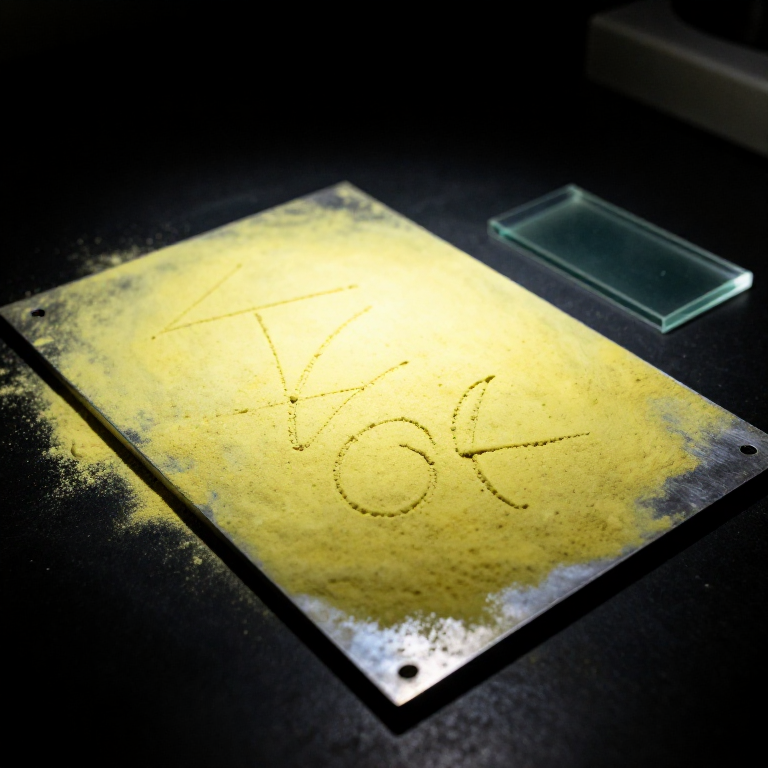
Use a slide or an inked glass plate — Carlson's first image was "10.-22.-38 ASTORIA" written in ink on a microscope slide.
Expose it briefly to a bright light
Expose it briefly to a bright light
Flash the light through the transparency. Light passes where the original is clear and discharges the plate there; the dark marks shield the plate and it stays charged.
Realise the image now exists and is invisible
Realise the image now exists and is invisible
The plate looks unchanged. It carries a latent image made purely of electric charge — this is the step that has no analogue in any earlier copying process.
Dust the plate with a fine powder
Dust the plate with a fine powder
Sift lycopodium powder or fine toner over the surface and tip off the excess. Powder clings only where charge remains, and the image appears.
Vật liệu cho bước này:
 Bột lycopodium20 g
Transfer the powder to paper
Transfer the powder to paper
Press a sheet of paper on the plate and lift. The powder transfers, and the copy is on ordinary paper — no special stock anywhere in the process.
Fix the image with heat
Fix the image with heat
Warm the paper gently so the powder softens and bonds. This is the fuser, and it is why a page from a photocopier comes out warm.
Repeat the whole cycle on the same plate
Repeat the whole cycle on the same plate
Clean, recharge, expose again. The plate is not consumed — unlike every photographic process, the imaging surface is reusable indefinitely.
Compendium — an image made of charge
Compendium — an image made of charge
The patent. US 2,297,691, "Electrophotography", filed 4 April 1939 and granted 6 October 1942 to Chester F. Carlson. Carlson was a patent attorney with arthritis who was tired of copying documents by hand, and he worked the problem in a rented room in Astoria, Queens, with a hired physicist, Otto Kornei. Their first successful image, on 22 October 1938, was the line "10.-22.-38 ASTORIA" inked on a glass slide, transferred to wax paper. Kornei was unimpressed and left shortly after.
The physics in four steps. Charge a photoconductive surface uniformly in the dark. Project an optical image onto it, so light discharges the illuminated areas and the dark areas retain charge — a latent electrostatic image. Present a charged powder, which is attracted only to the remaining charge. Transfer that powder to paper and fuse it with heat. Every photocopier and laser printer in existence runs this same four-step cycle; a laser printer simply writes the latent image with a scanned beam instead of projecting a page.
Twenty companies said no. Between 1939 and 1944 Carlson was rejected by more than twenty firms, IBM, General Electric and RCA among them. The Battelle Memorial Institute took it on in 1944, and a small photographic-paper company in Rochester called Haloid licensed it in 1947. They coined "xerography" from the Greek for dry writing, renamed themselves Xerox, and launched the 914 in 1959 — a machine so successful that the company's revenue rose from about 30 million to over 500 million dollars within a decade. Carlson gave away much of his fortune.
Why nobody wanted it. The rejections were not stupidity. In 1939 the market for copies was small, because making copies was hard — offices used carbon paper at the moment of typing and simply did not generate demand for copying an existing page. Executives were asked to fund a costly machine for a need nobody had expressed. Xerox's later insight was commercial rather than technical: lease the machines and charge per copy, so customers paid nothing up front and the supplier captured the demand it created. The technology was ready in 1938 and the business model that unlocked it took twenty-one years.
Vật liệu
3- 50 gTạm thời
- 1 tờTạm thời
- 20 gTạm thời
Blueprint liên quan
Các blueprint này chia sẻ kiến thức — kỹ thuật, vật liệu hoặc nguyên tắc

CC0 Phạm vi công cộng
Bản thiết kế này được phát hành theo CC0. Bạn tự do sao chép, sửa đổi, phân phối và sử dụng cho bất kỳ mục đích nào mà không cần xin phép.
Hỗ trợ nhà sáng tạo bằng cách mua sản phẩm qua bản thiết kế, nơi họ nhận Hoa hồng nhà sáng tạo do nhà bán hàng đặt, hoặc tạo phiên bản mới và kết nối trong bản thiết kế riêng để chia sẻ doanh thu.