NGHỆ THUẬT
LÀM ĐẸP VÀ SỨC KHỎE
THỦ CÔNG
VĂN HÓA VÀ LỊCH SỬ
GIẢI TRÍ
MÔI TRƯỜNG
THỰC PHẨM VÀ ĐỒ UỐNG
KỸ THUẬT NGƯỢC
KHOA HỌC
THỂ THAO
CÔNG NGHỆ
THIẾT BỊ ĐEO
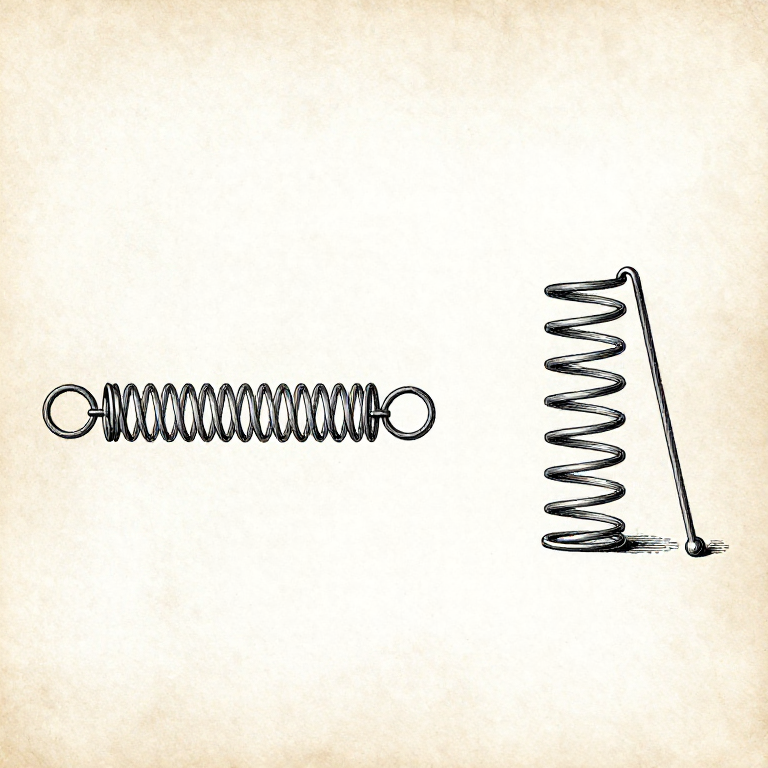


Extension and Torsion Springs: Initial Tension, Hooks and Handedness
An extension spring is not a compression spring turned round, and a torsion spring is not either of them. Both break the assumptions the first rungs were built on.
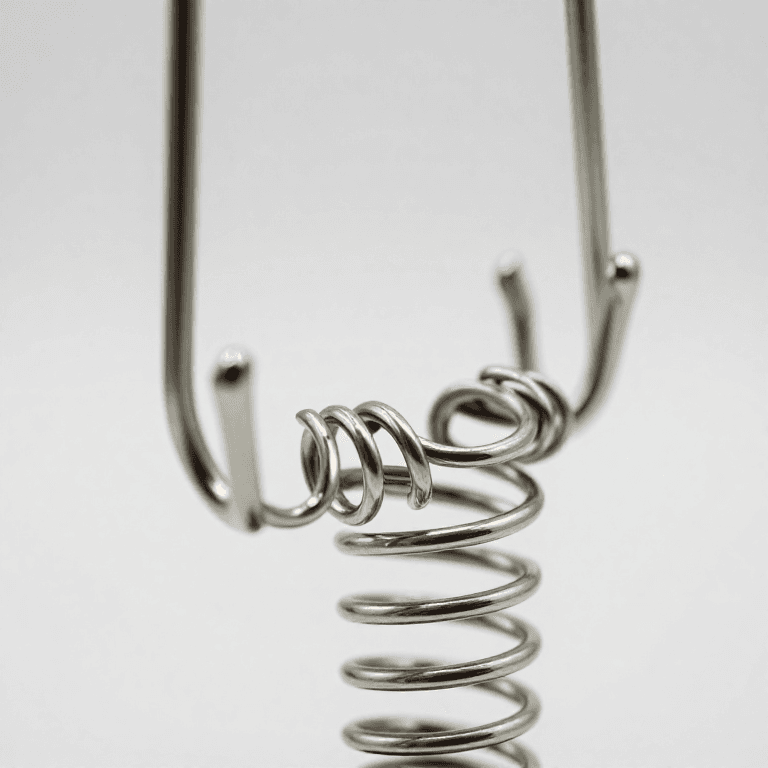
An extension spring is wound with its coils already touching, so it starts with force in it — the initial tension — and nothing moves at all until that force is exceeded. Its force-extension line does not pass through the origin, which means a single measurement cannot tell you its rate. And it has hooks: bent wire, working in bending where the body works in torsion, on a tighter radius than the coil, which is why the hook is almost always where it fails.
A torsion spring, despite its name, works its wire in **bending**, so its rate depends on Young's modulus and not the shear modulus. It must be wound the way that closes the coil, and the coil shrinks onto its shaft as it is wound up — which is a clearance you have to calculate, not guess.
Trung cấp
4 hours
Hướng dẫn
1
1
Extension springs: what initial tension is
Extension springs: what initial tension is
**It is force wound in, not force applied.** When an extension spring is coiled, the wire can be fed on with the coils pressed hard against each other. The residual twist in the wire keeps them pressed together, and that press has to be overcome before the spring will open at all.
**It is a property of the coiling, not of the design.** You cannot order a particular initial tension the way you order a rate; you specify a range and the spring maker hits it by feel and by machine setting. Typical values are between about 10% and 25% of the maximum working load, and the tolerance on it is wide.
**It cannot be adjusted afterwards.** Stretching a spring to 'loosen' it removes initial tension by taking a set, and takes free length with it. The spring is then a different spring, permanently.
**A compression spring has no equivalent**, and a compression spring that seems to have one is a compression spring with coils touching — which is a fault.
**Why it is useful.** A spring that does nothing until a threshold force is a very handy thing: a screen door that stays shut until you push, a latch that holds until it is asked. And on a machine it means the spring is doing nothing at all in the rest position, which is one fewer thing creeping.
**Why it is a nuisance.** It makes a single force-and-length measurement useless, it has a loose tolerance, and it drifts in service as the spring relaxes.
Vật liệu cho bước này:
 Lò xo kéo1 cái
Công cụ cần thiết:
 Lực kế (cân lò xo)
 Bộ quả cân chuẩn
 Thước kẻ
2
2
Initial tension, hook stress, and the torsion spring derived
Initial tension, hook stress, and the torsion spring derived
Đang tải sổ tay Jupyter…
Công cụ cần thiết:
 Máy tính để bàn
3
3
Ends, and choosing between them
Ends, and choosing between them
**Machine loop or machine hook.** The last coil bent up into the axis and left as a loop, or bent further into a hook. Cheap, standard, made on the same machine as the spring. The bend radius is small, so these are the weakest ends there are — fine for light loads and wrong for heavy ones.
**Crossover loop.** The end coil crosses the axis and loops on the far side. Slightly better aligned with the load and no stronger where it matters.
**Extended hook.** The end wire is carried out beyond the body before being formed. Lets the bend radius be generous, which is the whole point, and adds length.
**Side loop.** The loop is formed to one side rather than on the axis. Easy to hook onto something, and it loads the spring off-centre, which adds a bending moment to the body. Avoid where the load is high.
**Threaded insert or swivel end.** A plug screwed into the end coils, with a tapped hole or an eye. No bent wire at all, so the ends are no longer the weak point and the load is taken into the body directly. More expensive, and the correct answer whenever the hook stress is the thing limiting the design.
**The choice, briefly:** light duty and cost matters, use a machine loop. High load or many cycles, get the bend radius up or get rid of the bend. And whatever you choose, make the two ends the same orientation unless you have a reason — a spring with its loops at 90 degrees to each other twists as it is pulled.
Vật liệu cho bước này:
Lò xo kéo2 cái Dây thép lò xo1 cái
Công cụ cần thiết:
 Kìm mỏ nhọn
 Trục gá bằng thép
 Kính lúp thợ kim hoàn
 Thước cặp
4
4
Fitting a torsion spring so it works
Fitting a torsion spring so it works
**Get the hand right first.** A torsion spring must be loaded so that the coils wind TIGHTER. Fit it backwards and the coil opens out under load, the ends unwind, the diameter grows into whatever is around it, and the rate is wrong because the coils are no longer helping each other. Left hand and right hand springs are not interchangeable and look almost identical in the box.
**Size the shaft for the wound-up diameter**, as the notebook computes — then take about another 10% of the wire diameter as clearance on top. A shaft that fits the relaxed spring will be gripped at full deflection.
**Support both legs properly.** A torsion spring leg bearing on a sharp corner concentrates the load at one point and will eventually notch itself there. Give each leg a flat face or a rounded post to bear against.
**Do not let the legs slide.** If a leg can creep along its bearing surface, the effective leg length changes and so does the torque, and the spring will appear to have an inconsistent rate. Capture the ends, or bend them so they cannot travel.
**Allow for the spring getting LONGER.** As the coils wind tighter the spring also grows in length by roughly one wire diameter per turn wound on. If it is trapped between two faces it will bind.
**Never let it go past its designed turns.** A torsion spring wound too far yields in bending on the inside fibre and takes a set, which shows up as the free angle between the legs having opened out. That is the measurement to check: not the torque, the free angle.
Vật liệu cho bước này:
 Lò xo xoắn1 cáiTrục gá bằng thép1 cái
Công cụ cần thiết:
Thước cặp Panme
PanmeVật liệu
4- 2 cáiTạm thời
- 1 cáiTạm thời
- 1 cáiTạm thời
- 1 cáiTạm thời
Công cụ yêu cầu
9- Tạm thời
- Tạm thời
- Tạm thời
- Tạm thời
- Tạm thời
- Tạm thời
- Tạm thời
- Tạm thời
- Tạm thời
Blueprint liên quan
Các blueprint này chia sẻ kiến thức — kỹ thuật, vật liệu hoặc nguyên tắc


CC0 Phạm vi công cộng
Bản thiết kế này được phát hành theo CC0. Bạn tự do sao chép, sửa đổi, phân phối và sử dụng cho bất kỳ mục đích nào mà không cần xin phép.
Hỗ trợ nhà sáng tạo bằng cách mua sản phẩm qua bản thiết kế, nơi họ nhận Hoa hồng nhà sáng tạo do nhà bán hàng đặt, hoặc tạo phiên bản mới và kết nối trong bản thiết kế riêng để chia sẻ doanh thu.