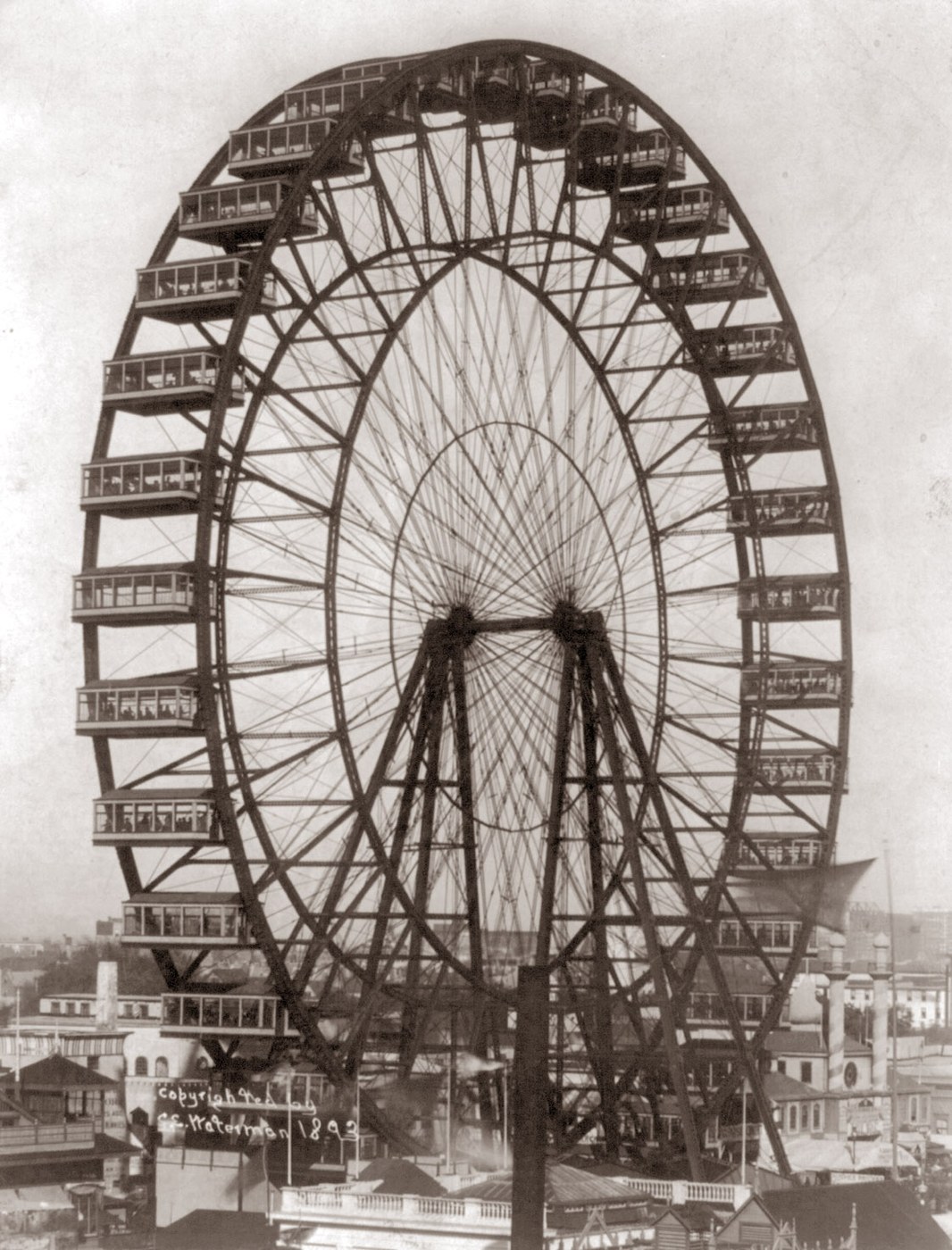


Ferris Wheel
Hướng dẫn
Prove a rigid-spoke wheel is the wrong idea
Prove a rigid-spoke wheel is the wrong idea
Build the obvious version first and find its limit.
- Make a small wheel with stiff wooden spokes into a hub.
- Load the rim and watch where it deflects.
- Note that the spokes below the hub are being squashed.
Vật liệu cho bước này:
 Bộ chốt gỗ thông1 bộ
 Ván ép bạch dương Baltic1 gói
Build it in tension instead
Build it in tension instead
Replace the spokes with something that can only pull.
- Rebuild the wheel using taut cord or wire from hub to rim.
- Tension every spoke evenly so the rim runs true.
- Load the rim again.
Vật liệu cho bước này:
 Dây bông1 cuộn
Hang the cars so they stay level
Hang the cars so they stay level
Passengers must remain upright through the whole revolution.
- Hang each car from a pivot at the rim rather than fixing it rigidly.
- Check it swings freely.
- Turn the wheel and watch the cars hold level by gravity alone.
Find where the load goes
Find where the load goes
Trace the path from a passenger to the ground.
- Load one car and feel which spokes tighten.
- Note the load runs: car → rim → upper spokes → axle → towers → foundations.
- Add cars all round and watch the tension even out.
History and context
History and context
The 1893 World's Columbian Exposition wanted a centrepiece to rival the Eiffel Tower of 1889. George Washington Gale Ferris Jr, a Pittsburgh engineer whose firm inspected steel for bridges, proposed the wheel. The Exposition's engineers were openly sceptical and he had to fund much of the early work and testing himself.
The numbers: about 250 feet — 76 metres — in diameter, 36 enclosed cars, each rated at 60 passengers, so more than 2,000 people at once. Two 140-foot towers carried the axle. It ran through the fair and carried well over a million passengers without incident.
It was not the first big wheel — pleasure wheels turned by hand are much older, some documented in seventeenth-century Bulgaria and Turkey. What was new was the scale, and specifically the tension-spoke structure that made the scale possible. That idea came from bridge engineering, which is what Ferris actually did for a living.
It ended badly for its inventor. Ferris fought the Exposition over his share of the receipts, his business suffered, and he died in 1896 aged 37, of typhoid, reportedly close to bankrupt. The wheel was moved, ran again at the 1904 St Louis fair, and was demolished with dynamite in 1906.
What this build shows and does not: the tension-spoke principle and the free-hanging car are both genuine and demonstrated here. A real wheel adds wind loading, thermal expansion of a 76-metre rim, and fatigue in every joint over millions of cycles — the things that decide whether a structure lasts, none of which appear at bench scale.
Vật liệu
3- 1 bộTạm thời
- Tạm thời
- 1 cuộnTạm thời
Blueprint liên quan
Các blueprint này chia sẻ kiến thức — kỹ thuật, vật liệu hoặc nguyên tắc

CC0 Phạm vi công cộng
Bản thiết kế này được phát hành theo CC0. Bạn tự do sao chép, sửa đổi, phân phối và sử dụng cho bất kỳ mục đích nào mà không cần xin phép.
Hỗ trợ nhà sáng tạo bằng cách mua sản phẩm qua bản thiết kế, nơi họ nhận Hoa hồng nhà sáng tạo do nhà bán hàng đặt, hoặc tạo phiên bản mới và kết nối trong bản thiết kế riêng để chia sẻ doanh thu.