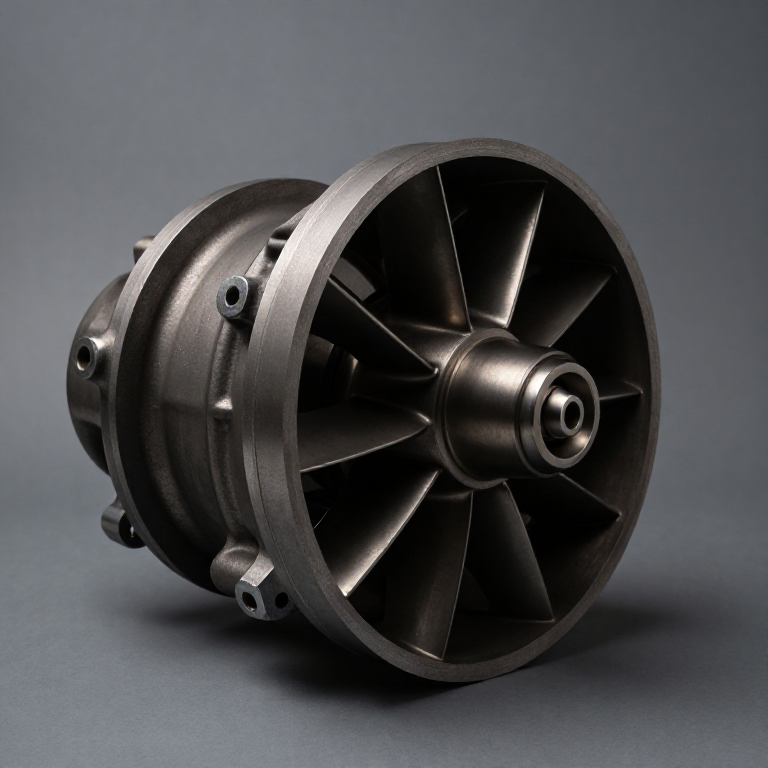


Torque Converter
A steam turbine wants to run at thousands of revolutions per minute. A ship's propeller wants to run at a few hundred. Gears can bridge that, but around 1900 a reduction gearbox big enough to take a ship's power was heavy, expensive and — with the tooth-cutting accuracy then available — noisy and short-lived.
Föttinger's answer was to stop using solid parts to carry the power at all. Put an impeller on the input shaft and a turbine on the output shaft, face them at each other inside a casing full of oil, and let the fluid do the work. The impeller flings oil outward; the oil strikes the turbine blades and drives them; the oil returns and is flung again. Nothing solid connects the two shafts.
That gives two properties no gearbox has. The drive is infinitely variable — output speed is whatever the load allows, with no steps. And the input can turn while the output is completely stationary, indefinitely, without anything slipping or burning, because there is nothing in contact to wear.
Adding a third element, a fixed stator that redirects the returning oil, turns a fluid coupling into a true converter that multiplies torque — output torque higher than input torque, at the cost of speed. That is the part that made automatic transmissions possible.
Hermann Föttinger, working at the Stettiner Vulkan shipyard, was granted patents on 24 June 1905 for a hydraulic transmission with driving and driven turbine wheels — cited as DE 221422 and DE 238804. ⚠ Those numbers come from secondary sources; we have not confirmed them against the German patent documents themselves.
Hướng dẫn
Build two facing impellers
Build two facing impellers
Take two shallow bowls and fit radial vanes inside each — straight blades running from centre to rim, 8 to 12 of them. Card, thin ply or 3D-printed vanes all work.
Mount them on separate shafts, facing each other about 10 mm apart, inside a container.
These are the impeller and the turbine. Note what you have not built: any connection between the two shafts.
Vật liệu cho bước này:
 Trục thép 30 mm2 cái
 Vòng bi4 cái
Công cụ cần thiết:
 Ê tô bàn nguội
Run it dry first
Run it dry first
Spin the input shaft with the container empty.
The output does not move. Air carries almost no momentum, so almost no torque crosses the gap.
Do this before filling it. It proves the shafts are genuinely independent, so that whatever happens next is the fluid's doing and not friction in a bearing.
Fill it and watch the drive appear
Fill it and watch the drive appear
Fill until both vane sets are submerged. Water shows the effect clearly; oil is what a real unit uses, because it does not corrode the parts and it carries away heat.
Spin the input again. The output now turns. Nothing was connected — the only change is a fluid.
Vật liệu cho bước này:
 Nước cất1000 ml
Measure the slip
Measure the slip
Count input and output revolutions over 10 seconds. Compute slip = (input − output) / input × 100%.
Expect substantial slip unloaded and more as you load the output with a finger.
Slip is not a defect here, it is the mechanism. Fluid drive only transmits torque when there is a speed difference to move oil across the gap — at zero slip there is no circulation and no drive. A real coupling runs at 2–4% slip, which is also exactly why it can never be 100% efficient.
Stall it — the test a clutch would fail
Stall it — the test a clutch would fail
Hold the output shaft completely still and keep the input spinning for a minute.
Nothing grinds, nothing burns, nothing wears. Feel the water: it is warmer. The power going in is turning into heat, and nothing else.
Do the same to a friction clutch and you destroy it. This is why an automatic car can sit in gear at a red light with the engine running — the converter is stalled, and stalling is a normal operating state rather than a failure.
History & Context
History & Context
The patent. Granted 24 June 1905 to Hermann Föttinger for a hydraulic transmission using one or more driving and one or more driven turbine wheels to transfer power between adjacent shafts. Commonly cited as DE 221422 and DE 238804. ⚠ Those numbers are from secondary sources and we have not verified them against the documents; the date and the substance are well attested, the numbers are not confirmed here.
It was a shipyard problem, not a car problem. Föttinger worked for Stettiner Vulkan. The steam turbine had just made marine propulsion far more efficient and utterly unsuited to driving a propeller directly. His device let a fast turbine drive a slow screw with no gear teeth at all.
Coupling versus converter — a real distinction. Two elements give a fluid coupling: it transmits torque unchanged, minus slip. Add a stationary stator between turbine outlet and impeller inlet and the returning oil is redirected to help the impeller instead of fighting it. Now output torque can exceed input torque, typically 2–2.5× at stall. Only the three-element version is properly a torque converter, and the two terms are used interchangeably far more often than they should be.
Where it went. Marine drives, then diesel locomotives, then — decisively — the automatic gearbox. Chrysler's Fluid Drive and GM's Hydra-Matic put Föttinger's shipyard solution under millions of cars. The modern refinement is the lock-up clutch: once cruising, a clutch bolts input to output directly and takes the fluid out of the loop, because the 2–4% slip that makes the device work is pure waste once you no longer need it.
Công cụ yêu cầu
1- Tạm thời
Vật liệu bản thiết kế liên kết

CC0 Phạm vi công cộng
Bản thiết kế này được phát hành theo CC0. Bạn tự do sao chép, sửa đổi, phân phối và sử dụng cho bất kỳ mục đích nào mà không cần xin phép.
Hỗ trợ nhà sáng tạo bằng cách mua sản phẩm qua bản thiết kế, nơi họ nhận Hoa hồng nhà sáng tạo do nhà bán hàng đặt, hoặc tạo phiên bản mới và kết nối trong bản thiết kế riêng để chia sẻ doanh thu.