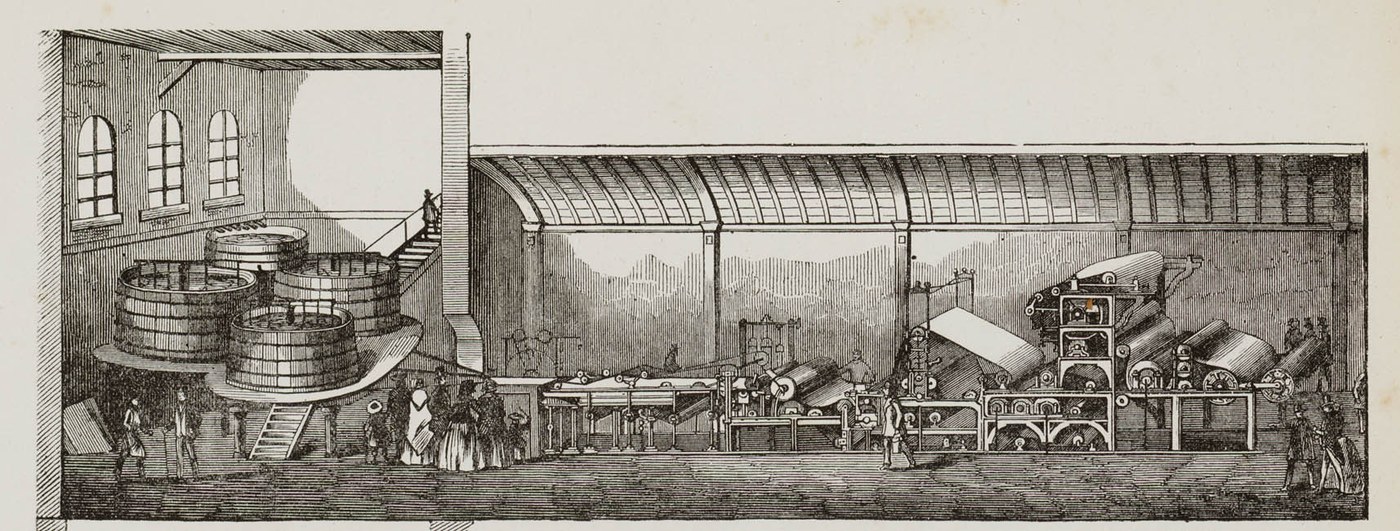


Fourdrinier Paper Machine
Hướng dẫn
Prepare the stock
Prepare the stock
Paper stock is mostly water. Getting the dilution right is the whole difference between a sheet and a lump.
- Tear paper or plant fibre into small pieces and soak until soft.
- Blend to a pulp, then dilute to roughly 1 part pulp to 100 parts water by volume.
- Stir immediately before use — fibre settles within seconds.
Vật liệu cho bước này:
 Giấy lọc1 gói
 Cốc thuỷ tinh borosilicat2 cái
Build the moving wire
Build the moving wire
The defining part is an endless screen that travels. Build the shortest possible version: a sloped fixed screen the slurry runs down.
- Stretch fine mesh over a frame and set it at a shallow slope, roughly 10-15 degrees.
- Support it so it does not sag — a sag makes a thick streak.
- Place a tray underneath to catch the drained water, which is called the white water.
Vật liệu cho bước này:
 Thước kẻ1 cái
Form the web
Form the web
Pour along the full width of the top of the screen, steadily, without stopping.
- Pour at a constant rate — variation in pour rate shows up directly as variation in thickness.
- Let the water drain through; the fibres mat together as it goes.
- Keep pouring to extend the sheet down the slope. This is the web.
Couch and press
Couch and press
The web leaves the wire far too wet to handle. Water comes out mechanically before any heat is applied.
- Lay felt or blotting cloth over the web and press firmly.
- Lift the web away on the felt.
- Press again between dry cloths to drive out more water.
Dry and measure
Dry and measure
Dry flat, then measure what you made.
- Dry against a smooth surface or between weighted boards to stop cockling.
- Cut a known area — 100 mm x 100 mm is convenient.
- Weigh it and calculate grammage: g/m² = mass in grams x 100 for a 100 x 100 mm square.
Vật liệu cho bước này:
 Cân nhà bếp điện tử1 cái
History and context
History and context
Nicolas-Louis Robert, a clerk at the Essonnes paper mill near Paris, patented a continuous paper machine in France in 1799. He could not raise money to develop it. The patent reached London through Robert's associate John Gamble, and the stationers Henry and Sealy Fourdrinier funded the work; the engineer Bryan Donkin turned the idea into a machine that ran reliably, with improved versions from 1803 onwards.
The name is an accident of finance. The machine is called a Fourdrinier after the men who paid for it, not the man who invented it or the engineer who built it. The Fourdriniers spent so much that they went bankrupt in 1810, and Robert died in poverty in 1828. Parliament later voted the brothers a partial compensation.
What it changed: paper stopped being sold by the sheet and started being sold by the roll. Cheap continuous paper is the precondition for the mass-circulation newspaper, and later for cheap books. It also created a fibre shortage that hand papermaking never had — rags could not keep up, which is what drove the search for wood pulp later in the century.
What this build does not reproduce: the continuity. A real machine's wire is an endless loop, and modern ones run at over 100 km/h with a web ten metres wide. The drainage, matting, pressing and drying are the same physics; the speed and the loop are not something a bench can imitate.
Blueprint liên quan
Các blueprint này chia sẻ kiến thức — kỹ thuật, vật liệu hoặc nguyên tắc




CC0 Phạm vi công cộng
Bản thiết kế này được phát hành theo CC0. Bạn tự do sao chép, sửa đổi, phân phối và sử dụng cho bất kỳ mục đích nào mà không cần xin phép.
Hỗ trợ nhà sáng tạo bằng cách mua sản phẩm qua bản thiết kế, nơi họ nhận Hoa hồng nhà sáng tạo do nhà bán hàng đặt, hoặc tạo phiên bản mới và kết nối trong bản thiết kế riêng để chia sẻ doanh thu.