

Genaille-Lucas Rulers
Hướng dẫn
Understand what problem the arrows solve
Understand what problem the arrows solve
Start by feeling the cost you are about to remove.
- Multiply a three-digit number by 7 using Napier's Bones.
- Note every place you had to ADD two digits and carry.
- Time it, and count the additions.
Vật liệu cho bước này:
 Giấy kẻ ô ly1 pad
 Đồng hồ bấm giờ1 cái
Draw the rulers
Draw the rulers
Each ruler is one digit; each row within it is one multiplier.
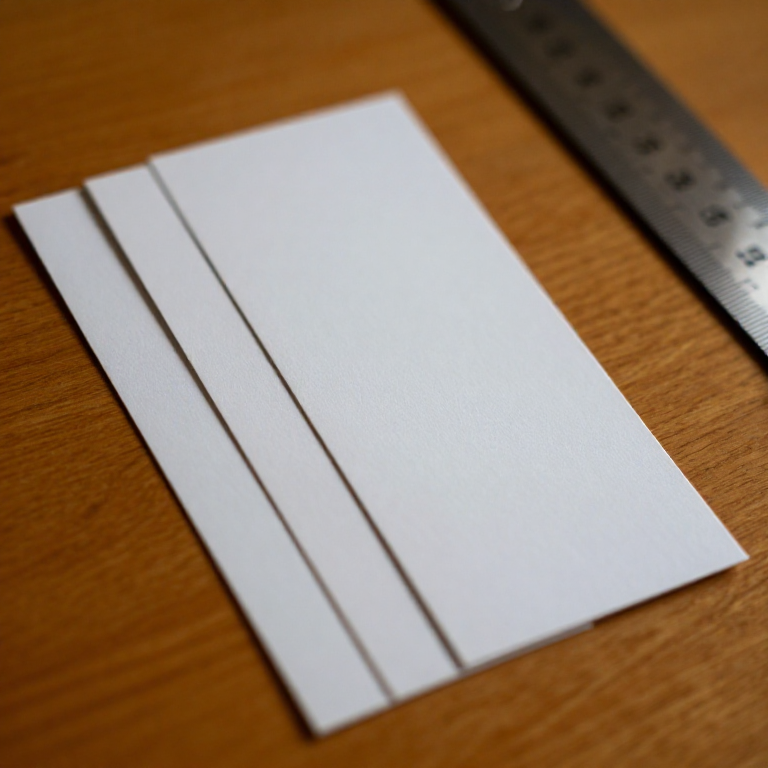
- Cut ten card strips and divide each into nine rows.
- In row n of ruler d, the cell contains the digits of n×d arranged in a column, largest at the bottom.
- Draw an arrow from each digit pointing LEFT to the digit it leads to on the next ruler — the position depends on the carry that digit produces.
- Make an index ruler numbered 1 to 9 for the rows.
Vật liệu cho bước này:
 Giấy bìa1 gói
 Thước kẻ1 cái
Read a product straight off
Read a product straight off
No arithmetic at all — only following arrows.
- Lay out the rulers spelling your multiplicand, index ruler on the left.
- Go to the row of your multiplier.
- Start at the TOP digit of the rightmost ruler and write it down.
- Follow its arrow to a digit on the next ruler left, write that down, and continue.
- Stop at the index ruler. Reading right to left, you have the product.
Measure the trade
Measure the trade
Nothing is free — find out what this cost.
- Time ten multiplications on Genaille-Lucas rulers, then ten on Napier's Bones.
- Count the errors in each set.
- Now count how long each SET of rods took to make, and compare their sizes.
Vật liệu cho bước này:
Đồng hồ bấm giờ1 cáiHistory and context
History and context
Henri Genaille, a French railway engineer, presented the rulers in 1885. They answered a problem posed by Édouard Lucas — the mathematician remembered for the Lucas numbers and for the Tower of Hanoi puzzle — at a meeting of the French Association for the Advancement of Science, and the pair are named for both men. Genaille went on to design a matching set of rulers for DIVISION on the same principle.
What they demonstrate: arithmetic can be replaced by a printed decision made in advance. The carry is not calculated by the user because the manufacturer already calculated every carry that could occur and drew it as an arrow. That idea — precompute all possible cases and encode them in the artefact — reappears in lookup tables, in printed navigation tables, and in every ROM that stores answers instead of computing them.
Where they sit in this catalogue: Napier's logarithms convert multiplication into addition via a table; Napier's Bones carry the times table as objects and leave you the adding; Genaille-Lucas removes the adding too. Three approaches to one goal, and the sequence shows the cost migrating steadily from the user into the equipment. The slide rule takes the other branch entirely — continuous scales, instant answers, but only three or four significant figures, while these rulers are exact.
Why they vanished anyway: mechanical calculators were already arriving, and by the 1890s a machine could do the whole multiplication. The rulers were the most refined form of a technology that was about to be replaced — which does not make them wrong, only late.
Blueprint liên quan
Các blueprint này chia sẻ kiến thức — kỹ thuật, vật liệu hoặc nguyên tắc

CC0 Phạm vi công cộng
Bản thiết kế này được phát hành theo CC0. Bạn tự do sao chép, sửa đổi, phân phối và sử dụng cho bất kỳ mục đích nào mà không cần xin phép.
Hỗ trợ nhà sáng tạo bằng cách mua sản phẩm qua bản thiết kế, nơi họ nhận Hoa hồng nhà sáng tạo do nhà bán hàng đặt, hoặc tạo phiên bản mới và kết nối trong bản thiết kế riêng để chia sẻ doanh thu.