

Shopping Cart
A self-service shop has one hard limit: how much a customer can carry. A hand basket holds maybe eight kilograms before it hurts, and the moment it hurts the customer stops shopping and goes to the till. The shop's takings are capped by the strength of an arm.
Put the basket on wheels and the limit moves. Goldman's carriage carries two baskets on a wheeled frame, so the load rests on the floor instead of on the shopper — and the trip ends when the list ends, not when the arm gives out.
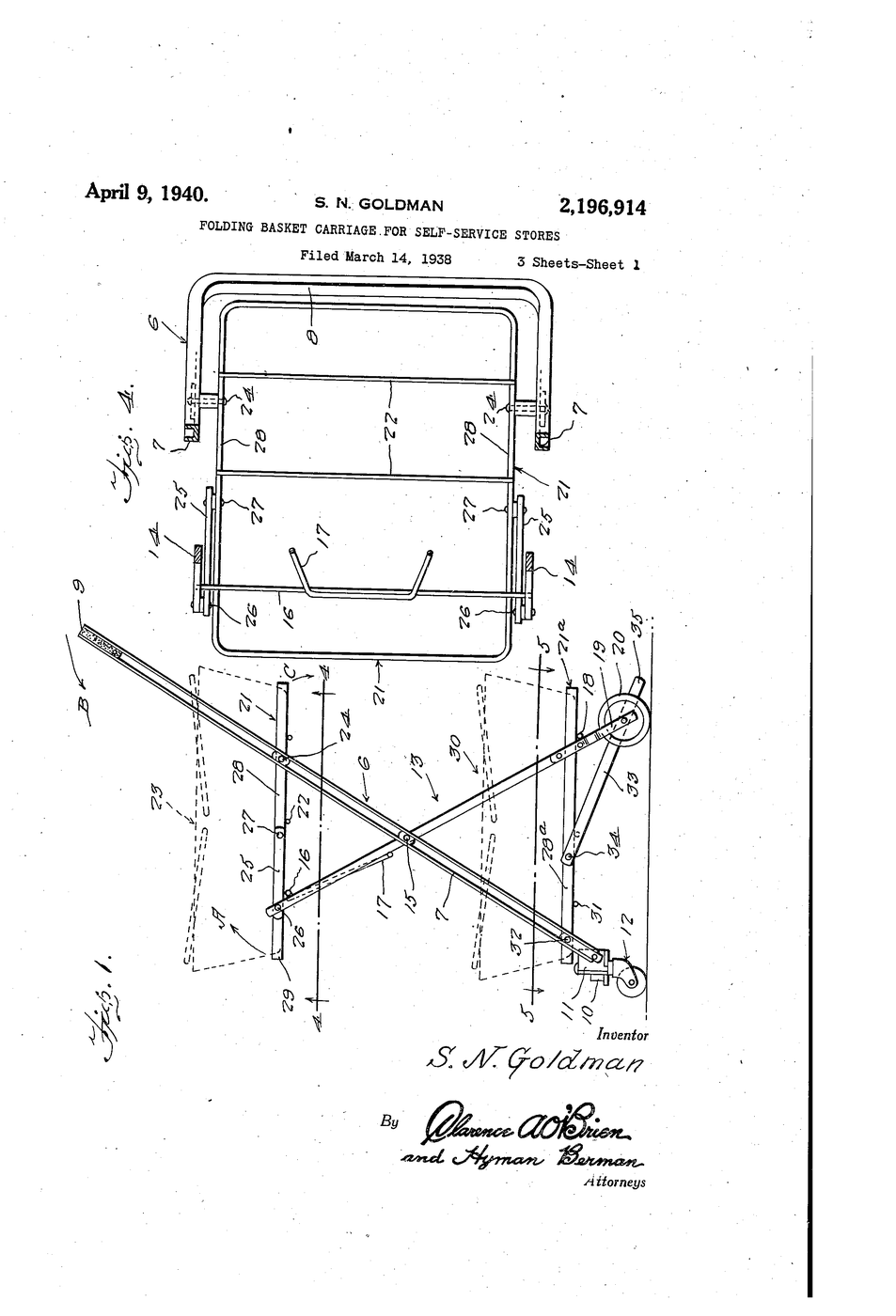
The real design problem is the empty ones. A hundred carts standing about would fill the shop they were meant to serve. Goldman's frame is a scissor: two pivoted leg frames that fold flat through a toggle joint, locking rigid when open and collapsing to almost nothing when not.
US Patent 2,196,914, "Folding basket carriage for self-service stores", filed 14 March 1938 and granted 9 April 1940 to Sylvan N. Goldman. Note the word folding — this cart does not nest.
Hướng dẫn
Read US 2,196,914 and find the toggle
Read US 2,196,914 and find the toggle
Goldman claims "a pair of complemental intersecting pivotally adjoined wheel supported leg frames" plus a toggle joint. The toggle is what makes it rigid when open and willing to collapse when asked.
Carry a hand basket until you want to stop
Carry a hand basket until you want to stop
Load a basket and walk with it, adding weight until you would rather put it down. Record the mass. That number was the ceiling on a shop's basket size.
Make two identical leg frames
Make two identical leg frames
Bend two rectangular frames from steel rod, the same size. They will cross like scissor blades, so they must match or the cart will rack.
Vật liệu cho bước này:
 Thanh thép mềm2 cái
Công cụ cần thiết:
 Kìm mỏ dẹt
Pivot them where they intersect
Pivot them where they intersect
Join the two frames with a pivot at the crossing point so they scissor freely. Check they swing through the full range without binding.
Fit swivel casters at the front
Fit swivel casters at the front
Put swivelling casters on the front legs. Swivel at the front is what lets a loaded cart be steered from behind with one hand.
Vật liệu cho bước này:
 Vòng bi4 cái
Fit fixed rollers at the back
Fit fixed rollers at the back
Give the rear legs fixed wheels. Fixed rear wheels hold a straight line; four swivels would make the cart wander uncontrollably.
Push it with all four swivelling and see why
Push it with all four swivelling and see why
Temporarily free the rear wheels to swivel and push. It crabs sideways and refuses to track. Restore them before continuing.
Add the upper and lower basket racks
Add the upper and lower basket racks
Fit two horizontal racks between the frames, one high and one low. Goldman carries two separate baskets, not one deep bin.
Link the frames with a toggle
Link the frames with a toggle
Connect the frames with two short links pivoted end to end. Straighten them past centre and the frame locks; break them and it folds.
Load it and try to collapse it
Load it and try to collapse it
Put the step 2 load in and push down. With the toggle over centre it will not fold. A locking joint that needs no catch — the geometry does the holding.
Unload and fold it flat
Unload and fold it flat
Empty it, break the toggle and press the legs together. Measure the folded thickness against the open footprint.
Fold three and stack them
Fold three and stack them
Build or simulate three and stack them folded. Work out how many fit where one open cart stood — that ratio is the whole storage argument.
Push a loaded cart one-handed round a corner
Push a loaded cart one-handed round a corner
Steer it loaded at walking pace. Note that you steer by pushing the back and letting the front casters follow — a cart is aimed, not turned.
Time the fold-and-unfold cycle
Time the fold-and-unfold cycle
Time how long it takes a person to open a folded cart and load a basket into it. Anything over a few seconds is a queue at the shop door.
History & Context — folding, not nesting
History & Context — folding, not nesting
The patent. US 2,196,914, "Folding basket carriage for self-service stores", filed 14 March 1938 and granted 9 April 1940 to Sylvan N. Goldman, who owned the Humpty Dumpty grocery chain in Oklahoma City. He was not a manufacturer solving an engineering problem; he was a shopkeeper who wanted his customers to buy more, and he built the machine that let them.
🔴 This is a FOLDING cart, and the cart you actually push is a NESTING one. Goldman's collapses flat like a scissor chair; the baskets lift out and the frame folds, and staff have to assemble it for each customer. The familiar cart — one you shove into the one in front, with a hinged rear flap that swings up as the trolleys telescope together — is a later and different invention, generally credited to Orla Watson in the mid-1940s. Nesting is better in every operational way: no assembly, no folding, a whole rank stored in a few metres, and one basket instead of two. Describing Goldman's patent as the modern shopping trolley is a small but real error, and step 11 versus step 12 shows the difference clearly.
The famous part is that nobody wanted it. Goldman introduced the carts in 1937 and customers ignored them. Men reportedly felt the cart implied they were not strong enough to carry a basket; women disliked its resemblance to a pram. His response has become a standard business-school story and appears to be true: he hired models of various ages to push carts around the store looking perfectly comfortable, and stationed greeters at the door to offer one to each arriving shopper. Adoption followed. The engineering was finished long before the objection was.
Why the wheel arrangement is not arbitrary. Step 7 is worth doing. Four swivelling casters give a trolley that can move in any direction and therefore holds no direction — fine for a hospital bed being positioned, useless for something pushed a kilometre round a shop. Fixed rear wheels supply a heading and the front casters supply steering, exactly as on a wheelbarrow or a supermarket trolley today. The familiar complaint about the one wobbly wheel is a symptom of the same design: a caster is only stable while it trails, and a damaged one fights the heading the fixed wheels are trying to hold.
What it did to shops. The cart is one of the clearest cases of a piece of hardware reshaping a building around itself. Bigger loads justified bigger stores, wider aisles to pass two carts, larger pack sizes, car parks for the loads people could now buy, and checkouts designed to unload a trolley rather than a basket. The supermarket as a building type is downstream of a device for not having to carry things.
Công cụ yêu cầu
1- Tạm thời
CC0 Phạm vi công cộng
Bản thiết kế này được phát hành theo CC0. Bạn tự do sao chép, sửa đổi, phân phối và sử dụng cho bất kỳ mục đích nào mà không cần xin phép.
Hỗ trợ nhà sáng tạo bằng cách mua sản phẩm qua bản thiết kế, nơi họ nhận Hoa hồng nhà sáng tạo do nhà bán hàng đặt, hoặc tạo phiên bản mới và kết nối trong bản thiết kế riêng để chia sẻ doanh thu.