NGHỆ THUẬT
LÀM ĐẸP VÀ SỨC KHỎE
THỦ CÔNG
VĂN HÓA VÀ LỊCH SỬ
GIẢI TRÍ
MÔI TRƯỜNG
THỰC PHẨM VÀ ĐỒ UỐNG
KỸ THUẬT NGƯỢC
KHOA HỌC
THỂ THAO
CÔNG NGHỆ
THIẾT BỊ ĐEO
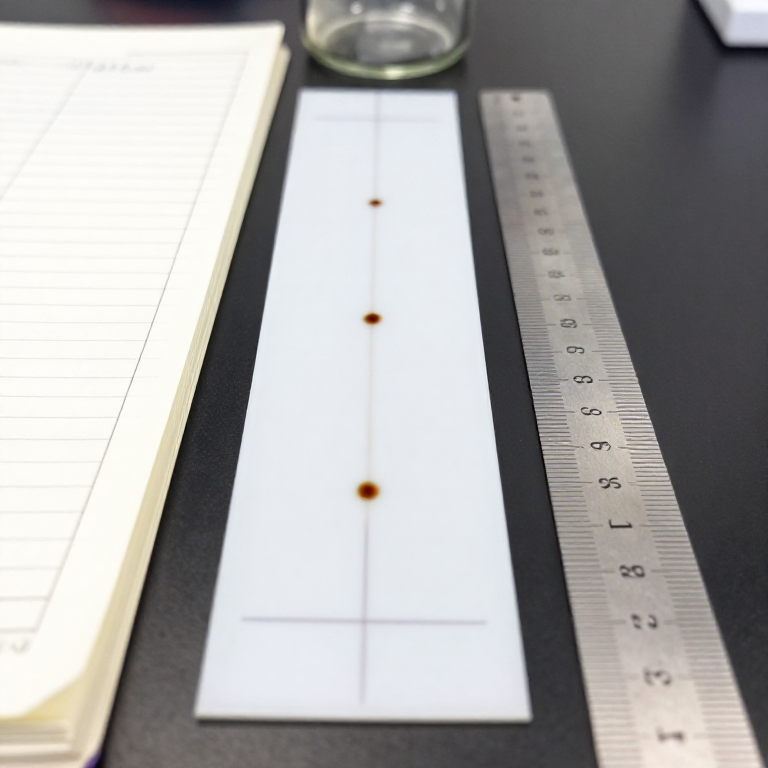


Identifying an Unknown Substance: Building a Reference Library
Seven rungs of this batch pull mixtures apart. None of them tells you what the pieces ARE — and that gap is where most home analysis quietly fails, because a beautiful separation with nothing to compare it against is a picture, not an answer.
An Rf value is not a property of a compound. It is a property of a compound IN a named solvent ON a named stationary phase AT a temperature, and quoting one without those is like quoting a distance without a unit. Which means a number from a textbook usually will not match yours, and that is not a mistake — it is the method working as designed.
So you build your own library. Run knowns on your own plates, in your own solvents, and record them properly. This rung is the least glamorous in the batch and the one that turns the other seven from demonstrations into an instrument you can actually answer a question with.
Trung cấp
2 days
Hướng dẫn
1
1
Fix a system and write it down before you run anything
Fix a system and write it down before you run anything
Decide one stationary phase and two solvent systems, record their exact composition by volume, and do not change them casually. Give each combination a short name you will use every time.
Every Rf you ever record belongs to a system, not to a compound. Change the solvent ratio from 8:2 to 7:3 and every number in your library is void. Writing the system down first — before the first run, in ink, at the front of the book — is what stops a library quietly becoming a list of unrelated numbers over six months.
2
2
Run knowns, three times each
Run knowns, three times each
Take substances you are certain of and run each one three times on separate plates. Record all three Rf values, not the average.
The spread between those three IS your measurement uncertainty, and you cannot identify anything without it. If your triplicates sit within 0.02 of each other you can distinguish compounds 0.05 apart; if they scatter by 0.08 you cannot distinguish anything at all and must fix your technique before the library is worth building. Averaging three runs into one number throws away exactly the information that makes the library usable.
Vật liệu cho bước này:
 Giấy sắc ký20 cái
 Etanol phẩm cấp thí nghiệm, 95 %200 ml
 Axit axetic (băng)20 ml
Công cụ cần thiết:
 Ống mao dẫn thủy tinh
 Lọ thuỷ tinh
 Thước kẻ
3
3
Record the temperature and the humidity too
Record the temperature and the humidity too
Note the room temperature at every run, and whether the day is damp.
Silica activity falls as it takes up atmospheric water, so the same compound in the same solvent runs measurably further on a wet week than a dry one. A library entry carrying its temperature can be compared; one without it turns into a puzzle the first time a result disagrees, and you will have no way to tell whether the substance or the weather was different.
Công cụ cần thiết:
 Nhiệt kế
4
4
Always co-spot — never identify on a matching number alone
Always co-spot — never identify on a matching number alone
For every candidate identification, run three lanes: unknown, reference, and a spot of the two mixed.
Matching Rf values are weak evidence, because plenty of unrelated compounds share an Rf in any one solvent — that is exactly the limitation the two-dimensional rung existed to fix. The mixed lane is the strong test: if they are the same substance, the co-spot is a single round spot. Any elongation, shoulder or doubling means two substances that merely travel alike, and the identification is wrong.
Công cụ cần thiết:
Ống mao dẫn thủy tinhLọ thuỷ tinh5
5
Confirm in a second, unrelated system
Confirm in a second, unrelated system
Repeat the match in your second solvent system, chosen to separate by a different property from the first.
A coincidence in one solvent is common; the same coincidence in two chemically unrelated solvents is rare. This is the cheapest real increase in confidence available to you, and it is the standard every published identification by chromatography alone has to meet. Two agreeing systems plus a clean co-spot is about as far as this technique can take you on its own.
Công cụ cần thiết:
Lọ thuỷ tinhThước kẻ Cồn isopropyl 99 %
6
6
How much confidence a match actually gives you
How much confidence a match actually gives you
Đang tải sổ tay Jupyter…
7
7
Keep the library in a form someone else can use
Keep the library in a form someone else can use
One row per compound per system: compound, stationary phase, solvent and exact ratio, temperature, the three Rf values, the visualisation used, and the date.
Anything less and the entry becomes unusable the moment you cannot remember the run. Record the visualisation in particular — an iodine-stained spot and a charred spot are not always in the same place, because iodine finds things charring destroys and vice versa. A library that another maker can pick up and extend is worth many times one that only you can read.
8
8
Report what you found, including what you ruled out
Report what you found, including what you ruled out
Write the result as a claim with its evidence: the systems, the co-spot outcome, and the candidates you tested and eliminated.
'Consistent with caffeine in two systems, co-spot single, not matching theophylline or theobromine' is a useful statement a stranger can check. 'It's caffeine' is not. The eliminations carry most of the weight, because they are what turn a match into the ONLY match you could find — and they are the part almost everyone leaves out of the notebook.
Vật liệu
3- 20 cáiTạm thời
- Tạm thời
- 20 mlTạm thời
Blueprint liên quan
Các blueprint này chia sẻ kiến thức — kỹ thuật, vật liệu hoặc nguyên tắc





CC0 Phạm vi công cộng
Bản thiết kế này được phát hành theo CC0. Bạn tự do sao chép, sửa đổi, phân phối và sử dụng cho bất kỳ mục đích nào mà không cần xin phép.
Hỗ trợ nhà sáng tạo bằng cách mua sản phẩm qua bản thiết kế, nơi họ nhận Hoa hồng nhà sáng tạo do nhà bán hàng đặt, hoặc tạo phiên bản mới và kết nối trong bản thiết kế riêng để chia sẻ doanh thu.