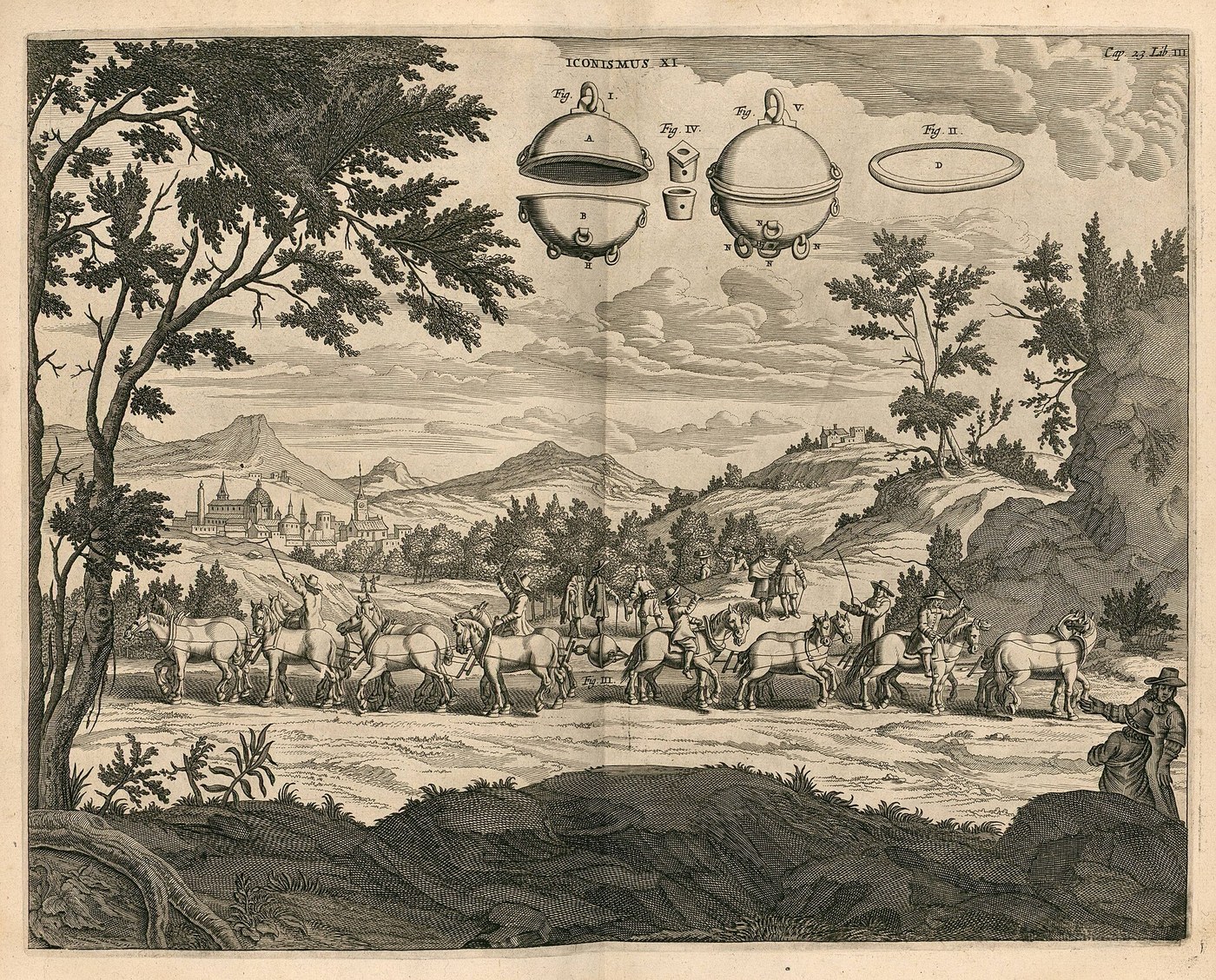


Magdeburg Hemispheres
Nothing holds the two halves together. There is no catch, no thread, no glue — just two polished rims greased and pressed face to face, with the air pumped out from between them. Thirty horses could not pull them apart, and one turn of a tap let them fall open in a child's hands.
What the horses were fighting was not suction. Nothing inside is pulling. The atmosphere outside is pushing, at about 100 kilonewtons per square metre, and with no air inside to push back there is nothing to balance it. Guericke's demonstration made an invisible ocean of air suddenly, violently obvious.
This blueprint builds a working pair at bench scale and measures the force — which turns a party trick into an experiment.
Hướng dẫn
Use metal or thick plastic, never glass
Use metal or thick plastic, never glass
An evacuated vessel implodes if it fails. Use spun metal bowls or thick rigid plastic domes, and keep faces clear while pulling vacuum.
Find two matching hemispheres
Find two matching hemispheres
Use two identical metal mixing bowls or spun domes, 150-200 mm across. They must be the same diameter and truly round at the rim.
Vật liệu cho bước này:
 Tấm thép mềm1 tờ
Flatten and true both rims
Flatten and true both rims
Rub each rim on abrasive paper laid on a flat surface until it is dead flat. A gap of a fraction of a millimetre anywhere means no vacuum at all.
Check the seal by looking through it
Check the seal by looking through it
Hold the two rims together against a light. If light shows anywhere, keep lapping. Do not trust the grease to fill a visible gap.
Fit a valve to one hemisphere
Fit a valve to one hemisphere
Drill and seal a tyre valve or tap into one dome. Seal it thoroughly — the fitting is the most likely leak on the whole assembly.
Vật liệu cho bước này:
 Phụ kiện đồng thau1 cái
Fit a pulling ring to each hemisphere
Fit a pulling ring to each hemisphere
Attach a strong ring or handle to each dome, on the axis. Off-axis handles peel the halves apart at one edge instead of testing the seal.
Grease the rims
Grease the rims
Smear a thin film of heavy grease on both rims. Guericke used a leather gasket soaked in oil and wax; grease alone is enough at this scale.
Vật liệu cho bước này:
 Sáp ong dạng hạt20 g
Press the halves together and evacuate
Press the halves together and evacuate
Hold them mated and pump the air out with a hand vacuum pump. You will feel them lock together well before the pump stops moving.
Close the valve and set the pump aside
Close the valve and set the pump aside
Shut the valve before disconnecting. Nothing is holding the halves but the pressure difference you just created.
Try to pull them apart by hand
Try to pull them apart by hand
Two people, one ring each, straight pull. At 150 mm diameter expect several hundred newtons — considerably more than most people can manage.
Measure the force with a spring balance
Measure the force with a spring balance
Hook a spring balance to one ring, anchor the other, and pull steadily until they separate. Record the reading at the moment they part.
Calculate the force you expected
Calculate the force you expected
Force = pressure difference × the area of the circle at the rim, πr² — not the surface area of the spheres. The projected disc is what counts, and that surprises almost everyone.
Compare measured against predicted
Compare measured against predicted
Your measured force will be lower, because a hand pump leaves a good fraction of an atmosphere inside. Work backwards to find the vacuum you actually achieved.
Open the valve and let them fall apart
Open the valve and let them fall apart
Crack the valve. Air rushes in, the difference vanishes and the halves separate with no effort. That contrast is the entire demonstration.
Compendium — the horses were pulling against the sky
Compendium — the horses were pulling against the sky
What actually happened, and where. Otto von Guericke, mayor of Magdeburg and inventor of the first practical air pump, performed the famous demonstration on 8 May 1654 at Regensburg, before the Reichstag and Emperor Ferdinand III, using thirty horses in two teams of fifteen. He repeated it at Magdeburg in 1656 with sixteen horses. The device is named for his city, not for the place of the celebrated experiment — nearly every retelling merges the two events into one.
Push, not pull. The persistent misconception is that a vacuum sucks. It cannot: a vacuum is an absence and absences exert no force. Every atom of air outside is bouncing off the hemispheres and pushing inward at roughly 101 kPa. Normally an equal crowd of atoms inside pushes back and the two cancel. Remove the inside crowd and the outside push stands unopposed. The horses were not fighting the vacuum; they were fighting the atmosphere.
Why the projected area, not the surface area. Pressure acts perpendicular to every point of a curved surface, so the sideways components all cancel around the ring and only the components along the axis survive. Summing them gives exactly the pressure times the area of the flat circle the rim encloses. A bigger sphere of the same rim diameter would not help at all — a genuinely counter-intuitive result that this experiment lets you verify with a spring balance.
Why it mattered so much. Aristotelian physics held that a vacuum was impossible — nature abhors it. Torricelli's barometer of 1643 had already produced one above the mercury, and Guericke's pump made vacuum something you could manufacture at will and put on public trial. Boyle, hearing of Guericke's work, had his own pump built with Hooke, and the experiments that followed produced Boyle's law. Guericke also showed that a bell in vacuum makes no sound and a candle goes out — the air was not nothing, and proving it took horses.
Vật liệu
3- 1 tờTạm thời
- 1 cáiTạm thời
- 20 gTạm thời
Vật liệu bản thiết kế liên kết


Blueprint liên quan
Các blueprint này chia sẻ kiến thức — kỹ thuật, vật liệu hoặc nguyên tắc
CC0 Phạm vi công cộng
Bản thiết kế này được phát hành theo CC0. Bạn tự do sao chép, sửa đổi, phân phối và sử dụng cho bất kỳ mục đích nào mà không cần xin phép.
Hỗ trợ nhà sáng tạo bằng cách mua sản phẩm qua bản thiết kế, nơi họ nhận Hoa hồng nhà sáng tạo do nhà bán hàng đặt, hoặc tạo phiên bản mới và kết nối trong bản thiết kế riêng để chia sẻ doanh thu.