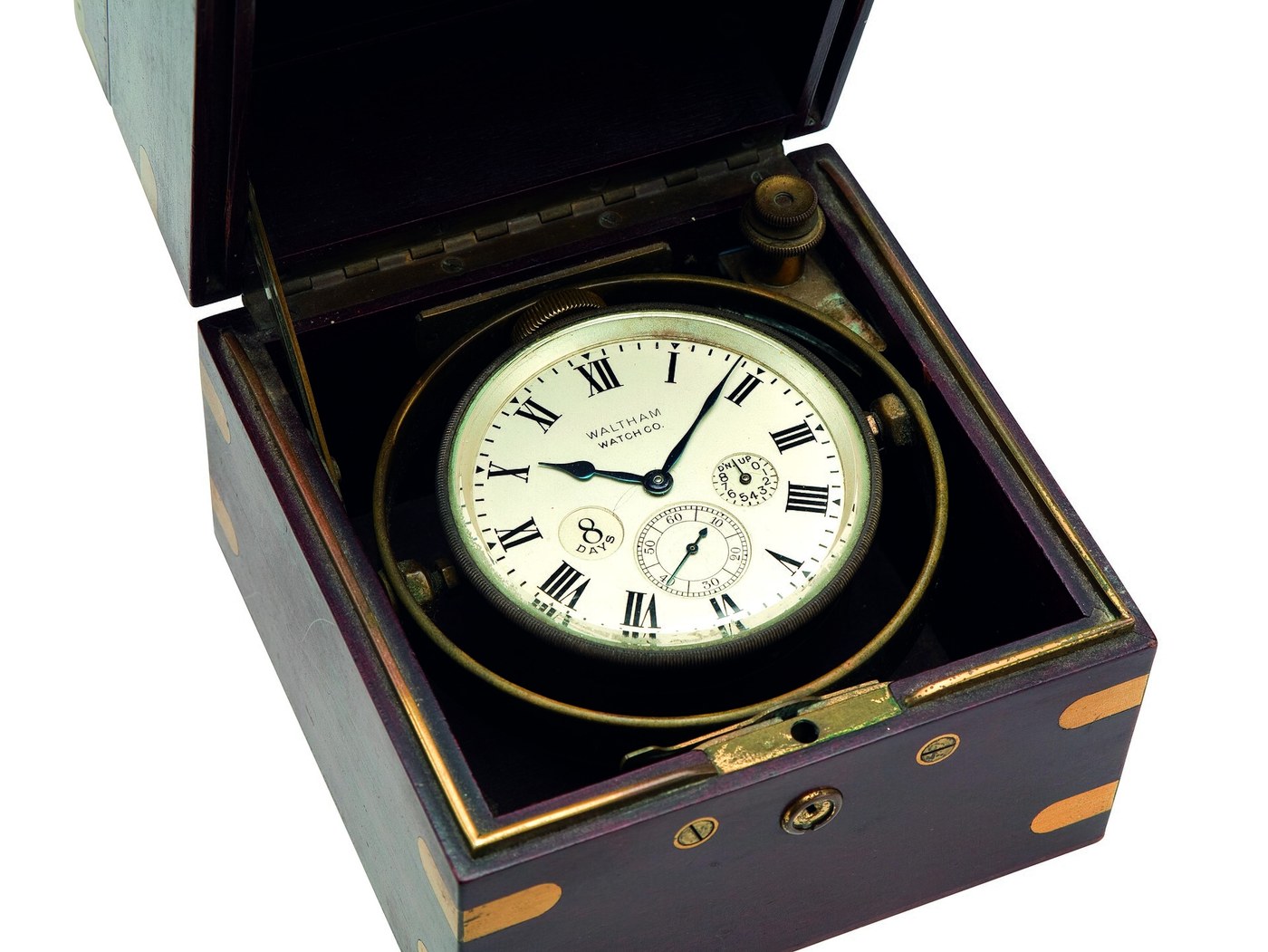


The Marine Chronometer
Latitude is easy: measure the sun's height at noon, or Polaris at night, and read it off. Ships had done it for centuries.
Longitude is a different kind of problem, because the Earth has no east-west landmarks — it just turns. Nothing in the sky tells you how far round you are unless you know what time it is somewhere else.
And that is the whole of it. The Earth rotates 360° in 24 hours, so 15° of longitude per hour. Find local noon by the sun, compare it with the time at a reference place, and the difference gives your longitude directly. One hour late means 15° west.
So longitude is not an astronomy problem. It is a clock problem — and a brutal one. At the equator, 1° is about 111 km, so four minutes of clock error puts you 111 km out. To find your position within about half a degree after a six-week Atlantic crossing, a clock must keep time to roughly three seconds a day — on a rolling, pitching, salt-soaked deck, through the temperature range from the Channel to the tropics, for weeks, without being reset.
Every previous blueprint in this batch removed one error that stood in the way. Put them together and you get a navigational instrument.
Hướng dẫn
Turn a time difference into a position
Turn a time difference into a position
Find local noon where you are — the moment a vertical stick's shadow is shortest — and note the time on a clock still set to a distant reference.
Compute longitude: 15° per hour of difference, west if your local noon is later.
Compare with your true longitude from a map.
Then work the error backwards: how many seconds of clock error would have put you 1 km out? Expect a startlingly small number.
Write it down as the specification. Everything else in this blueprint is a consequence of that figure.
Công cụ cần thiết:
 Thước dây cuộn
 Que gnomonThước dây cuộn
Kill the pendulum idea properly
Kill the pendulum idea properly
Run a pendulum clock on a board and rock, tilt and swing the board as a deck would.
Expect the rate to change immediately, and the clock to stop if you tilt far enough.
Now do the same with a balance-and-spring oscillator.
Expect it to keep running, with a smaller rate change.
This is why a chronometer is a large watch and not a small clock. Gravity is the pendulum's restoring force, so anything that alters apparent gravity alters the rate — and a ship alters apparent gravity constantly.
Công cụ cần thiết:
 Đồng hồ quả lắc
Gimbal it and find what gimbals do not fix
Gimbal it and find what gimbals do not fix
Mount your oscillator in a two-axis gimbal in a box and repeat the motions from step 2.
Expect the instrument to stay level however the box is tilted.
Now shake the box up and down without tilting it, and watch.
Expect the gimbal to do nothing at all for that.
Gimbals remove orientation changes, not accelerations. The remaining defence has to come from the movement itself — a heavy balance with a strong spring, beating fast, so that a jolt is small compared with the forces already at work. Robustness against acceleration is bought with frequency and inertia, not with suspension.
Công cụ cần thiết:
 Khung treo hai trục
Run a real trial and learn to use the RATE
Run a real trial and learn to use the RATE
Run your best timekeeper for a week against a reference and record the error each day.
Expect a consistent daily gain or loss rather than random wandering.
Now do the thing that made chronometers usable: do not correct it. Measure the daily rate, write it on a card, and apply it as a correction.
Compute your predicted error after 40 days and compare with reality.
Expect the corrected result to be far better than the raw one.
A chronometer was never a clock that told the right time. It was a clock that was wrong by a KNOWN and STEADY amount, which is a much weaker and much more achievable requirement.
Carry more than one, and let them vote
Carry more than one, and let them vote
Run three timekeepers side by side for a week and log all three.
Now suppose one starts to drift. With two, you can tell that something is wrong and not which. With three, the odd one out identifies itself.
Compute the average of the two that agree and compare with the truth.
Expect it to beat any single instrument.
This is why ships carried three or more chronometers and why the practice survives in redundant systems everywhere — aircraft instruments, spacecraft computers, distributed databases. Two devices detect a fault; three locate it.
History & Context
History & Context
Britain put a fortune on the problem because ships kept dying. The Longitude Act of 1714 offered up to £20,000 for a method of determining longitude at sea — a colossal sum — after repeated disasters, most notoriously the loss of Sir Cloudesley Shovell's squadron on the Scilly Isles in 1707 with around 1,400 to 2,000 men. The prize existed because navigation error was killing people at scale.
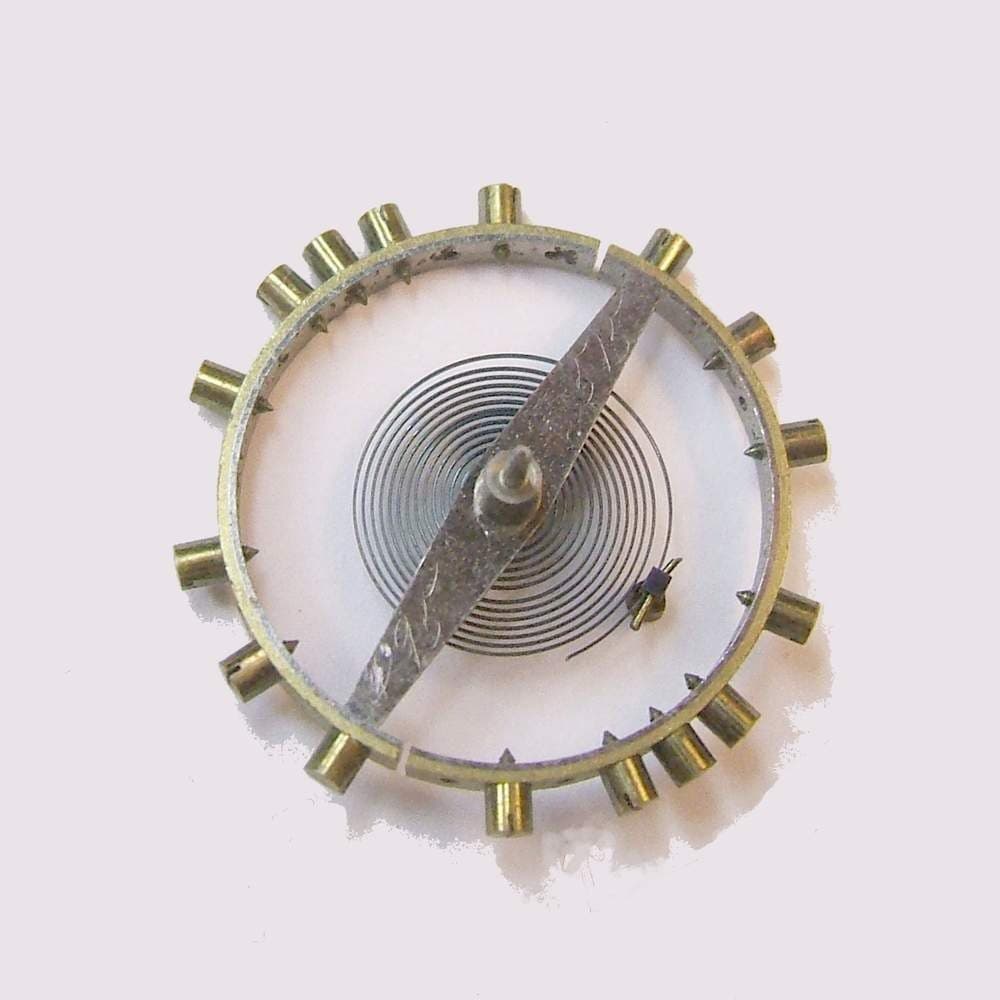
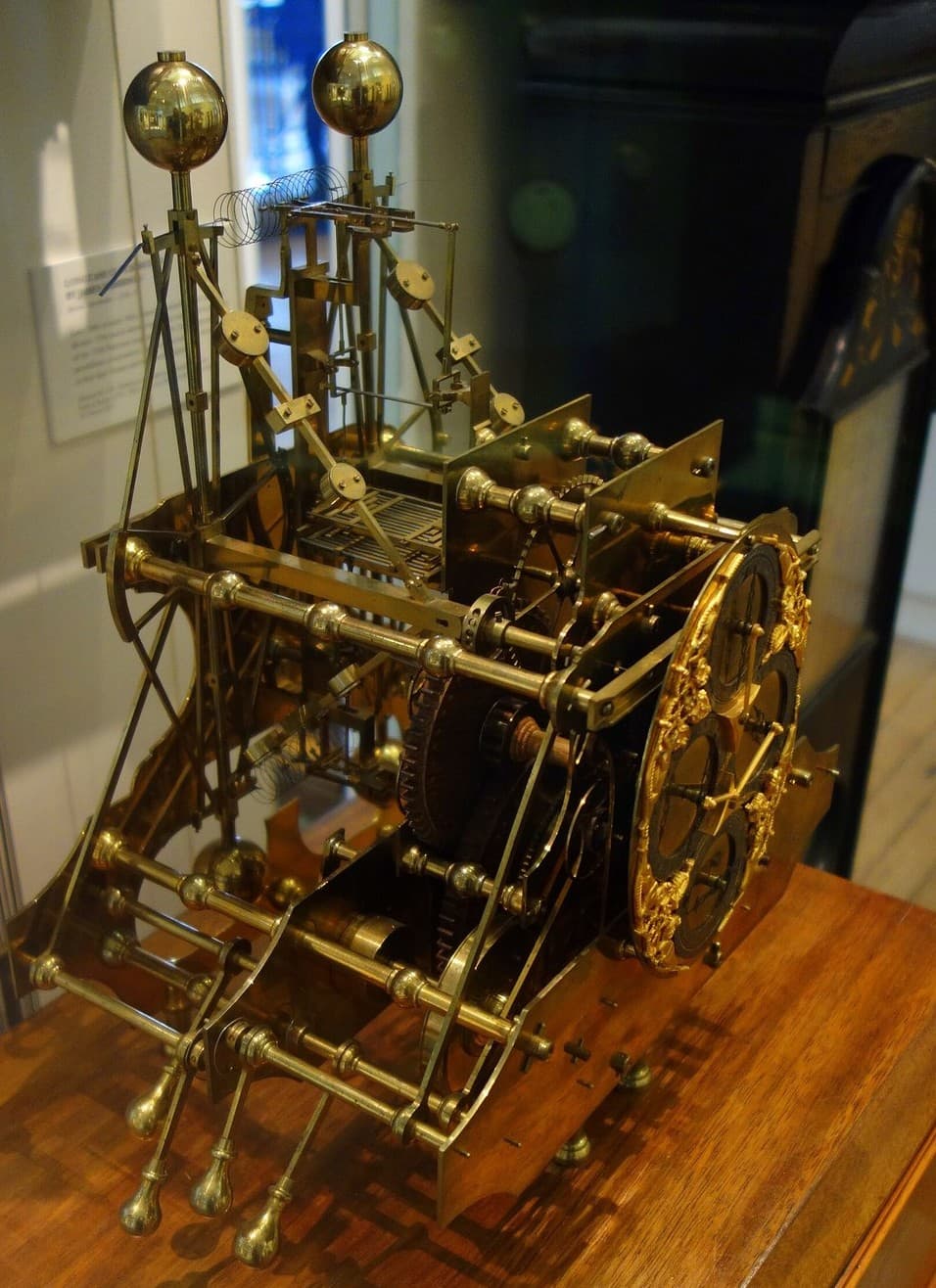
Harrison won it with H4, and by abandoning his own methods. H1, H2 and H3 were large sea clocks with his grasshopper escapement and no pendulum. H4, tested on a voyage to Jamaica in 1761–62, was a watch about 13 cm across, with a fast-beating balance, jewelled pallets and a remontoire — the opposite design philosophy. It performed far inside the prize's requirement. The man who spent thirty years perfecting large clocks won by building a big watch.
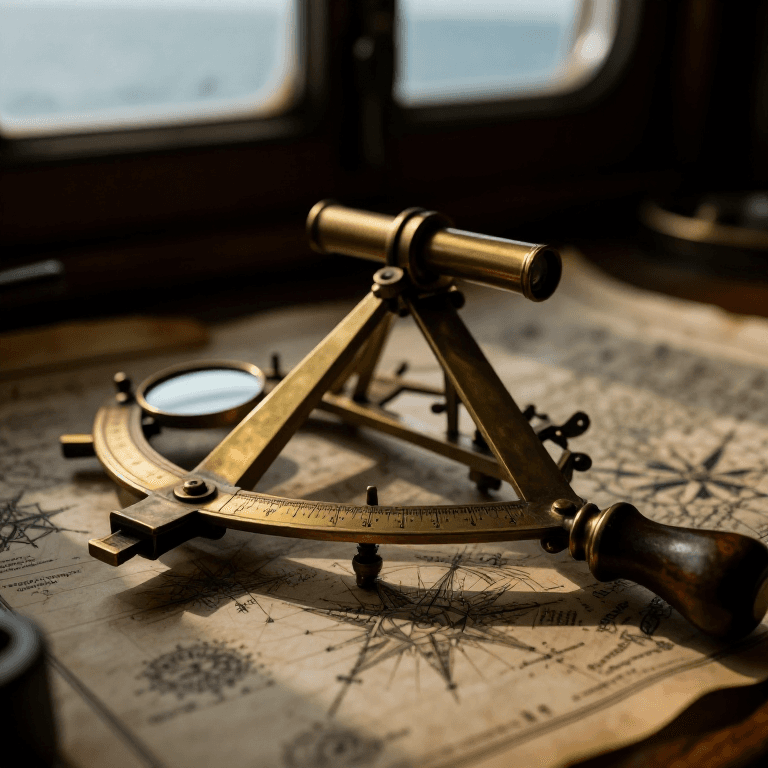
The rival method was astronomical, and it did not simply lose. Lunar distances — measuring the Moon against a star and looking up the reference time in tables — needed no expensive clock, only a sextant and hours of arithmetic. It worked, and it was cheap, and for decades ships used both. Chronometers won when they became reliable and affordable rather than because lunars failed. A method with no capital cost dies slowly.
The Board of Longitude's treatment of Harrison is contested, and worth stating carefully. He received substantial payments over the years and eventually, after appealing to Parliament, a further award — but never the prize as such under the Act's terms. Whether that reflected sceptical, astronomically-minded commissioners defending their own method, or a genuine requirement that a method be repeatable by others rather than embodied in one artisan's masterpiece, is argued to this day. Both readings contain something true, and the corpus should not flatten it into a simple injustice.
Honest limits. A chronometer tells you the time and nothing else; you still need a sextant, tables and clear sky for the local observation. It must never stop, so it is wound daily by a designated officer and never carried about. Its rate must be checked against a known longitude before departure, and it drifts as the rate itself slowly changes. It was, for a century, extremely expensive. And the entire method assumes you know your reference meridian — which is why the world eventually had to agree on one.
Công cụ yêu cầu
5- 1 vendor sell this, none ship to you yetTạm thời
- Tạm thời
- 1 vendor sell this, none ship to you yetTạm thời
- Tạm thời
- Tạm thời
Vật liệu bản thiết kế liên kết

Blueprint liên quan
Các blueprint này chia sẻ kiến thức — kỹ thuật, vật liệu hoặc nguyên tắc
CC0 Phạm vi công cộng
Bản thiết kế này được phát hành theo CC0. Bạn tự do sao chép, sửa đổi, phân phối và sử dụng cho bất kỳ mục đích nào mà không cần xin phép.
Hỗ trợ nhà sáng tạo bằng cách mua sản phẩm qua bản thiết kế, nơi họ nhận Hoa hồng nhà sáng tạo do nhà bán hàng đặt, hoặc tạo phiên bản mới và kết nối trong bản thiết kế riêng để chia sẻ doanh thu.