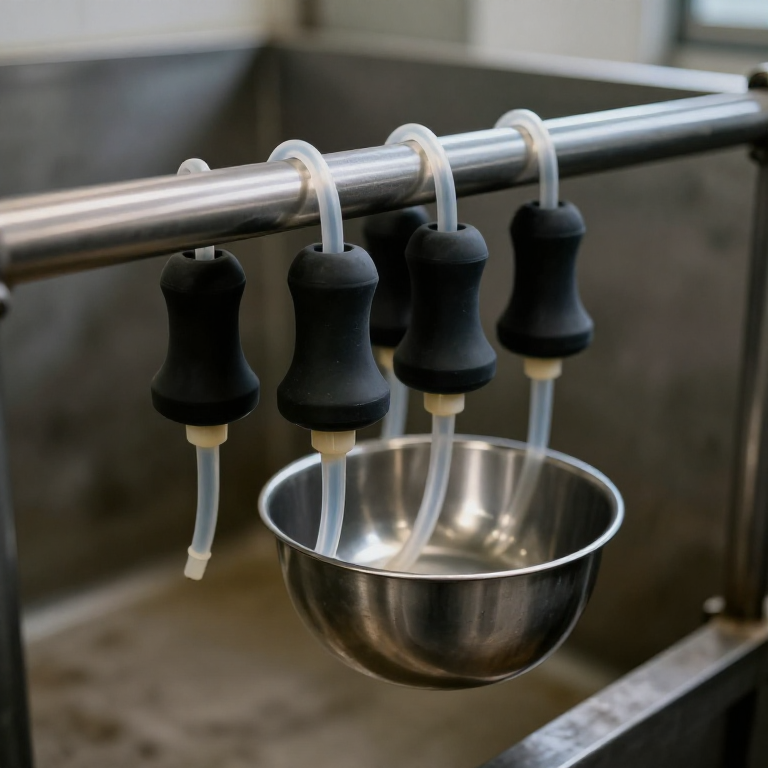


Milking Machine
Hướng dẫn
Show why steady suction fails
Show why steady suction fails
Model the teat with something that behaves like soft tissue.
- Fit a short length of soft rubber tubing over a nozzle to stand in for the teat.
- Apply steady gentle suction with a syringe and hold it.
- Watch the tube walls draw in and stay drawn in.
Vật liệu cho bước này:
 Ống cao su1 length
Build the liner and shell
Build the liner and shell
Two chambers, one inside the other. This is the whole hardware.
- Put the soft tube (the liner) inside a rigid outer tube (the shell), sealed at both ends.
- Connect the INSIDE of the liner to the milk line.
- Connect the space BETWEEN liner and shell to the pulsator line.
Vật liệu cho bước này:
 Ống PVC1 length
Pulsate it by hand
Pulsate it by hand
Alternate the shell chamber between vacuum and atmosphere.
- Keep steady vacuum inside the liner throughout.
- Open the shell chamber to air: the liner collapses and squeezes — the REST phase.
- Apply vacuum to the shell chamber: the liner opens and milk flows — the MILK phase.
- Alternate at roughly one cycle per second.
Measure rate and ratio
Measure rate and ratio
Two numbers define a pulsator, and both matter to the animal.
- Count cycles per minute — typical machines run about 60.
- Time the milk phase against the rest phase.
- Express as a ratio, commonly around 60:40.
Vật liệu cho bước này:
 Đồng hồ bấm giờ1 cái
History and context
History and context
Mechanical milking was attempted through the nineteenth century and mostly failed, sometimes cruelly. Early devices inserted tubes into the teat canal, which carried infection directly into the udder. Others applied continuous vacuum and caused the congestion demonstrated in step 1.
Pulsation is what made it work. The Scottish engineer Alexander Shiels introduced a pulsating machine in the early 1890s, and Alexander Gillies patented a design in 1902 in which the vacuum acts through a flexible liner rather than directly on the teat. The two ideas together — pulsation plus a liner — are the basis of every milking machine since.
Why the biology had to come first. Milk is not simply sucked out. Let-down is a reflex: stimulation causes oxytocin release, which contracts muscle cells around the alveoli and pushes milk into the ducts. The reflex takes a minute or so to arrive and fades within several minutes, so a machine that is attached too early or left on too long fights the animal instead of working with it. Machines that ignored this milked poorly and were blamed on mechanics rather than physiology.
What it changed: herd sizes. Hand milking limits a dairy to the number of animals people can milk twice a day, every day. Machines broke that limit, and dairying moved from many small herds to fewer large ones. Modern parlours add automatic cluster removal — sensing when flow drops and detaching, because leaving the cups on an empty udder is precisely the damage this blueprint starts with.
What this build is not: a working milking machine, and it must never be used on an animal. It demonstrates the pulsation principle on rubber tubing, which is where the engineering insight lives.
Vật liệu
3- 1 lengthTạm thời
- 1 lengthTạm thời
- 1 cáiTạm thời
Blueprint liên quan
Các blueprint này chia sẻ kiến thức — kỹ thuật, vật liệu hoặc nguyên tắc

CC0 Phạm vi công cộng
Bản thiết kế này được phát hành theo CC0. Bạn tự do sao chép, sửa đổi, phân phối và sử dụng cho bất kỳ mục đích nào mà không cần xin phép.
Hỗ trợ nhà sáng tạo bằng cách mua sản phẩm qua bản thiết kế, nơi họ nhận Hoa hồng nhà sáng tạo do nhà bán hàng đặt, hoặc tạo phiên bản mới và kết nối trong bản thiết kế riêng để chia sẻ doanh thu.