

Monotype Casting
The Linotype casts a whole line as one solid slug. Correct a single letter and you recast the entire line. Tolbert Lanston's machine took the opposite approach: cast every character as a separate piece of type, then assemble them into justified lines.
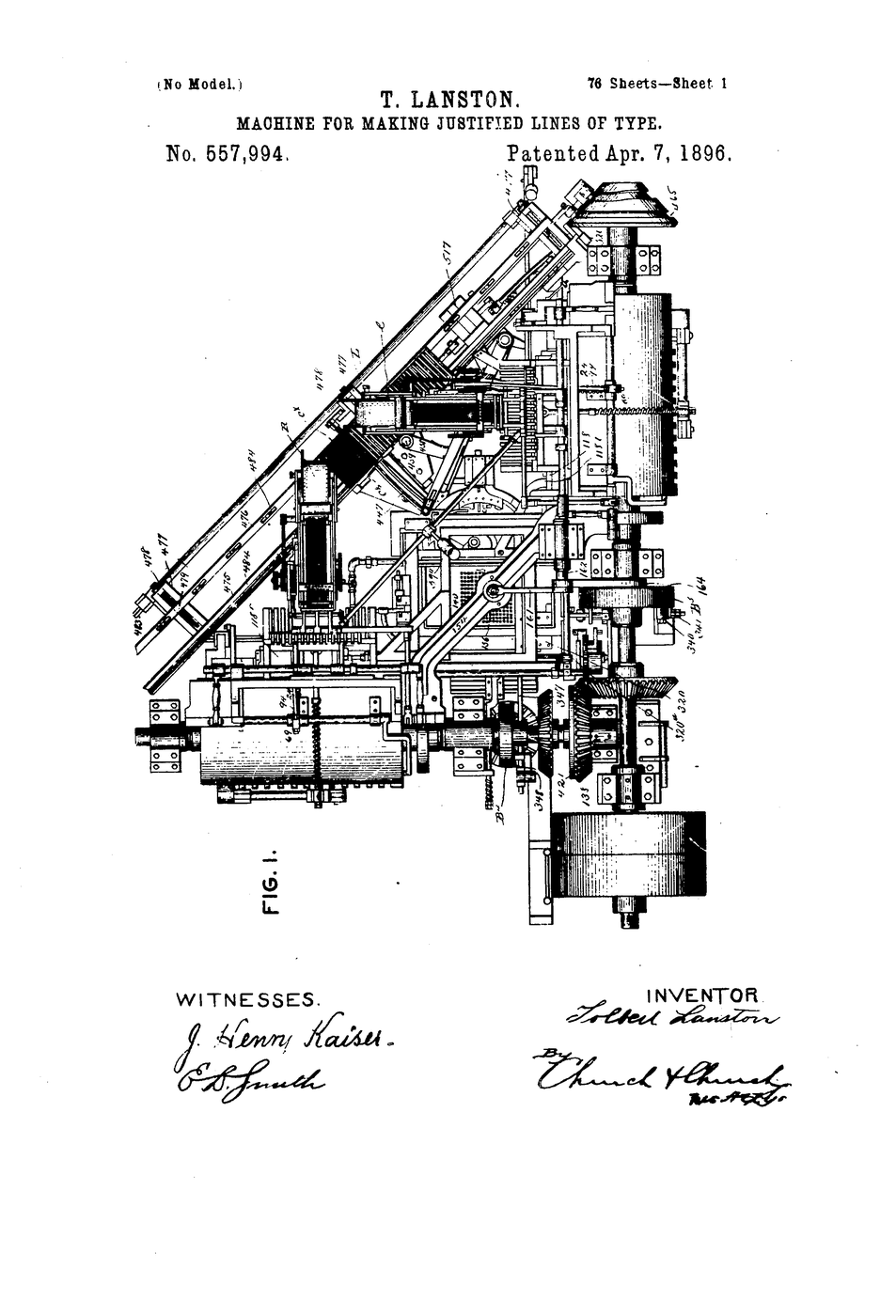
US 557,994, “Machine for making justified lines of type”, granted 7 April 1896. Its classification, B41B7/04, is precise: mechanical composition in which the type is cast or moulded from matrices. The patent runs to 76 sheets of drawings.
Separate types mean a compositor can pull one wrong letter with tweezers. It also means the hard problem moves to justification — deciding, before casting begins, exactly how much extra width each space in a line must carry. This blueprint builds the mould-and-matrix geometry and solves the justification arithmetic by hand, without melting any metal.
Hướng dẫn
Understand the difference from Linotype
Understand the difference from Linotype
Linotype casts a line as one slug. Monotype casts single characters. Write down one advantage and one disadvantage of each before building.
Safety substitution — no molten type metal
Safety substitution — no molten type metal
Real type metal is a lead–antimony–tin alloy. Lead is a cumulative poison and casting it is not a classroom activity. This blueprint casts plaster of Paris instead. The mould geometry, the matrix, and the justification arithmetic are identical; only the material changes.
Cut a matrix
Cut a matrix
Carve a single letter, in reverse, into the rubber sheet about 3 mm deep. This is your matrix — the female form the type is cast against.
Vật liệu cho bước này:
 Tấm cao su thiên nhiên1 cái
Công cụ cần thiết:
 Dao rọc thủ công
Build an adjustable mould
Build an adjustable mould
Make a small open box from card, one wall movable. The matrix forms the base. The movable wall is the point — Monotype's mould changes width for every character.
Vật liệu cho bước này:
 Tấm bìa sóng1 tờ
 Keo dán gỗ3 ml
Công cụ cần thiết:
Dao rọc thủ công Thước kẻ
Set the mould to one character width
Set the mould to one character width
Set the movable wall to 8 mm. Record the setting.
Công cụ cần thiết:
Thước kẻCast the first type
Cast the first type
Mix plaster to a pourable cream and fill the mould. Level the top.
Vật liệu cho bước này:
 Thạch cao Paris50 g
Công cụ cần thiết:
 Cân nhà bếp điện tử
Let it set and release
Let it set and release
Wait 15 minutes, then flex the rubber matrix away. You have a single piece of type with a raised reversed letter.
Công cụ cần thiết:
 Đồng hồ bấm giờ
Cast three more at different widths
Cast three more at different widths
Reset the movable wall to 6 mm, 10 mm and 12 mm and cast three more. Real type is proportional — an 'i' is not as wide as an 'm'.
Vật liệu cho bước này:
Thạch cao Paris150 gCông cụ cần thiết:
Thước kẻDress the castings
Dress the castings
Sand each casting flat on its back and sides so all four stand at identical height.
Công cụ cần thiết:
 Tờ giấy nhám
Measure the set widths
Measure the set widths
Measure each type body. Record the four widths. These are your character set widths.
Công cụ cần thiết:
Thước kẻDo the justification arithmetic
Do the justification arithmetic
Choose a line length of 120 mm. Add up your character widths for a short sentence. Subtract from 120. Divide the remainder by the number of spaces. That quotient is what every space must be widened by — and Monotype had to know it before it cast the first character of the line.
Công cụ cần thiết:
Thước kẻCast spaces to your computed width
Cast spaces to your computed width
Set the mould to the width you calculated and cast the spaces.
Vật liệu cho bước này:
Thạch cao Paris50 gCông cụ cần thiết:
Thước kẻCompose and measure the line
Compose and measure the line
Assemble types and spaces in a card channel. Measure the finished line. It should reach 120 mm within a millimetre.
Vật liệu cho bước này:
Tấm bìa sóng1 tờCông cụ cần thiết:
Thước kẻCorrect one character
Correct one character
Pull a single type out and replace it. Note that this took seconds. On a Linotype it means recasting the whole line — the entire argument for Monotype in one action.
Ink and pull a proof
Ink and pull a proof
Roll ink over the assembled line and press paper onto it.
Vật liệu cho bước này:
 Mực in khắc gỗ2 ml
 Giấy1 tờ
Công cụ cần thiết:
 Con lăn mực cao su
History & Context
History & Context
US 557,994, “Machine for making justified lines of type”, Tolbert Lanston, granted 7 April 1896. Patent protection ran 17 years from grant and expired in 1913.
Lanston, of Washington D.C., applied in 1885 for a typesetting system that produced its printing surface by cold-stamping rather than casting, and demonstrated a prototype in 1887. The hot-metal machine of this 1896 patent is the mature form. Sources disagree over whether to date the Monotype to 1885, 1887 or 1896 because they are describing three different things — the application, the prototype, and the casting machine.
A note on the record. Google Patents shows the filing date for US 557,994 as identical to the grant date. That is a cataloguing artefact, as with Hawes's envelope machine in this same batch; cite the grant date only.
How the real machine split the job in two. Monotype used two separate units — a keyboard that punched a paper ribbon, and a caster that read it. The operator typed; the ribbon was carried to the caster; the caster read the ribbon backwards, which is why the justification had to be computed and recorded at the end of each line as it was keyed. This is a genuine ancestor of stored-program control: an operator producing a physical instruction tape consumed later by a separate machine, in the same family as Jacquard's cards and Hollerith's punched strips.
Monotype outlived Linotype in fine bookwork precisely because of single types — corrections were cheap and the typographic quality was higher. Both were finished by phototypesetting and then by digital composition.
Vật liệu
6- Tạm thời
- 1 tờTạm thời
- 3 mlTạm thời
- 250 gTạm thời
- 2 mlTạm thời
- 1 tờTạm thời
Vật liệu bản thiết kế liên kết


Blueprint liên quan
Các blueprint này chia sẻ kiến thức — kỹ thuật, vật liệu hoặc nguyên tắc


CC0 Phạm vi công cộng
Bản thiết kế này được phát hành theo CC0. Bạn tự do sao chép, sửa đổi, phân phối và sử dụng cho bất kỳ mục đích nào mà không cần xin phép.
Hỗ trợ nhà sáng tạo bằng cách mua sản phẩm qua bản thiết kế, nơi họ nhận Hoa hồng nhà sáng tạo do nhà bán hàng đặt, hoặc tạo phiên bản mới và kết nối trong bản thiết kế riêng để chia sẻ doanh thu.