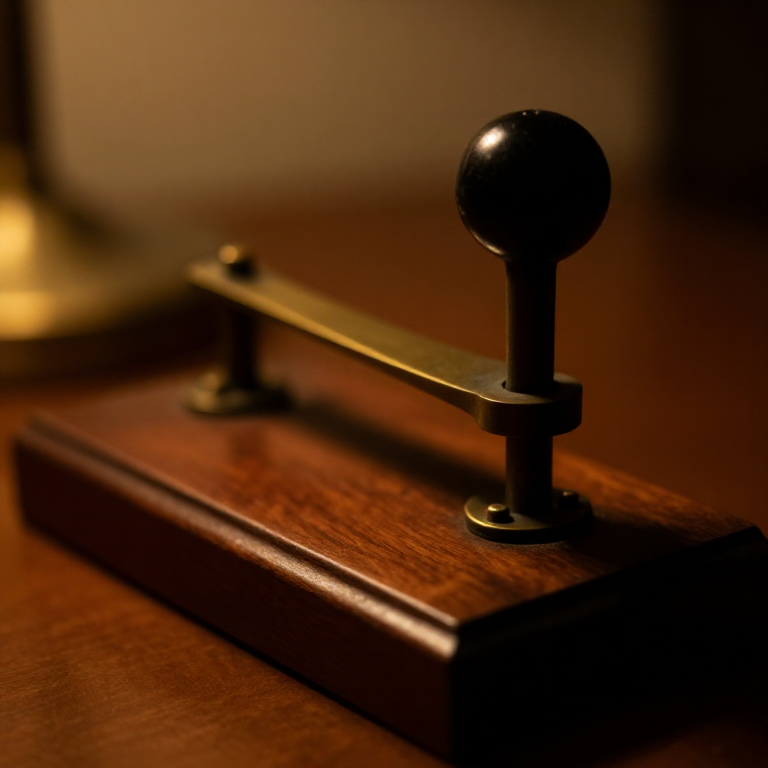


Morse Code
Hướng dẫn
Count letters and derive the weighting yourself
Count letters and derive the weighting yourself
Do what Vail did — count, then assign.
- Take a page of ordinary English and tally how often each letter appears.
- Rank the letters from commonest to rarest.
- Assign your own codes: one element to the top two letters, two elements to the next four, and so on.
Vật liệu cho bước này:
 Giấy kẻ ô ly1 pad
 Bộ bút chì than chì1 bộ
Learn the timing, because the timing IS the code
Learn the timing, because the timing IS the code
Five durations carry the whole system.
- A dot is one unit.
- A dash is three units.
- The gap between elements inside a letter is one unit.
- The gap between letters is three units.
- The gap between words is seven units.
Vật liệu cho bước này:
 Đồng hồ bấm giờ1 cái
Send it four different ways
Send it four different ways
Prove that the code is independent of the channel.
- Tap a short message on a table with a pencil.
- Send the same message by covering and uncovering a lamp.
- Send it by voice, saying dit and dah.
- Send it by squeezing a partner's hand.
Vật liệu cho bước này:
 Bộ giấy bìa nhiều màu1 gói
Measure the saving against a fixed-length code
Measure the saving against a fixed-length code
Put a number on what the frequency weighting buys.
- Encode a 100-letter passage in Morse and count the total time units.
- Now encode the same passage giving EVERY letter the same five-element length, as Baudot does.
- Compare the totals.
History and context
History and context
Alfred Vail and Samuel Morse developed the code around 1838; the frequency weighting is generally credited to Vail. The original American Morse used internal spaces within some letters, which machines handled badly. The International Morse agreed at Berlin in 1851 removed those and is the version still in use.
The code outlived its machine by a century. The telegraph is a museum piece; Morse is not. It stayed in maritime service until 1999, remains in amateur radio, and is still specified for aviation navigation beacons, which identify themselves in Morse to this day. Its endurance comes from the property in step 3: any channel that can be turned on and off can carry it, and a human ear can pull it out of noise that would defeat a voice transmission entirely.
Where it sits among neighbours in this catalogue: Baudot uses fixed-length codes so a machine can print without judging gaps; Huffman coding computes the provably shortest variable-length code for a specific message rather than for English in general; barcodes apply the same short-and-long idea to space instead of time. Morse's region is the one where a person is the receiver, the channel is poor, and the equipment might be nothing more than a torch.
A note on SOS: it stands for nothing. It was adopted in 1906 because three dots, three dashes, three dots is an unmistakable rhythm, easy to send and hard to confuse — the letters were chosen to fit the pattern, not the other way round.
Vật liệu
4- 1 padTạm thời
- Tạm thời
- 1 cáiTạm thời
- Tạm thời
Blueprint liên quan
Các blueprint này chia sẻ kiến thức — kỹ thuật, vật liệu hoặc nguyên tắc
CC0 Phạm vi công cộng
Bản thiết kế này được phát hành theo CC0. Bạn tự do sao chép, sửa đổi, phân phối và sử dụng cho bất kỳ mục đích nào mà không cần xin phép.
Hỗ trợ nhà sáng tạo bằng cách mua sản phẩm qua bản thiết kế, nơi họ nhận Hoa hồng nhà sáng tạo do nhà bán hàng đặt, hoặc tạo phiên bản mới và kết nối trong bản thiết kế riêng để chia sẻ doanh thu.