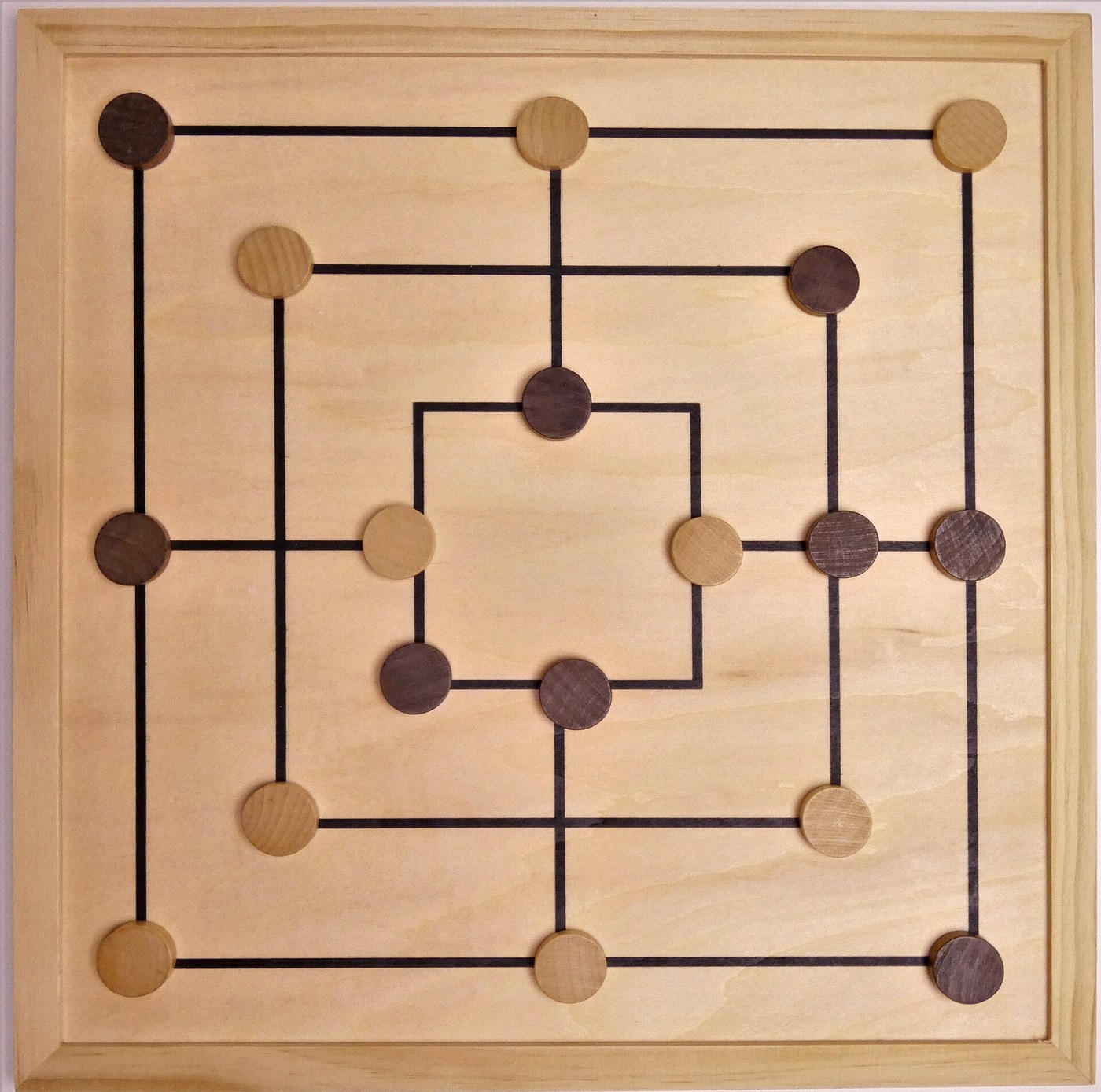


Nine Men's Morris
Three squares inside one another, joined at the midpoints of their sides. Twenty-four intersections, nine pieces each, and one rule that carries the whole game: get three in a line and you take one of your opponent's pieces off the board.
The board has been cut into stone across the Roman Empire and into the cloister benches and pew ledges of medieval cathedrals — often by people who were supposed to be doing something else. It travels well because it needs nothing: any flat surface, a knife, and eighteen pebbles of two colours.
Cut it into a board that will outlive you. The layout is pure geometry, so the accuracy of your marking-out is the whole quality of the piece.
Hướng dẫn
Prepare a board 240 mm square
Prepare a board 240 mm square
Plane a hardwood board to 240 x 240 x 18 mm and sand it flat. Oak, beech or any close-grained hardwood takes a crisp incised line; softwood tears.
Vật liệu cho bước này:
 Tấm gỗ cứng1 cái
Công cụ cần thiết:
 Bào tay
Find the centre and draw the axes
Find the centre and draw the axes
Mark the diagonals to find the centre, then draw a vertical and a horizontal line through it. Every point on the board is measured from these two lines.
Công cụ cần thiết:
 Thước kẻ
Mark three concentric squares
Mark three concentric squares
Draw squares of 180, 120 and 60 mm centred on that point. The even 30 mm step between them is what makes the finished board look right.
Join the midpoints of the sides
Join the midpoints of the sides
Draw a short line joining the midpoint of each side of the outer square to the midpoints of the middle and inner squares. Four connecting lines, one per side. The diagonals are NOT joined — corners connect only round their own square.
Check you have 24 points
Check you have 24 points
Count the intersections: eight per square, twenty-four in all. If you have more, you have drawn diagonals that do not belong there.
Score the lines
Score the lines
Cut each line with a knife against a steel rule, two light passes rather than one deep one. A scored line stays sharp for centuries; a pencil line lasts a season.
Công cụ cần thiết:
 Dao rọc thủ côngThước kẻ
Deepen the lines with a V-tool
Deepen the lines with a V-tool
Follow the knife cuts with a small V gouge to open them into a visible groove. Working inside your own knife line stops the tool wandering with the grain.
Công cụ cần thiết:
 Bộ dao khắc linoleum
Drill a shallow dish at each point
Drill a shallow dish at each point
Drill or carve a shallow 12 mm depression at all twenty-four intersections. The dishes hold the pieces so a knocked board does not lose the position.
Finish the board
Finish the board
Sand and oil the board. Rub a little dark pigment into the grooves first if you want the lines to read from across a table.
Vật liệu cho bước này:
 Dầu lanh đun chín50 ml
Make eighteen pieces
Make eighteen pieces
Cut eighteen discs about 20 mm across from a dowel, nine of each colour. Nine per player is what gives the game its name.
Vật liệu cho bước này:
 Thanh chốt gỗ1 cái
Công cụ cần thiết:
 Cưa tay
Phase one — place the pieces
Phase one — place the pieces
Players take turns placing one piece on any empty point until all eighteen are down. Complete three in a row along a line — a mill — and remove one enemy piece from the board.
Phase two — slide along the lines
Phase two — slide along the lines
Once all pieces are placed, a turn is moving one piece along a line to an adjacent empty point. Mills still capture, and a mill broken and reformed captures again.
Phase three — flying
Phase three — flying
A player reduced to three pieces may move to any empty point rather than an adjacent one. It is the losing player's compensation and it makes the endgame genuinely sharp.
Know how it ends
Know how it ends
A player loses at two pieces, or when they have no legal move. Agree before starting whether flying is in play — it is the one rule that varies most between traditions.
Play the double mill
Play the double mill
Try to build two mills sharing a piece, so moving it out of one closes the other. A double mill captures on every single turn and is close to winning outright — finding it is the whole strategy of the game.
History & Context
History & Context
Where the boards are found. Nine men's morris boards are cut into stone across the Roman Empire and into the stonework and woodwork of medieval cathedrals and cloisters all over Europe. The game needs no equipment beyond scratches and pebbles, which is exactly why it turns up wherever people had to wait: guard posts, church benches, workshop floors.
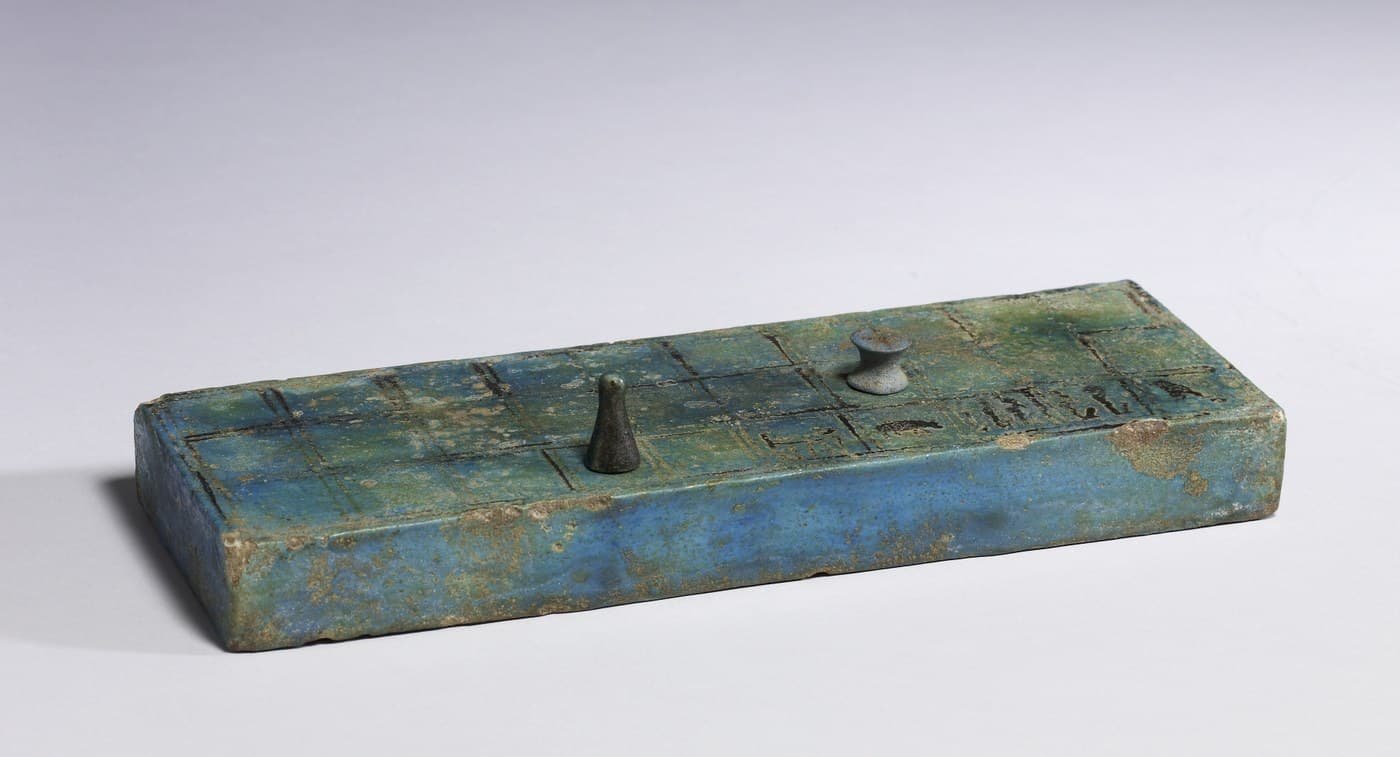
The oldest board, and a caution. A board cut into a roofing slab at the temple at Kurna in Egypt is often cited as dating to around 1400 BCE, which would make it the oldest known. That dating is doubtful: some of the diagrams on the same slab include Coptic crosses, which are many centuries later, so the carvings cannot all be contemporary with the building. The honest position is that the game is certainly ancient and demonstrably Roman, and that the 1400 BCE claim rests on a stone that cannot be securely dated.
The names. Mill, merels, merrils, mühle, molino — most European names describe the same thing, the three-in-a-row that mills your opponent's pieces away. Merels comes through Old French from the Latin merellus, a gaming counter. Shakespeare has "the nine men's morris is filled up with mud" in A Midsummer Night's Dream, describing a board cut into village turf and left to the weather.
It is a solved game. Ralph Gasser solved it by computer in October 1993: played perfectly by both sides it is a draw. That does not spoil it in the slightest — the same is true of noughts and crosses and very nearly true of draughts — but it does mean that every win between two human players is somebody's mistake, which is a useful thing to know while you are looking for the double mill.
Vật liệu
3- 1 cáiTạm thời
- 50 mlTạm thời
- 1 cáiTạm thời
Bản thiết kế này làm ra

Blueprint liên quan
Các blueprint này chia sẻ kiến thức — kỹ thuật, vật liệu hoặc nguyên tắc
CC0 Phạm vi công cộng
Bản thiết kế này được phát hành theo CC0. Bạn tự do sao chép, sửa đổi, phân phối và sử dụng cho bất kỳ mục đích nào mà không cần xin phép.
Hỗ trợ nhà sáng tạo bằng cách mua sản phẩm qua bản thiết kế, nơi họ nhận Hoa hồng nhà sáng tạo do nhà bán hàng đặt, hoặc tạo phiên bản mới và kết nối trong bản thiết kế riêng để chia sẻ doanh thu.