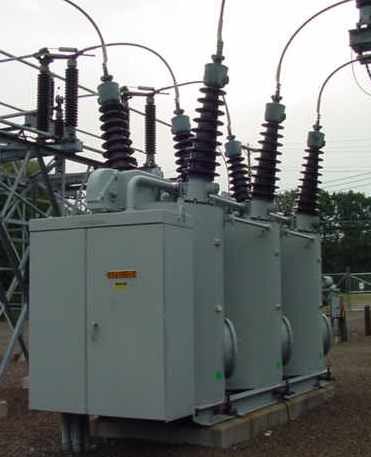


Oil Circuit Breaker
Hướng dẫn
Watch an arc refuse to die in air
Watch an arc refuse to die in air
Establish why a switch is not a breaker. Do this at low voltage and with care.
- Set up a low-voltage but high-current circuit through two carbon rods.
- Touch the rods together to start current flowing, then draw them slowly apart.
- Observe the arc stretching between them and continuing to conduct.
- Note how far apart they can be drawn before it finally breaks.
- Repeat with the rods separating quickly.
Wear proper eye protection — an arc emits intense ultraviolet, exactly as in the arc welding blueprint. Work at the lowest voltage that demonstrates the effect, with a current limit in circuit, and never look directly at the arc.
The arc persists because it maintains its own conditions: it is hot enough to keep the gas ionised, and ionised gas conducts. Simply pulling contacts apart in air only works at low power, which is why a domestic light switch is adequate and a substation switch is not.Vật liệu cho bước này:
 Dây đồng1 cuộn
 Nguồn điện bàn điều chỉnh được1 cái
Công cụ cần thiết:
 Đồng hồ vạn năng số cấp phòng thí nghiệm
 Đồng hồ bấm giờ
 Thước cặp điện tử 6 inch
Build contacts that separate fast under oil
Build contacts that separate fast under oil
Speed matters as much as the medium, because a short arc is easier to kill.
- Make a fixed contact and a moving contact from copper or brass rod.
- Mount both inside a sealed vessel filled with insulating oil, with the contacts fully submerged.
- Drive the moving contact with a strong spring, released by a latch.
- Ensure the travel is long and the acceleration high.
- Bring insulated leads out through sealed bushings.
Spring-driven, not hand-driven. A breaker must open at the same speed regardless of how quickly the operator moves the handle — a slow opening leaves the arc burning for longer and can destroy the contacts. The handle charges a spring; a latch releases it; the spring does the opening. Every breaker of any size works this way, and it is why a breaker makes a bang rather than a scrape.
The bushings are the same problem as the vacuum feedthrough in batch 75: something has to pass through a sealed wall while the wall keeps its integrity. Here it must also insulate at high voltage, which is why substation breakers have those tall porcelain columns on top.Vật liệu cho bước này:
 Thanh đồng thau tròn1 cái
 Thanh đồng tròn1 cái
 Bộ lò xo nén1 bộ
 Dầu lanh đun chín1 chai
Công cụ cần thiết:
 Máy khoan pin
 Bộ mũi khoan
 Bộ giũa
 Ê tô bàn nguộiThước cặp điện tử 6 inch
Understand what the oil actually does
Understand what the oil actually does
Three separate mechanisms, all triggered by the arc itself.
- Note first that oil is a far better insulator than air, so the contacts can be closer together when open.
- The arc's heat decomposes the oil into gas — mostly hydrogen.
- That gas forms a bubble at high pressure which blasts across the arc and cools it.
- Hydrogen conducts heat away several times better than air, so the arc path cools rapidly.
- Fresh oil rushes in behind and restores insulation.
The arc supplies the energy for its own extinction. A bigger fault current makes a hotter arc, which cracks more oil, which produces a stronger blast — so the mechanism scales itself with the severity of the fault. That self-regulation is the design's elegance and the reason it dominated for half a century.
The extinction happens at a current zero. AC crosses zero twice per cycle, and at that instant the arc briefly stops; the breaker's job is to make the gap insulating fast enough that it cannot restrike. This is also why breaking DC is far harder — there is no natural zero to wait for.Công cụ cần thiết:
 Máy hiện sóng sốĐồng hồ vạn năng số cấp phòng thí nghiệmĐồng hồ bấm giờ
Inspect the oil after operation and find the maintenance burden
Inspect the oil after operation and find the maintenance burden
The oil is consumed by doing its job, which is the design's central weakness.
- Operate the breaker under load several times.
- Draw a sample of oil and examine it against fresh oil — colour, clarity, smell.
- Look for carbon particles in suspension.
- Test the oil's insulating strength by measuring the voltage at which it breaks down between two close electrodes.
Công cụ cần thiết:
Đồng hồ vạn năng số cấp phòng thí nghiệmNguồn điện bàn điều chỉnh đượcThước cặp điện tử 6 inch Bộ ống thủy tinh
The arc as its own executioner, and history
The arc as its own executioner, and history
Oil circuit breakers came into use in the early 1900s as transmission voltages climbed past what air-break switches could handle, and they dominated high-voltage switching until the middle of the century. J. N. Kelman is generally credited with an early practical design around 1901 — reportedly little more than contacts in a barrel of oil, which worked well enough to launch an industry.
The self-scaling property is worth dwelling on. Most protective devices have a fixed capability and fail if the fault exceeds it. Here the fault's own energy drives the extinguishing mechanism harder, so the breaker's performance rises with the severity of what it is interrupting. Designs with that character are unusual and valuable, and it is the same instinct as the self-energising band brake in batch 70 — let the thing you are fighting do the work.
Why it was eventually replaced. Oil degrades, must be tested and changed, and a large tank of hot mineral oil next to a fault arc is a fire and explosion risk. Substations were laid out with blast walls between oil breakers for that reason. Air-blast and later SF6 designs removed the flammable medium entirely, and modern vacuum breakers removed the medium altogether.
Its honest limits: flammability, maintenance, contact erosion each operation, slow reset, and considerable mass. Against that it was simple, robust, and needed no compressed air or exotic gas — which is why oil breakers remained in service for decades after better designs existed, and why some still operate today.
Vật liệu
6- 1 cuộnTạm thời
- Tạm thời
- 1 cáiTạm thời
- 1 cáiTạm thời
- 1 bộTạm thời
- 1 chaiTạm thời
Công cụ yêu cầu
10- Tạm thời
- Tạm thời
- 1 vendor sell this, none ship to you yetTạm thời
- Tạm thời
- Tạm thời
- Tạm thời
- 1 vendor sell this, none ship to you yetTạm thời
- Tạm thời
- Tạm thời
Blueprint liên quan
Các blueprint này chia sẻ kiến thức — kỹ thuật, vật liệu hoặc nguyên tắc



CC0 Phạm vi công cộng
Bản thiết kế này được phát hành theo CC0. Bạn tự do sao chép, sửa đổi, phân phối và sử dụng cho bất kỳ mục đích nào mà không cần xin phép.
Hỗ trợ nhà sáng tạo bằng cách mua sản phẩm qua bản thiết kế, nơi họ nhận Hoa hồng nhà sáng tạo do nhà bán hàng đặt, hoặc tạo phiên bản mới và kết nối trong bản thiết kế riêng để chia sẻ doanh thu.