

Panen Cengkeh Maluku — Memetik dan Mengeringkan Bunga Cengkeh Tradisional
Hướng dẫn
Mengenal pohon cengkeh (Syzygium aromaticum)
Mengenal pohon cengkeh (Syzygium aromaticum)
Pohon cengkeh (Syzygium aromaticum, keluarga Myrtaceae) adalah pohon hijau abadi (evergreen) yang berasal dari Kepulauan Maluku. Pohon dewasa mencapai tinggi 10-15 meter, dengan bentuk tajuk kerucut yang khas. Daunnya berbentuk lonjong, berwarna hijau tua mengkilap, panjang 8-13 cm, dan mengandung minyak eugenol yang berbau harum bila diremas. Kulit batangnya halus dan berwarna abu-abu. Pohon cengkeh mulai berbunga pada umur 5-7 tahun dan mencapai produksi penuh pada umur 15-20 tahun. Satu pohon dewasa menghasilkan 3-7 kg cengkeh kering per tahun. Komponen utama minyak cengkeh adalah eugenol (72-90%), yang memberikan aroma khas dan sifat antiseptik. Di Maluku, musim panen utama jatuh antara September hingga Desember.
Menilai kesiapan pohon untuk dipanen
Menilai kesiapan pohon untuk dipanen
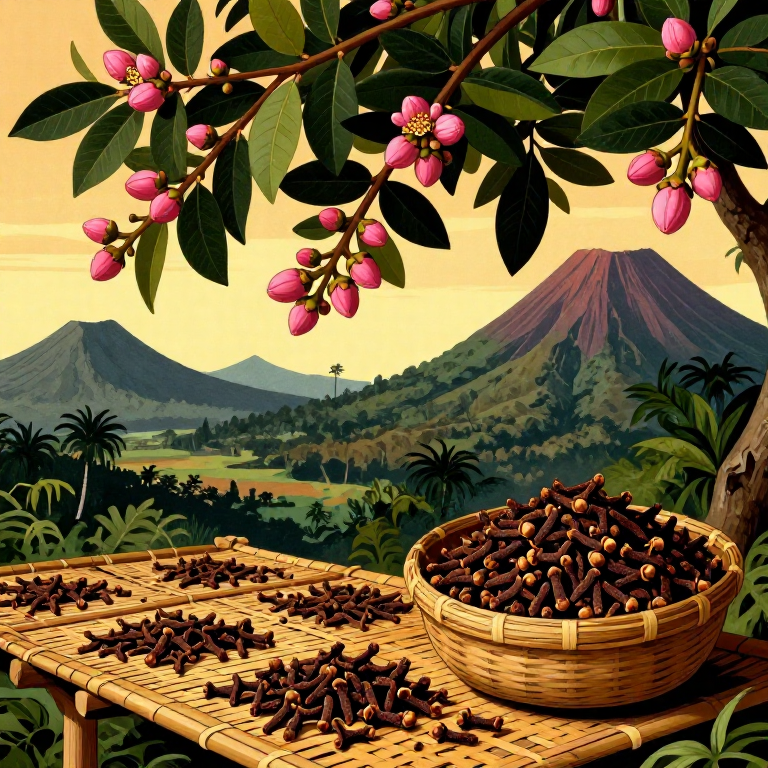
Sebelum panen, periksa setiap pohon untuk menentukan kesiapan bunga. Cengkeh tumbuh dalam kelompok (cluster) yang disebut 'tandan' di ujung ranting. Setiap tandan berisi 3-20 kuncup bunga. Perhatikan warna kuncup dengan seksama: kuncup yang masih muda berwarna hijau, kemudian berubah menjadi merah muda (pink) saat mendekati kematangan. Waktu panen ideal adalah saat kuncup sudah berwarna merah muda cerah hingga merah muda kemerahan, dengan panjang kuncup sekitar 1,5-2 cm. Kelopak empat buah masih tertutup rapat membentuk bola bulat di ujung kuncup. Jangan menunggu sampai kelopak mulai terbuka — cengkeh yang sudah mekar (disebut 'cengkeh kembang') mutunya jauh lebih rendah karena kandungan eugenol berkurang dan warnanya menjadi pucat setelah dikeringkan.
Công cụ cần thiết:
 Ống nhòm
Menyiapkan peralatan panen
Menyiapkan peralatan panen
Persiapkan semua peralatan sebelum naik ke pohon. Wadah pemetikan berupa ember plastik kecil atau kantong kain yang diikatkan di pinggang agar kedua tangan bebas untuk memetik. Siapkan tangga bambu (galah tangga) yang cukup panjang untuk menjangkau cabang pertama — biasanya 3-5 meter. Hamparkan terpal di bawah pohon untuk menampung kuncup yang jatuh selama pemetikan. Periksa kondisi tangga — pastikan anak tangga kuat dan tidak retak. Siapkan juga tali untuk mengikat diri ke cabang utama saat bekerja di ketinggian. Gunakan sepatu yang tidak licin karena kulit pohon cengkeh bisa licin saat basah oleh embun pagi.
Vật liệu cho bước này:
 Túi đeo hông bằng vải bạt1 cái
 Dây thừng nylon5 mét
 Tấm bạt1 cái
Công cụ cần thiết:
 Thang tre
 Giày đế cao su
Memanjat pohon dan teknik pemetikan
Memanjat pohon dan teknik pemetikan
Sandarkan tangga bambu pada batang utama dan naik ke cabang pertama. Dari cabang utama, panjat lebih tinggi dengan berpegangan pada cabang-cabang yang kokoh. Di Maluku, pemetik berpengalaman bisa bekerja di ketinggian 10-12 meter. Teknik pemetikan: pegang tandan (cluster) kuncup dengan satu tangan, kemudian petik kuncup satu per satu atau dalam kelompok kecil (2-3 kuncup sekaligus) dengan tangan yang lain. Gunakan ibu jari dan telunjuk untuk mematahkan tangkai kuncup tepat di bawah kelopak. Jangan menarik seluruh tandan sekaligus karena ini merusak ranting dan mengurangi produksi tahun berikutnya. Masukkan kuncup ke dalam kantong pinggang. Saat kantong penuh, turunkan menggunakan tali ke orang di bawah. Pemetikan harus dilakukan pagi hari (06.00-11.00) saat udara masih sejuk — kuncup lebih renyah dan mudah dipetik.
Công cụ cần thiết:
Túi đeo hông bằng vải bạtThang treMengumpulkan hasil petikan
Mengumpulkan hasil petikan
Kumpulkan semua kuncup yang telah dipetik dari terpal dan kantong ke dalam keranjang bambu besar. Satu pemetik berpengalaman dapat menghasilkan 5-10 kg kuncup segar per hari. Periksa hasil petikan secara kasar: buang daun, ranting kecil, dan kuncup yang sudah mekar (kembang). Kuncup segar berwarna merah muda, berisi minyak, dan terasa lengket bila diremas. Jangan menumpuk kuncup segar terlalu tinggi (maksimal 20 cm) dalam keranjang karena tekanan menyebabkan kuncup pecah dan minyak menguap. Bawa hasil petikan ke tempat pemrosesan sesegera mungkin — kuncup segar yang ditumpuk lebih dari 12 jam mulai berfermentasi dan kehilangan mutu.
Vật liệu cho bước này:
 Giỏ tre lớn2 cái
Memisahkan kuncup dari tangkai
Memisahkan kuncup dari tangkai
Kuncup cengkeh yang dipetik masih menempel pada tangkai pendek (peduncle). Tangkai ini harus dipisahkan karena dijual terpisah dengan harga lebih rendah (tangkai cengkeh mengandung eugenol 5-6%, jauh lebih rendah dari kuncup yang mengandung 15-20%). Duduk di tempat teduh dan ambil kuncup satu per satu. Patahkan tangkai tepat di pangkal kuncup dengan ibu jari dan telunjuk. Kumpulkan tangkai terpisah — jangan buang karena tangkai cengkeh (clove stems) masih bernilai ekonomis untuk penyulingan minyak. Proses ini memakan waktu dan biasanya dilakukan oleh seluruh keluarga bersama-sama. Dari 10 kg kuncup bertangkai, diperoleh sekitar 7-8 kg kuncup tanpa tangkai dan 2-3 kg tangkai.
Vật liệu cho bước này:
 Nong sảy2 cái
Penjemuran cengkeh di atas tikar bambu
Penjemuran cengkeh di atas tikar bambu
Hamparkan tikar bambu (para-para) di halaman yang terkena sinar matahari langsung sepanjang hari. Sebar kuncup cengkeh dalam satu lapisan tipis di atas tikar — ketebalan maksimal 3-4 cm. Jangan menumpuk terlalu tebal karena bagian bawah tidak kering merata dan bisa berjamur. Aduk dan balik kuncup 3-4 kali sehari agar pengeringan merata. Penjemuran memakan waktu 4-5 hari pada cuaca cerah. Kuncup yang sedang dijemur berubah warna dari merah muda menjadi cokelat tua kehitaman. Pada malam hari dan saat hujan, tutupi cengkeh dengan terpal dan angkat tikar ke tempat bernaung. Hindari kontak langsung dengan tanah — kelembapan tanah menyebabkan jamur. Di Maluku, halaman penjemuran tradisional disebut 'lantai jemur' dan biasanya terbuat dari beton yang diplester halus.
Vật liệu cho bước này:
 Chiếu phơi bằng tre đan4 cáiTấm bạt1 cái
Công cụ cần thiết:
 Cào gỗ
Memeriksa kadar air cengkeh kering
Memeriksa kadar air cengkeh kering
Cengkeh dianggap kering sempurna bila kadar airnya mencapai 12-14%. Uji sederhana tanpa alat: ambil satu kuncup kering dan tekan tangkainya dengan kuku — jika patah dengan bunyi 'klik' yang nyaring, kadar air sudah cukup rendah. Jika tangkai hanya melengkung tanpa patah, cengkeh masih terlalu basah dan perlu dijemur lagi. Uji lain: remas beberapa kuncup di telapak tangan — cengkeh kering yang baik terasa keras, tidak lengket, dan mengeluarkan aroma eugenol yang kuat. Berat cengkeh menyusut sekitar 65-70% selama penjemuran: dari 10 kg kuncup segar menjadi 3-3,5 kg cengkeh kering. Jika tersedia, gunakan moisture meter untuk pengukuran lebih akurat — kadar air di atas 14% menyebabkan jamur selama penyimpanan.
Công cụ cần thiết:
 Máy đo độ ẩm hạt
Membersihkan cengkeh kering
Membersihkan cengkeh kering
Setelah kering sempurna, cengkeh perlu dibersihkan dari kotoran. Tuang cengkeh ke dalam tampah (nyiru) bambu dan tampi dengan gerakan mengayun — debu, pasir halus, dan pecahan kecil akan tertiup angin. Pisahkan kuncup yang utuh dari yang pecah. Buang sisa tangkai, daun kering, dan benda asing lainnya. Cengkeh yang bersih berwarna cokelat tua kehitaman yang merata, berminyak di permukaan, dan berbau harum tajam. Proses pembersihan ini penting untuk mendapatkan harga terbaik di pasar — cengkeh yang bercampur kotoran dihargai jauh lebih rendah.
Công cụ cần thiết:
Nong sảySortasi dan pengelompokan mutu
Sortasi dan pengelompokan mutu
Cengkeh kering disortasi ke dalam beberapa kelas mutu berdasarkan standar SNI (Standar Nasional Indonesia 01-3392-1994). Mutu I: kuncup utuh, warna cokelat tua-hitam seragam, tangkai pendek masih menempel, kadar air maksimal 12%, kadar minyak atsiri minimal 18%, tidak ada jamur. Mutu II: kuncup utuh hingga sedikit pecah, warna agak kurang seragam, kadar air maksimal 14%, kadar minyak atsiri minimal 16%. Mutu III: campuran kuncup utuh dan pecah, warna tidak seragam, kadar minyak atsiri minimal 14%. Selain kuncup, tangkai cengkeh (clove stems) dan kuncup mekar (mother cloves) dijual terpisah dengan harga lebih rendah. Sortasi dilakukan secara visual di atas meja datar dengan pencahayaan yang baik.
Công cụ cần thiết:
 Bàn phân loại mặt phẳng
 Cân điện tử
Menimbang dan mencatat hasil panen
Menimbang dan mencatat hasil panen
Timbang setiap kelas mutu secara terpisah. Catat berat, tanggal panen, asal pohon, dan kelas mutu dalam buku catatan. Dokumentasi ini penting untuk mengetahui produktivitas setiap pohon dan merencanakan panen tahun berikutnya. Satu pohon cengkeh dewasa (umur 20+ tahun) menghasilkan rata-rata 3-7 kg cengkeh kering per panen, tetapi produksi bersifat musiman — tahun produksi tinggi (on-year) biasanya diikuti tahun produksi rendah (off-year). Di perkebunan tradisional Maluku, petani memiliki 50-200 pohon dan total panen satu musim bisa mencapai 200-500 kg cengkeh kering per keluarga.
Vật liệu cho bước này:
 Sổ ghi chép1 cái
Công cụ cần thiết:
Cân điện tửPenyimpanan cengkeh kering
Penyimpanan cengkeh kering
Masukkan cengkeh kering ke dalam karung goni bersih yang telah dilapisi kantong plastik di dalamnya untuk mencegah penyerapan kelembapan. Isi karung hingga maksimal 60 kg — jangan terlalu padat agar sirkulasi udara tetap ada. Ikat karung dengan kuat dan beri label berisi kelas mutu, berat, dan tanggal pengemasan. Simpan karung di gudang yang kering, berventilasi baik, dan tidak terkena sinar matahari langsung. Letakkan karung di atas palet kayu, minimal 15 cm dari lantai, agar tidak menyerap kelembapan lantai. Jangan simpan berdekatan dengan bahan berbau tajam lainnya karena cengkeh mudah menyerap bau. Cengkeh kering yang disimpan dengan benar dapat bertahan 2-3 tahun tanpa kehilangan mutu secara signifikan. Periksa secara berkala setiap 2-3 minggu untuk memastikan tidak ada jamur, serangga, atau peningkatan kelembapan.
Vật liệu cho bước này:
 Bao đay5 cái
 Túi lót polyetylen5 cái
 Pa-lét gỗ để kê hàng2 cái
 Nhãn dán10 cái
Công cụ cần thiết:
 Kim khâu bao (cong)
 Dây đay
Perawatan pohon cengkeh setelah panen
Perawatan pohon cengkeh setelah panen
Setelah panen selesai, pohon cengkeh memerlukan perawatan agar produksi tahun berikutnya tetap baik. Bersihkan area di bawah tajuk pohon dari gulma dan semak. Berikan pupuk organik (kompos atau pupuk kandang) sebanyak 15-20 kg per pohon dewasa, ditaburkan merata di bawah tajuk pada radius 1-2 meter dari batang. Pemupukan dilakukan setelah panen saat musim hujan dimulai (Desember-Januari di Maluku) agar pupuk terserap oleh tanah basah. Pangkas ranting yang mati, sakit, atau tumbuh terlalu rapat untuk menjaga sirkulasi udara dalam tajuk. Periksa adanya serangan hama penggerek batang (Hexamitodera semivelutina) — tanda serangannya berupa lubang kecil di kulit batang dengan serbuk kayu halus di bawahnya. Pohon cengkeh yang dirawat baik dapat berproduksi selama 100-150 tahun.
Vật liệu cho bước này:
 Phân trộn hữu cơ20 kg
Công cụ cần thiết:
 Kéo cắt tỉa cành
 Cuốc làm vườn
Vật liệu
13- Tạm thời
- 5 métTạm thời
- 1 cáiTạm thời
- 2 cáiTạm thời
- 2 cáiTạm thời
- Tạm thời
- 1 cáiTạm thời
- 5 cáiTạm thời
- 5 cáiTạm thời
- 2 cáiTạm thời
- 10 cáiTạm thời
- 20 kgTạm thời
- 1 cáiTạm thời
Công cụ yêu cầu
13- Tạm thời
- Tạm thời
- Tạm thời
- Tạm thời
- Tạm thời
- Tạm thời
- Tạm thời
- Tạm thời
- Tạm thời
- Tạm thời
- Tạm thời
- Tạm thời
- Tạm thời
Bản thiết kế này làm ra
CC0 Phạm vi công cộng
Bản thiết kế này được phát hành theo CC0. Bạn tự do sao chép, sửa đổi, phân phối và sử dụng cho bất kỳ mục đích nào mà không cần xin phép.
Hỗ trợ nhà sáng tạo bằng cách mua sản phẩm qua bản thiết kế, nơi họ nhận Hoa hồng nhà sáng tạo do nhà bán hàng đặt, hoặc tạo phiên bản mới và kết nối trong bản thiết kế riêng để chia sẻ doanh thu.