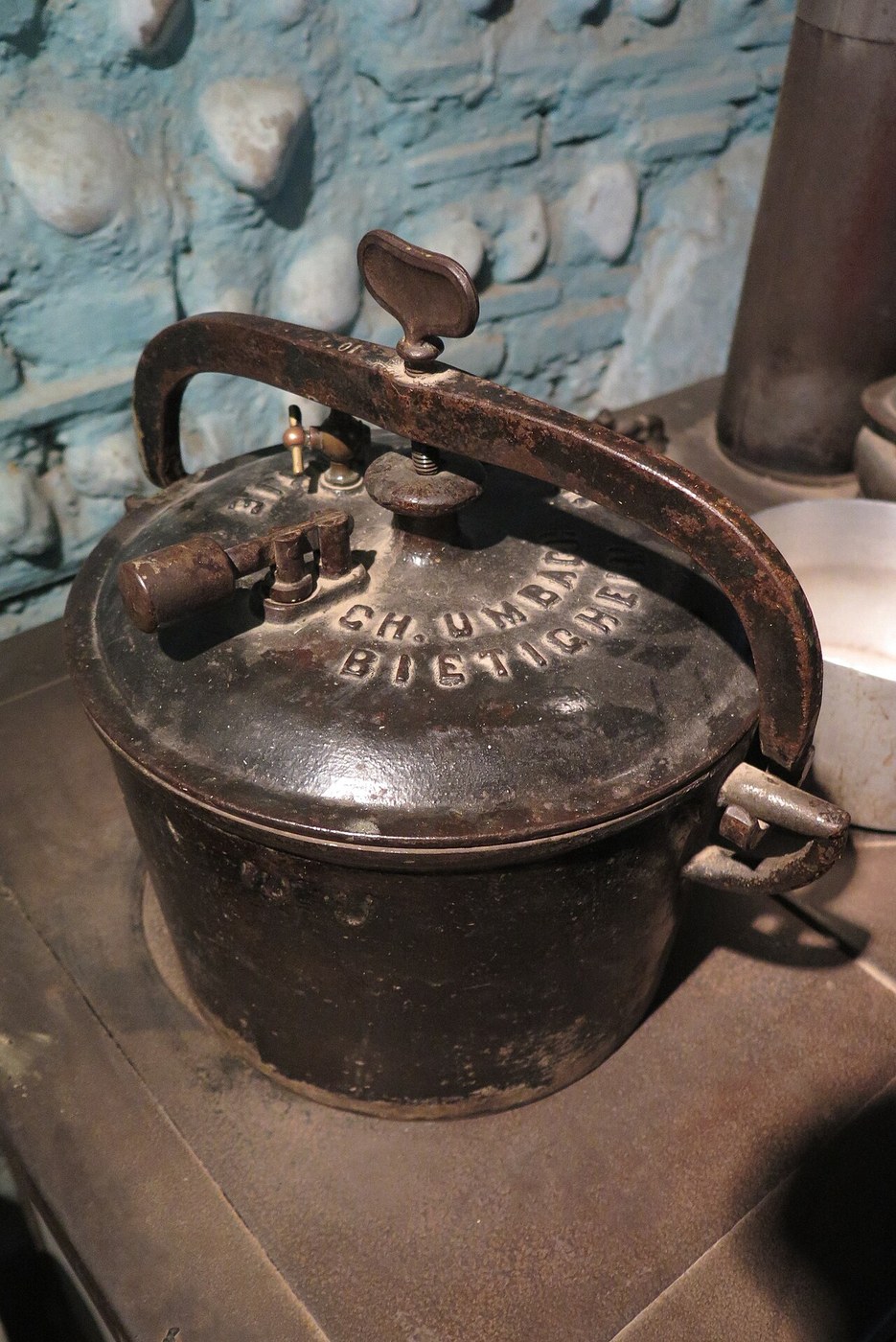


Papin's Steam Digester
Hướng dẫn
Find the ceiling on open-pan temperature
Find the ceiling on open-pan temperature
Establish the limit the digester exists to break.
- Heat water in an open pan with a thermometer in it.
- Record the temperature as it comes to the boil.
- Turn the heat up further and keep watching.
Vật liệu cho bước này:
 Nhiệt kế đọc nhanh1 cái
 Cốc thuỷ tinh borosilicat1 cái
Watch the boiling point move
Watch the boiling point move
Boiling point is not a property of water alone — it depends on the pressure above it.
- Use a modern pressure cooker, following its instructions exactly.
- Note the working pressure marked on it, typically about 1 bar above atmospheric.
- At that pressure water boils near 121 °C.
Build the safety valve
Build the safety valve
Papin's actual invention, and the piece you should understand best.
- A plug seals an opening in the lid.
- A weight on a lever arm holds the plug down.
- Pressure pushes up on the plug area; when that force exceeds the weight's moment, the plug lifts and vents.
Vật liệu cho bước này:
 Thanh đồng thau1 length
 Cân nhà bếp điện tử1 cái
Test the effect on cooking
Test the effect on cooking
Measure the difference rather than asserting it.
- Cook identical portions of a tough ingredient — dried beans or a bony cut — in an open pan and in a pressure cooker.
- Time each to the same tenderness.
- Compare the times and the fuel used.
Vật liệu cho bước này:
 Đồng hồ bấm giờ1 cái
History and context
History and context
Denis Papin (1647-1713) was a French Huguenot physicist who worked with Robert Boyle in London and later held a chair at Marburg. He described his New Digester for Softening Bones in 1679 and demonstrated it to the Royal Society, where he cooked a meal for the Fellows in 1682.
The safety valve is the part that changed the world. Papin's early vessels burst, and his weighted-lever valve was the response. Once a sealed vessel could be trusted not to explode, steam power became a subject you could work on without expecting to be killed — and Papin himself went on to describe a piston raised by steam, which is a direct ancestor of the atmospheric engine that Newcomen built in 1712.
He died poor and his grave is unknown. His later years in London were spent unsuccessfully seeking support; his last letters to the Royal Society went unanswered. The line from his digester to the industrial steam engine is short and direct, and he benefited from none of it.
The domestic afterlife took two centuries. Pressure cookers stayed industrial and institutional until the twentieth century; the home version arrived in the 1930s and 40s. Reputation problems from early models exploding took decades to shake off, and modern cookers carry multiple independent pressure releases plus a lid interlock precisely because of that history.
Safety note for this build: never modify or defeat the valve on a commercial pressure cooker, never fill one past its marked limit, and do not attempt a home-made pressure vessel. The valve you build here is a bench demonstration of the lever principle, not a fitting for anything under real pressure.
Vật liệu
5- 1 cáiTạm thời
- Tạm thời
- 1 lengthTạm thời
- 1 cáiTạm thời
- 1 cáiTạm thời
CC0 Phạm vi công cộng
Bản thiết kế này được phát hành theo CC0. Bạn tự do sao chép, sửa đổi, phân phối và sử dụng cho bất kỳ mục đích nào mà không cần xin phép.
Hỗ trợ nhà sáng tạo bằng cách mua sản phẩm qua bản thiết kế, nơi họ nhận Hoa hồng nhà sáng tạo do nhà bán hàng đặt, hoặc tạo phiên bản mới và kết nối trong bản thiết kế riêng để chia sẻ doanh thu.