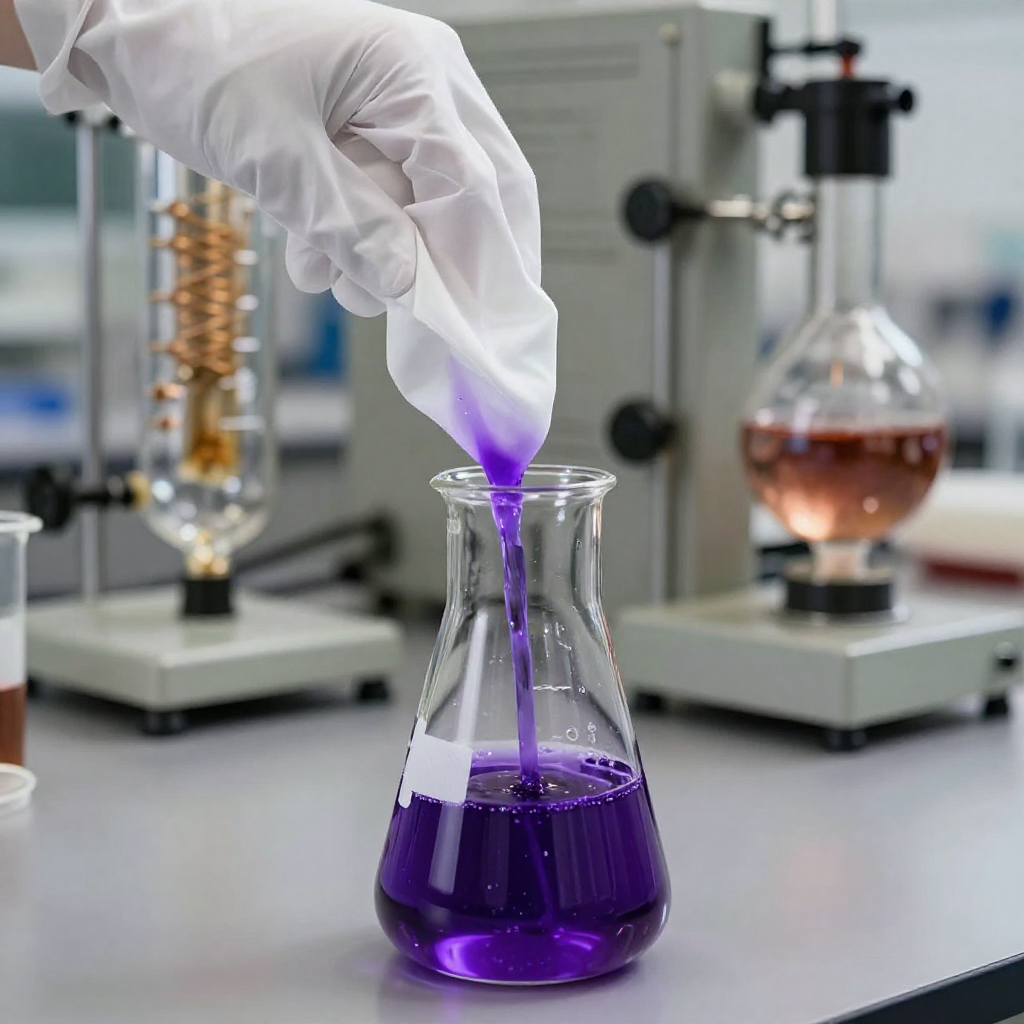


Perkin's Mauveine — The First Synthetic Aniline Dye from Coal Tar
In 1856, eighteen-year-old William Henry Perkin, a chemistry student at the Royal College of Chemistry in London, accidentally synthesized the first synthetic dye while attempting to make quinine from coal tar derivatives. His experiment failed to produce quinine, but the reddish-brown residue in his flask dissolved in alcohol to produce a vivid purple solution that dyed silk beautifully and resisted washing and sunlight. He called it 'mauveine' — the color mauve.
Perkin immediately recognized the commercial potential. Natural purple dyes were among the most expensive in the world: Tyrian purple from murex shells cost more than gold by weight, and orchil lichen dye faded rapidly. Perkin's mauveine was cheap, consistent, and permanent. At age nineteen, he patented the process, built a factory in Greenford, and began mass-producing synthetic dye. By 1859, mauveine was fashionable across Europe — Queen Victoria wore a mauveine-dyed silk gown to her daughter's wedding in 1858.
Perkin's discovery launched the synthetic dye industry and, with it, the entire field of organic chemistry. Within twenty years, German chemists had synthesized dozens of new colors — fuchsine, alizarin, methyl violet, Congo red, indigo — each cheaper and more permanent than its natural counterpart. The natural dye trade collapsed. India's indigo plantations, Turkey's madder fields, and Mexico's cochineal farms lost their markets to factories in Germany and England. By 1900, over 90% of the world's dyes were synthetic, all descended from Perkin's accidental purple.
Nội dung nguy hiểm
Blueprint này chứa các quy trình nguy hiểm. Đăng nhập và bật nội dung nguy hiểm trong cài đặt tài khoản của bạn để xem hướng dẫn từng bước.
Đăng nhậpBản thiết kế này làm ra
Blueprint liên quan
Các blueprint này chia sẻ kiến thức — kỹ thuật, vật liệu hoặc nguyên tắc

CC0 Phạm vi công cộng
Bản thiết kế này được phát hành theo CC0. Bạn tự do sao chép, sửa đổi, phân phối và sử dụng cho bất kỳ mục đích nào mà không cần xin phép.
Hỗ trợ nhà sáng tạo bằng cách mua sản phẩm qua bản thiết kế, nơi họ nhận Hoa hồng nhà sáng tạo do nhà bán hàng đặt, hoặc tạo phiên bản mới và kết nối trong bản thiết kế riêng để chia sẻ doanh thu.