

Pitch Bowl for Repoussé
Chasing and repoussé need a support that behaves in two contradictory ways. It has to be firm enough that a hammered punch moves the metal instead of just pushing it away — and soft enough to yield behind the punch so the metal stretches into it rather than tearing.
Pitch does exactly that. It is a viscoelastic solid: strike it fast and it resists like a solid, press it slowly and it flows like a liquid. Warm the surface and the sheet beds into it; work it cold and it holds.
The mix is the whole craft. Pitch alone is too soft and too sticky, so it is loaded with a filler — plaster of Paris or brick dust — for body, and a little tallow or linseed oil for pliability. Adjust the ratio to your workshop temperature, not to a number in a book, because the right hardness in a cold shed is the wrong hardness in a warm one.
Hướng dẫn
Get a heavy hemispherical bowl
Get a heavy hemispherical bowl
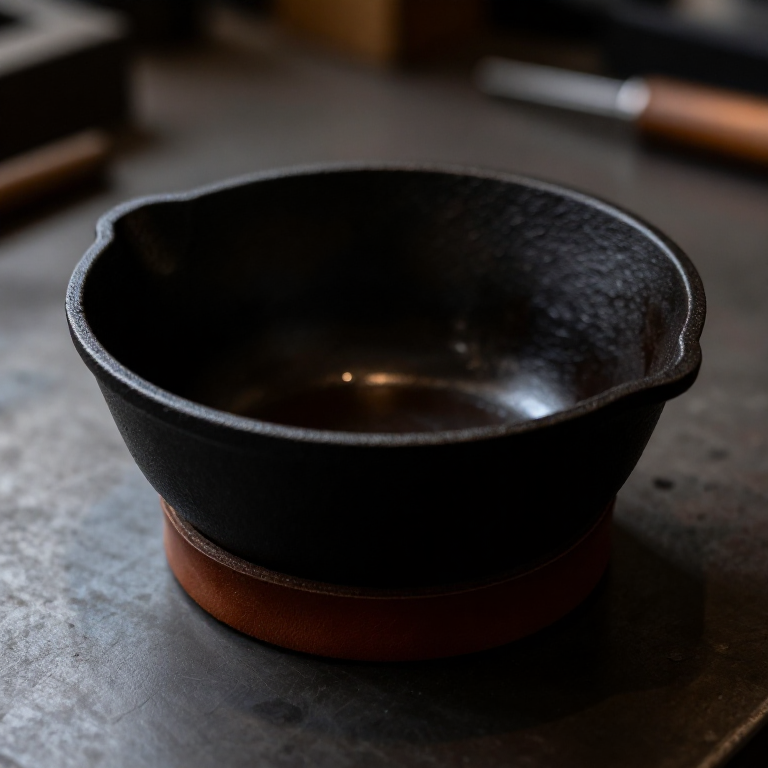
Use a cast iron hemisphere 150-200 mm across. Weight matters — a light bowl bounces under the hammer and absorbs the blow that should be going into the metal.
Vật liệu cho bước này:
 Bát gang1 cái
Make a ring to seat it in
Make a ring to seat it in
Make a leather or rope ring for the bowl to sit in. It lets you tilt the bowl to any angle and hold it there, so the work can always be presented square to the hammer.
Weigh out the pitch
Weigh out the pitch
Weigh 600 g of pine pitch or chaser's pitch. This is the binder and everything else is judged against it.
Vật liệu cho bước này:
 Nhựa gắn của thợ chạm600 g
Công cụ cần thiết:
 Cân điện tử
Weigh the filler at roughly equal parts
Weigh the filler at roughly equal parts
Weigh out 600 g of plaster of Paris or fine brick dust — a documented starting point is one part pitch to one part filler by volume, with published recipes running as high as eight parts filler to six of pitch for a harder mix.
Vật liệu cho bước này:
 Thạch cao Paris600 g
Measure a small quantity of tallow
Measure a small quantity of tallow
Measure about 60 g of tallow or boiled linseed oil — roughly one part to ten of pitch. This is the plasticiser; too much and the pitch never firms up at all.
Vật liệu cho bước này:
 Mỡ lá bò60 g
Melt the pitch gently outdoors
Melt the pitch gently outdoors
Melt the pitch slowly in a metal pot over low heat, outdoors or with strong ventilation. Pitch is flammable and burns badly on skin because it sticks. Keep a lid within reach to smother the pot and never leave it heating unattended.
Công cụ cần thiết:
 Găng tay nitrile
 Kính bảo hộ kín
Never add water to hot pitch
Never add water to hot pitch
Keep all water away from the pot. Water hitting molten pitch flashes to steam instantly and throws burning material out of the vessel.
Stir the filler in a little at a time
Stir the filler in a little at a time
Add the plaster or brick dust in small additions, stirring each in fully before the next. Dumping it in at once makes lumps that never disperse.
Stir in the tallow last
Stir in the tallow last
Add the tallow or oil at the end and stir until the mix is uniform and glossy.
Test a spoonful before pouring the lot
Test a spoonful before pouring the lot
Pour a spoonful onto a cold plate, let it set and press it with a thumb. It should take a slow dent under steady pressure and resist a quick jab. Too soft, add filler; too hard, add pitch and a little tallow.
Pour the bowl and let it cool slowly
Pour the bowl and let it cool slowly
Fill the bowl to a slight dome and leave it to cool undisturbed for several hours. Cooling it fast makes it crack; a cracked block still works but tears the sheet where the crack opens.
Warm the surface to set the work in
Warm the surface to set the work in
Warm the top of the pitch with a soft flame until it is tacky, not running, then press the annealed sheet into it and work the pitch up over the edges to grip it.
Chase and repoussé
Chase and repoussé
Work from the back to push forms out and from the front to define lines, with the metal seated in the pitch throughout. Reheat and re-seat whenever the pitch stops supporting the area you are hitting.
Release and clean the piece
Release and clean the piece
Warm the pitch to lift the sheet, then burn the residue off with a soft flame or dissolve it with turpentine. Then anneal the metal again before the next round of work.
Adjust the mix for your workshop
Adjust the mix for your workshop
Note the room temperature alongside how the pitch behaved. Remelt with more filler for a warm shop and more pitch for a cold one. Working pitch is kept in three grades — soft, medium and hard — for exactly this reason.
History & Context
History & Context
The oldest support in metalworking. Chasing and repoussé are among the earliest ways of shaping sheet metal, and both need a backing that is firm and yielding at once. Pitch has filled that role for thousands of years because nothing else does the job as cheaply — sandbags spread the blow too much, lead marks the work and is poisonous, and hard forms only suit shapes made in a die.
Recipes, not a recipe. The historical formulations vary widely and all follow the same three-part logic: a pitch binder, a mineral filler for body, and a fat or oil for pliability. Published mixes include six parts chaser's pitch to eight parts plaster of Paris or brick dust with one part tallow or linseed oil; one part black pitch to one part plaster with a little linseed; and, from the jewellery literature, burgundy pitch with tallow or beeswax and a little linseed oil. Pumice, fine clay and sand all appear as fillers too. There is no single correct ratio, which is why the thumb test matters more than the numbers.
Why the bowl is a hemisphere. A hemisphere in a ring can be tilted to any angle and stays there. The chaser wants the working surface square under the hammer at all times; on a flat block that means moving your body, on a tilting bowl it means moving the bowl. It is a small piece of ergonomics that changes how long you can work.
What it is not. Pitch is not an adhesive holding the work down, and it is not a die. It is a support that deforms under the punch and stays deformed, so the metal is stretched into a shape rather than bent over an edge. That distinction is the difference between repoussé and simple sheet bending, and it is why the medium has never been replaced — modern shops still use pitch, and the only real change is that some now use synthetic pitch compounds instead of pine.
Vật liệu
5- 1 cáiTạm thời
- Tạm thời
- 600 gTạm thời
- 60 gTạm thời
- 600 gTạm thời
Công cụ yêu cầu
3- Tạm thời
- Tạm thời
- Tạm thời
Bản thiết kế này làm ra

CC0 Phạm vi công cộng
Bản thiết kế này được phát hành theo CC0. Bạn tự do sao chép, sửa đổi, phân phối và sử dụng cho bất kỳ mục đích nào mà không cần xin phép.
Hỗ trợ nhà sáng tạo bằng cách mua sản phẩm qua bản thiết kế, nơi họ nhận Hoa hồng nhà sáng tạo do nhà bán hàng đặt, hoặc tạo phiên bản mới và kết nối trong bản thiết kế riêng để chia sẻ doanh thu.