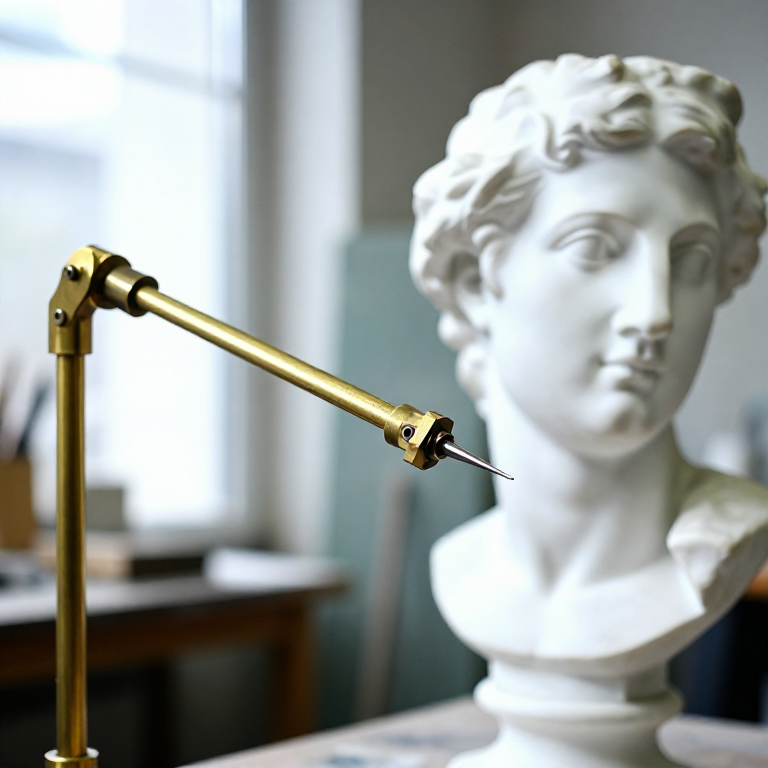


Pointing Machine
Copying a sculpture in stone is a measurement problem. Every point on the model has a height, a width and a depth, and carving it into a block means transferring all three — thousands of times — without accumulating error.
Callipers do it in three separate measurements per point. The pointing machine does it in one. A jointed arm carries a needle that can be set to any position in space and locked there. Touch the needle to a point on the model, lock everything, carry the whole frame to the block, set it on the same three reference points, and carve until the needle reaches its stop. That point is now transferred exactly.
It is not a shortcut around skill — it is a device for eliminating one specific kind of error, and it is why marble copies of the same statue can be identical to the millimetre.
Hướng dẫn
Understand what has to stay fixed
Understand what has to stay fixed
The machine only works if it can be set up identically on model and block. That needs three reference points that exist on both — usually three fixed studs or drilled marks arranged in a wide triangle. Choose them before you build anything.
Make the cross frame
Make the cross frame
Build a rigid frame or crosspiece that seats on those three points. Everything else hangs off it, so any flex here is error in every single measurement.
Vật liệu cho bước này:
 Thanh thép mềm1 cái
Fit three adjustable feet
Fit three adjustable feet
Fit three feet to the frame that locate positively on the reference points and lock. They must seat the same way every time, which means a point sitting in a cone, not a flat resting on a flat.
Build the arm from brass or steel rods
Build the arm from brass or steel rods
Make an arm of two or three rods joined by pivots, each of which can be locked. Brass and stainless steel are the traditional materials because they stay dimensionally stable and do not rust into their joints.
Vật liệu cho bước này:
 Thanh đồng thau2 cái
Công cụ cần thiết:
 Bộ giũa kim
Make each joint lock hard
Make each joint lock hard
Give every pivot a clamping screw that holds it absolutely. A joint that creeps under the weight of the arm turns an exact measurement into an approximate one, silently.
Fit the sliding needle
Fit the sliding needle
Fit a long needle that slides through the last joint and can be clamped at any extension. The needle is the measurement — everything else exists to hold it in place.
Add the stop collar
Add the stop collar
Fit a collar that clamps to the needle behind the joint. This stop is the depth memory of the whole machine: carving continues until the needle can slide back until it meets the collar.
Set the three points on the model
Set the three points on the model
Fix the three reference studs onto the plaster model and mark their positions carefully. These points are the shared coordinate system between two objects.
Vật liệu cho bước này:
 Thạch cao Paris2 kg
Transfer the three points to the block
Transfer the three points to the block
Set matching points on the stone block, checking all three distances between them against the model. Get these wrong and every transferred point is wrong by the same amount.
Take the first measurement
Take the first measurement
Seat the frame on the model, swing the arm so the needle tip just touches a chosen point at right angles to the surface there, and lock every joint and the stop.
Move the whole machine to the block
Move the whole machine to the block
Lift the frame with everything still locked, seat it on the corresponding three points on the stone, and see how far the needle is buried in the waste.
Drill down to the needle depth
Drill down to the needle depth
Carve or drill carefully at that spot until the needle can slide back to its stop. That single hole bottom is now exactly the surface of the finished sculpture at that point.
Repeat across the whole form
Repeat across the whole form
Work systematically over the model, taking points more densely where the form changes fast — noses, fingers, drapery folds — and sparsely on flat areas. Dozens to hundreds of points produce an accurate copy.
Carve away the ground between the points
Carve away the ground between the points
Remove the waste between the drilled point bottoms until the surface just touches all of them. The points are the map; the carving between them is still done by eye and hand.
Check accuracy by re-measuring
Check accuracy by re-measuring
Go back and re-take a few points already carved. If the needle no longer reaches its stop, you have gone past the surface — and that error is unrecoverable in stone, which is the reason for measuring first and cutting second.
History & Context
History & Context
Disputed invention, well-understood need. The pointing machine's invention has been ascribed both to the French sculptor and medallist Nicolas-Marie Gatteaux (1751–1832) and to the British sculptor John Bacon (1740–1799), and it was later refined in Canova's studio. The honest position is that it emerged in the late eighteenth century among sculptors who had the same problem and that no single claim is secure.
Similar devices are much older. Copying Greek sculpture for the Roman market was a large industry, and it used measuring and transfer methods of its own. The eighteenth-century machine is a refinement of an ancient practice, not a new idea.
The actual advantage, precisely stated. With callipers, every point costs three measurements — height, width and depth — and three chances to make an error. The pointing machine measures each point once, as a single locked position in space. That is the whole efficiency, and over several hundred points it is the difference between a feasible job and an impossible one.
Why sculptors argue about it. A pointing machine lets a studio produce marble from a clay or plaster model made by the master, carved by assistants who need not have designed anything. That is exactly how Canova's and Thorvaldsen's studios worked, and it is why "did the sculptor carve it?" is a genuinely complicated question for nineteenth-century marble. The machine did not lower the skill needed to carve; it separated the design from the carving, and the argument since has been about whether that matters.
What replaced it. Photogrammetry, 3D scanning and CNC carving do the same job now — measure a model, transfer to stone — with the points taken in millions rather than hundreds. The logic is identical. Plenty of studios still keep a pointing machine, because it needs no power, no computer and no calibration beyond three points that stay put.
Vật liệu
3- 1 cáiTạm thời
- 2 cáiTạm thời
- 2 kgTạm thời
Công cụ yêu cầu
1- Tạm thời
Vật liệu bản thiết kế liên kết

Bản thiết kế này làm ra
CC0 Phạm vi công cộng
Bản thiết kế này được phát hành theo CC0. Bạn tự do sao chép, sửa đổi, phân phối và sử dụng cho bất kỳ mục đích nào mà không cần xin phép.
Hỗ trợ nhà sáng tạo bằng cách mua sản phẩm qua bản thiết kế, nơi họ nhận Hoa hồng nhà sáng tạo do nhà bán hàng đặt, hoặc tạo phiên bản mới và kết nối trong bản thiết kế riêng để chia sẻ doanh thu.