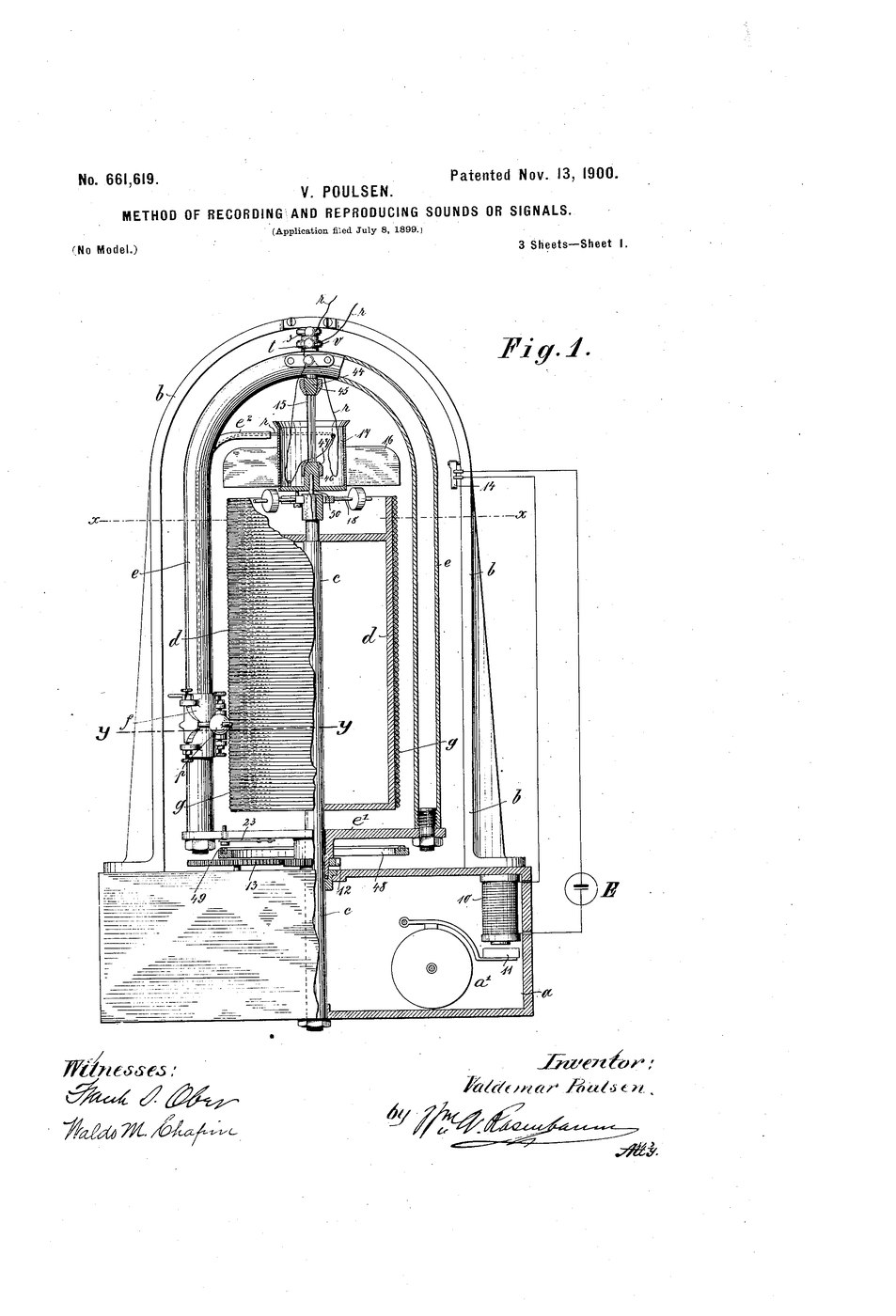


Telegraphone
Every recording method before this one cuts something. A phonograph dents wax, a gramophone scratches a groove — the sound becomes a physical shape, and physical shapes wear out. Every playback drags a needle across the record and takes a little of it away, and nothing recorded can ever be un-recorded.
Poulsen stores sound as magnetism instead. A steel wire runs past an electromagnet carrying the signal current, and each stretch of wire is left magnetised in proportion to the sound at that instant. Nothing is cut, nothing touches hard enough to wear, playback takes nothing away — and running a strong field over it wipes the wire clean for re-use.
US Patent 661,619, "Method of recording and reproducing sounds or signals", filed 8 July 1899 and granted 13 November 1900 to Valdemar Poulsen. He describes "a paramagnetic body such as a steel wire", and gives the purpose plainly: receiving and temporarily storing telephone messages when the subscriber is out.
Hướng dẫn
Read US 661,619 and note the intended use
Read US 661,619 and note the intended use
Poulsen is not aiming at music. He wants a telephone that takes messages while you are out — the answering machine, patented in 1899.
Magnetise a needle and prove it holds
Magnetise a needle and prove it holds
Stroke a steel needle with a magnet and check it picks up filings hours later. Steel remembers a field — that memory is the storage medium.
Wind steel wire in a helix on a cylinder
Wind steel wire in a helix on a cylinder
Wind hard steel wire in a single close helix along a wooden cylinder, exactly as the patent describes. Turns must not touch or the recording bleeds between them.
Vật liệu cho bước này:
 Dây thép mạ kẽm1 mét
Công cụ cần thiết:
 Kìm mỏ dẹt
Mount the cylinder to turn steadily
Mount the cylinder to turn steadily
Fit it on an axle that rotates at a constant rate. Speed changes during recording becomes pitch wobble on playback, so consistency matters more than speed.
Vật liệu cho bước này:
 Thanh chốt gỗ1 cái
Wind the recording head
Wind the recording head
Wind several hundred turns of fine enamelled wire on a small soft-iron core, leaving a narrow gap that will ride against the steel wire.
Vật liệu cho bước này:
 Dây đồng tráng men1 cuộn
Mount the head on a follower
Mount the head on a follower
Fix the head so it tracks along the helix as the cylinder turns, staying in contact. Poulsen's head follows the wire; it does not sit still.
Check the head's resistance
Check the head's resistance
Measure the coil. A few ohms to a few tens of ohms is workable; open circuit means a broken enamel joint, which is the usual fault.
Công cụ cần thiết:
 Đồng hồ vạn năng số — tự chọn thang, True RMS
Wipe the wire with a strong magnet
Wipe the wire with a strong magnet
Run a permanent magnet along the whole helix to erase it. Always start from a blank medium — old magnetisation prints through as a ghost.
Record a tone
Record a tone
Feed a low-level audio signal through the head while the cylinder turns once. The wire is now magnetised in a pattern matching the waveform.
Công cụ cần thiết:
 Nguồn điện để bàn
Play it back into an amplifier
Play it back into an amplifier
Disconnect the source, connect the head to an amplifier and speaker, and turn the cylinder again at the same speed. The tone returns.
Công cụ cần thiết:
 Loa mini 8 ohm 2 W
Now listen without the amplifier
Now listen without the amplifier
Connect the head straight to an earpiece, as Poulsen had to. It is barely audible. This faintness is why the invention failed for thirty years.
Play the same recording ten times
Play the same recording ten times
Replay repeatedly and listen for degradation. There is essentially none — nothing is being scraped away. Compare with a stylus in a groove.
Erase and record something else
Erase and record something else
Wipe with the magnet and record again on the same wire. The medium is reusable — no other recording method of 1900 could do this.
Halve the rotation speed and re-record
Halve the rotation speed and re-record
Record at half speed and play back at full. Everything shifts up in pitch, and the top end gets worse — how much wire passes per second sets the fidelity ceiling.
History & Context — right invention, missing amplifier
History & Context — right invention, missing amplifier
The patent. US 661,619, "Method of recording and reproducing sounds or signals", filed 8 July 1899 and granted 13 November 1900 to Valdemar Poulsen, a Danish engineer at the Copenhagen Telephone Company.
It worked, and it won prizes. The Telegraphone took the Grand Prix at the 1900 Paris Exposition, where Poulsen recorded the voice of Emperor Franz Joseph of Austria — believed to be the oldest surviving magnetic recording. The principle was correct in 1899 and is still correct: it is what a cassette, a hard disk platter and a credit-card stripe all do.
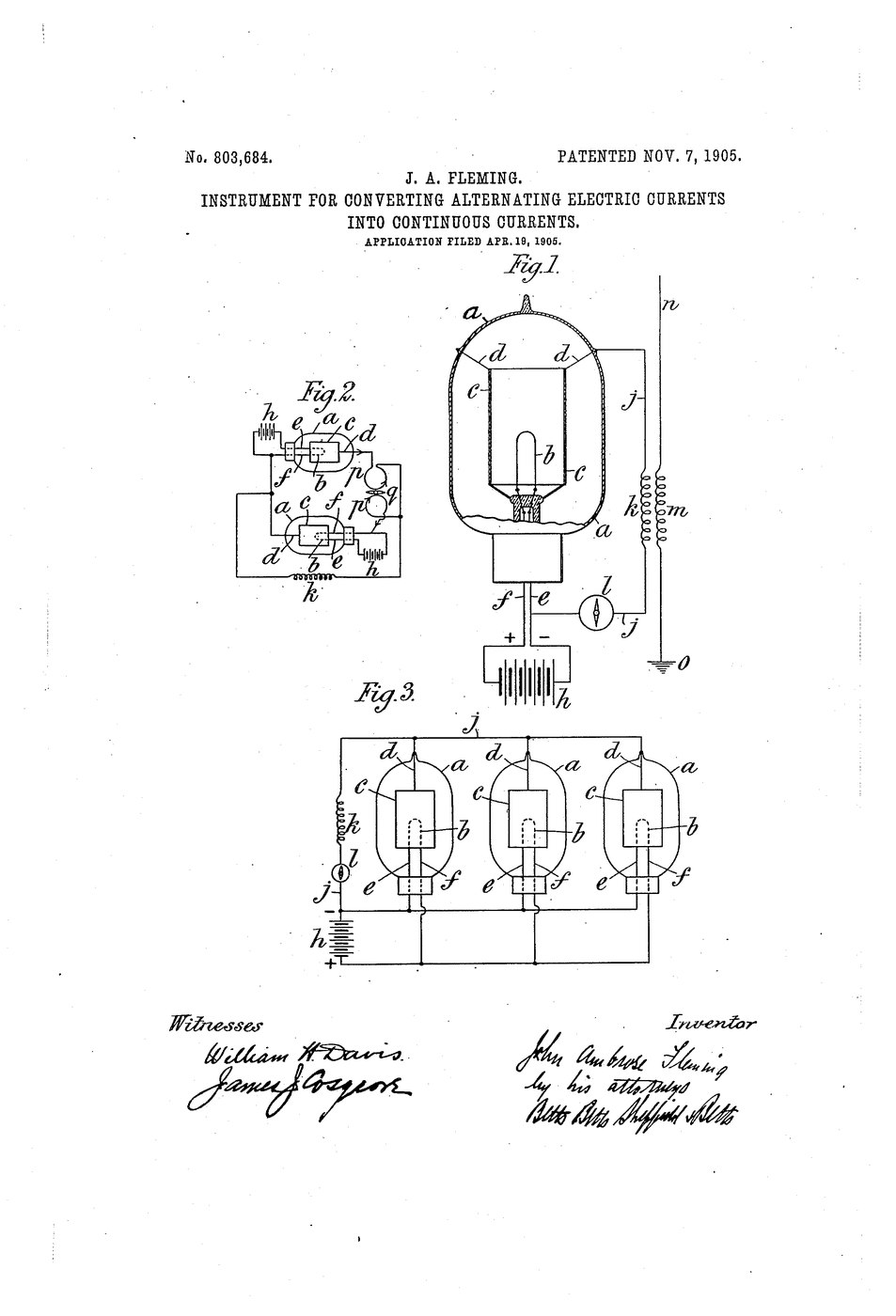
🔴 And it failed commercially for three decades, for one reason. The signal a magnetised wire induces back into a coil is tiny — step 11 is not a defect in your build, it is the historical condition. In 1900 there was no way to make a small electrical signal larger. The Fleming valve arrives in 1905 and De Forest's amplifying Audion in 1906, both elsewhere in this collection, and only then does magnetic recording become listenable in a room rather than through a pressed-to-the-ear receiver. Poulsen is the third inventor in this programme whose idea was complete and whose supporting technology did not exist yet — Nipkow needed the same amplifier for television, and Seely's electric iron needed a daytime power grid. Being right early is a distinct failure mode, and it is common.
Why magnetism beats cutting, once you can hear it. Steps 12 and 13 are the two properties no mechanical format has. Playback is non-destructive because the head reads a field rather than being dragged by a groove wall, so a recording can be played indefinitely. And the medium is erasable, which means a reusable, editable, correctable record — a completely different relationship with recorded sound from a wax cylinder you have ruined if you make a mistake. Broadcasting, dictation and eventually multitrack music production all depend on being able to record over something.
What came after the gap closed. Once amplification existed, magnetic recording moved from wire to coated tape — Fritz Pfleumer's paper tape dusted with iron oxide in the late 1920s, then German Magnetophon machines in the 1930s, whose captured examples startled Allied engineers after the war with how good they sounded. Wire recorders lingered into the 1950s and lost, because tape can be cut and spliced and wire cannot. Poulsen himself moved on to the arc transmitter for radio, and is better remembered in Denmark for that.
Vật liệu
3- 1 métTạm thời
- 1 cáiTạm thời
- 1 cuộnTạm thời
Công cụ yêu cầu
4- Tạm thời
- Tạm thời
- Tạm thời
Blueprint liên quan
Các blueprint này chia sẻ kiến thức — kỹ thuật, vật liệu hoặc nguyên tắc


CC0 Phạm vi công cộng
Bản thiết kế này được phát hành theo CC0. Bạn tự do sao chép, sửa đổi, phân phối và sử dụng cho bất kỳ mục đích nào mà không cần xin phép.
Hỗ trợ nhà sáng tạo bằng cách mua sản phẩm qua bản thiết kế, nơi họ nhận Hoa hồng nhà sáng tạo do nhà bán hàng đặt, hoặc tạo phiên bản mới và kết nối trong bản thiết kế riêng để chia sẻ doanh thu.