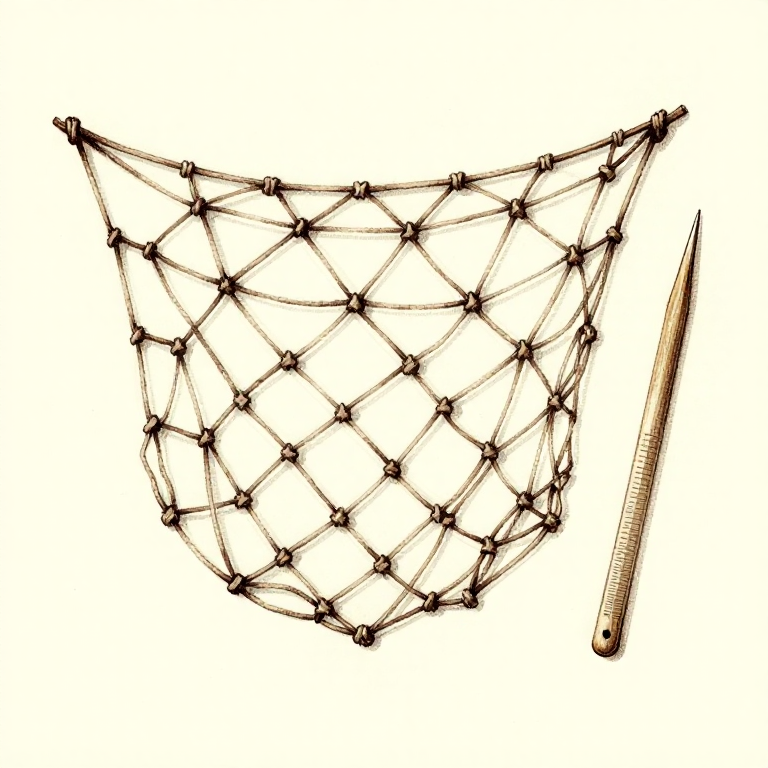


Knotting a Cord Fishing Net — Mesh Netting from Plant Fiber
Hướng dẫn
Prepare Cordage and Tools
Prepare Cordage and Tools
You need a large quantity of thin, strong cordage — 50-80 metres for a net roughly 2m x 1m. Reverse-wrap cordage from nettle bast, lime inner bark, or hemp fiber works well. The cord should be about 2mm diameter — thin enough to be nearly invisible in water but strong enough to hold a thrashing fish. Carve a flat netting shuttle from a thin piece of hardwood — this holds a length of cord and passes through the mesh loops. Also carve a mesh gauge — a flat stick whose width determines the size of each mesh opening. For general river fish, a gauge width of 3-4cm produces suitable mesh.
Vật liệu cho bước này:
 Dây thừng, dây bện50-80m total m
 Xương1 cái
 Thanh chốt gỗ1 (determines mesh size) cái
 Dây thừng chịu lực2m for headline m
Công cụ cần thiết:
 Dao đá lửa
 Vồ gỗ
Vồ gỗSet Up the Headline
Set Up the Headline
Stretch a thicker cord (the headline) horizontally between two fixed points at working height. This is the top edge of the net. Tie a series of foundation loops onto the headline, spaced at intervals equal to twice the gauge width. These loops form the first row of meshes. The number of loops determines the net width — 20-30 loops creates a net about 1.5-2 metres across.
Knot the Mesh Rows
Knot the Mesh Rows
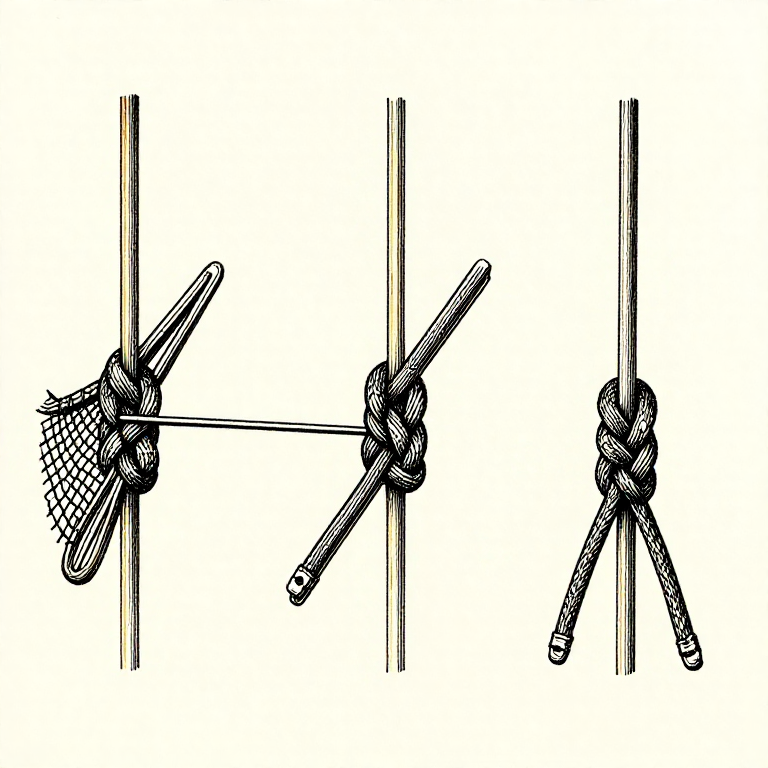
Load the shuttle with cordage. Working left to right, pass the shuttle down through the first loop, around the gauge stick, and tie a sheet bend knot (also called a mesh knot). The gauge stick ensures every mesh is the same size. Continue across the row, knotting into each loop. At the end of the row, turn and work back right to left, knotting into the loops of the previous row. This creates the characteristic diamond pattern of netting. Keep consistent tension — loose knots create uneven mesh that fish escape through.
Finish the Net Edges
Finish the Net Edges
After reaching the desired depth (typically 0.5-1m for a river gill net), finish the bottom edge by running a cord through the final row of loops and tying each one off. Reinforce the side edges by running a vertical cord through the outermost meshes. For a gill net, attach small stone weights to the bottom edge and small floats (bark or hollow reed sections) to the headline. The weights pull the net vertical in the water while the floats hold the top edge at the surface.
Set the Net
Set the Net
Stretch the net across a stream or river channel, securing both ends to stakes driven into the bank or to heavy stones. The net should hang vertically in the water column like a curtain. Fish swimming into the mesh become entangled by their gill covers (hence 'gill net'). Check the net every few hours — fish left too long may be taken by scavengers or begin to deteriorate. A well-made net lasts for an entire fishing season with minor repairs.
Vật liệu
7- 50-80m total mTạm thời
- 1 cáiTạm thời
- 1 (determines mesh size) cáiTạm thời
- 2m for headline mTạm thời
- Tạm thời
- 1 (determines mesh size) cáiTạm thời
- 2m for headline cáiTạm thời
CC0 Phạm vi công cộng
Bản thiết kế này được phát hành theo CC0. Bạn tự do sao chép, sửa đổi, phân phối và sử dụng cho bất kỳ mục đích nào mà không cần xin phép.
Hỗ trợ nhà sáng tạo bằng cách mua sản phẩm qua bản thiết kế, nơi họ nhận Hoa hồng nhà sáng tạo do nhà bán hàng đặt, hoặc tạo phiên bản mới và kết nối trong bản thiết kế riêng để chia sẻ doanh thu.