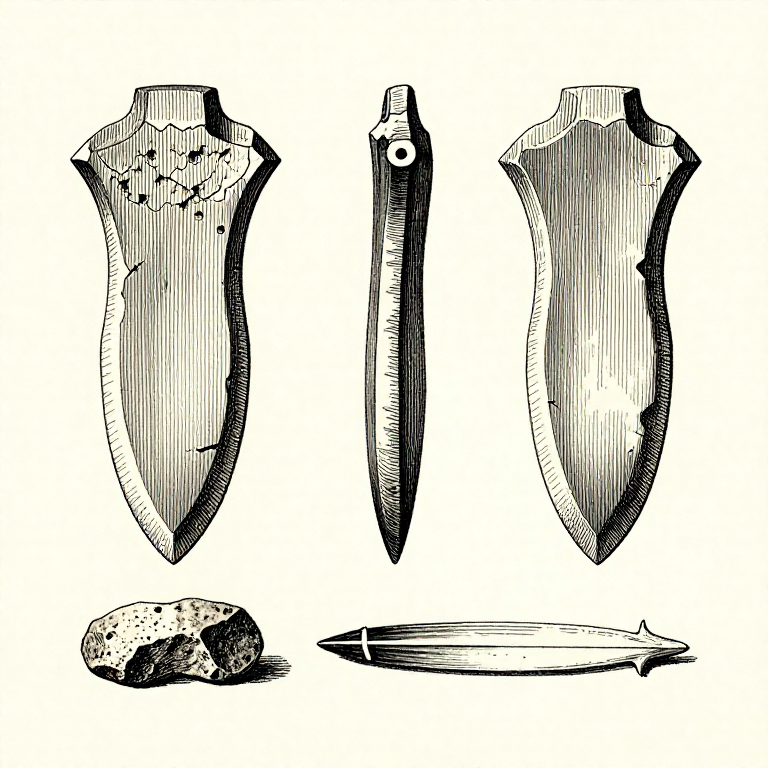


Knapping a Flint Hand Axe — Bifacial Reduction Technique
Hướng dẫn
Select and Assess the Raw Material
Select and Assess the Raw Material
Choose a flint nodule large enough to produce a hand axe 12-18 cm long. The nodule should be free of major fracture planes, frost cracks, or inclite inclusions — tap it and listen for a clear ring rather than a dull thud, which indicates internal flaws. Flint, chert, and obsidian are all conchoidal fracture materials, meaning they break in smooth, curved surfaces predictable enough to control. Assess the nodule's shape and plan which face will become which side of the finished axe. The best starting point is a naturally flat or slightly convex surface.
Vật liệu cho bước này:
 Cục đá lửa1 large piece, 15-20 cm cm
 Dây da1 piece cái
Công cụ cần thiết:
 Đá đập (hòn ghè)
 Chày gạc hươu
 Dùi ép tách vảy bằng gạc hươu
Rough Out with Hard Hammer
Rough Out with Hard Hammer
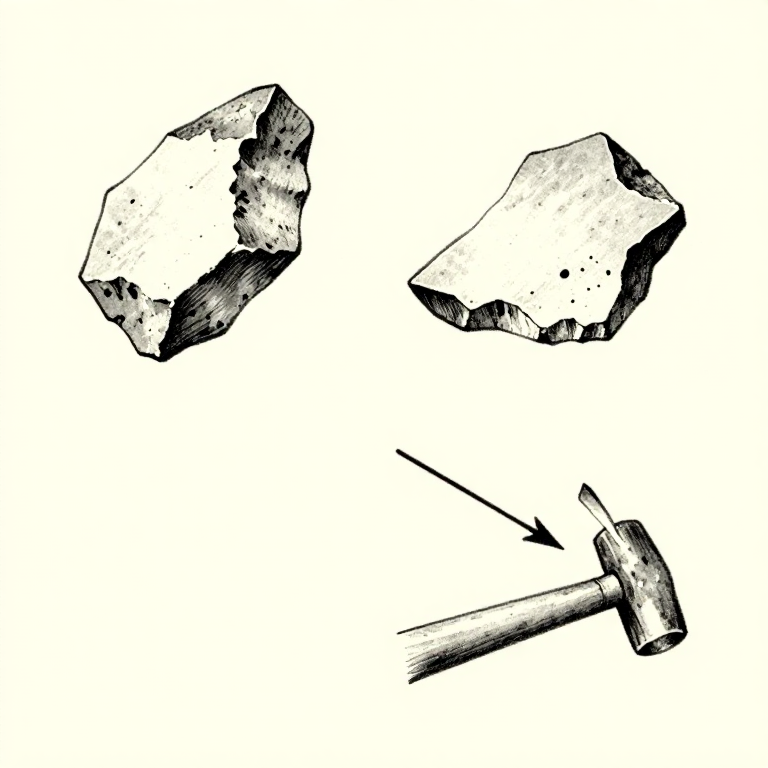
Using a round hammerstone (a hard, dense river cobble about fist-sized), strike large flakes from both faces of the nodule to establish the basic teardrop outline. Strike at the edge at an angle of about 60 degrees, aiming to remove broad, flat flakes. Work alternately on both faces — this is the bifacial technique. Each flake removed from one face creates a new platform for removing flakes from the opposite face. The goal at this stage is to reduce the nodule to a rough biface approximately the right size and shape, with a continuous edge around the perimeter.
Thin and Shape with Soft Hammer
Thin and Shape with Soft Hammer
Switch to an antler billet (a section of deer antler used as a soft hammer) for the thinning stage. Soft hammer percussion removes thinner, wider, flatter flakes than hard hammer, allowing precise control of the biface cross-section. Strike near the edge with a sweeping follow-through motion. The antler absorbs some impact energy and grips the stone surface slightly, producing a different fracture than hard stone. Work both faces evenly to maintain symmetry and a lenticular (lens-shaped) cross-section. The biface should now be about 2-3 cm thick with regular flake scars covering both faces.
Refine the Edge with Pressure Flaking
Refine the Edge with Pressure Flaking
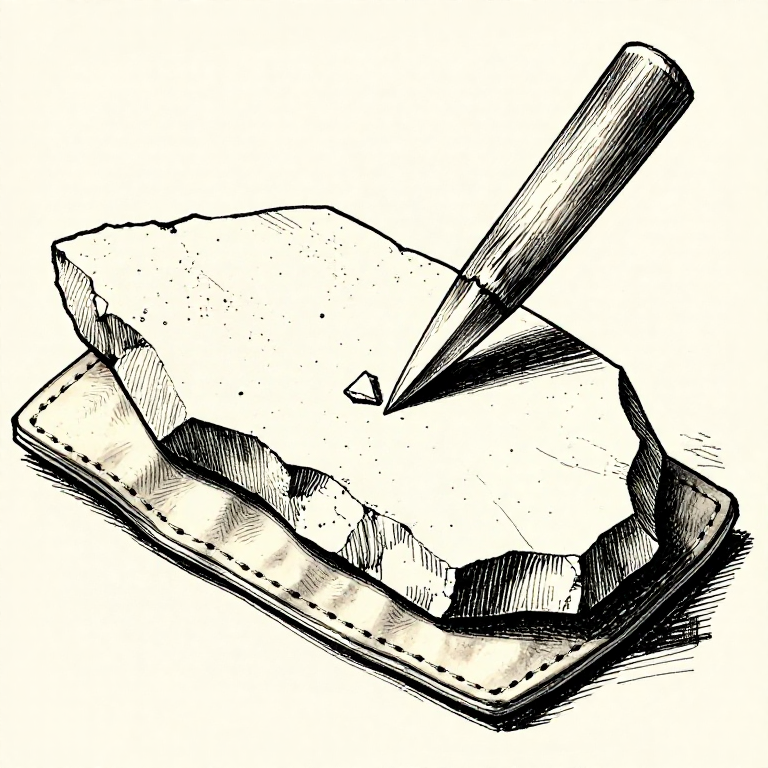
For final edge refinement, use an antler tine as a pressure flaker. Place the tip of the tine against the edge and push firmly, levering tiny flakes off the surface. Pressure flaking produces very controlled, shallow removals that straighten and sharpen the edge. Work around the entire perimeter, removing any irregularities or step fractures left by percussion. The finished edge should be sinuous but sharp — capable of cutting hide, meat, and wood. A well-made hand axe has a balanced, symmetrical form with a sharp edge extending around the pointed tip and both lateral margins.
Test and Evaluate
Test and Evaluate
Test the finished hand axe by cutting through a piece of rope or slicing into a green branch. A properly knapped edge should slice cleanly without excessive force. Assess the axe for symmetry by holding it at eye level and checking the outline from both ends. Examine the cross-section — it should be evenly lenticular, not wedge-shaped or lumpy on one face. Acheulean hand axes were multi-purpose tools used for butchering game, digging roots, cutting wood, and scraping hides. The broad base provides a comfortable grip while the pointed tip concentrates force for piercing and chopping tasks.
Vật liệu
3- 1 large piece, 15-20 cm cmTạm thời
- 1 piece cáiTạm thời
- 1 piece cáiTạm thời
Công cụ yêu cầu
4- Tạm thời
- Tạm thời
- Tạm thời
- Tạm thời
CC0 Phạm vi công cộng
Bản thiết kế này được phát hành theo CC0. Bạn tự do sao chép, sửa đổi, phân phối và sử dụng cho bất kỳ mục đích nào mà không cần xin phép.
Hỗ trợ nhà sáng tạo bằng cách mua sản phẩm qua bản thiết kế, nơi họ nhận Hoa hồng nhà sáng tạo do nhà bán hàng đặt, hoặc tạo phiên bản mới và kết nối trong bản thiết kế riêng để chia sẻ doanh thu.