

Oil-Based Printing Ink
The type mould solves the manufacture of letters. It is useless without an ink that will stay on them, and the ink the world already had would not.
Scribes and Chinese woodblock printers used water-based inks — carbon black in a water gum. On a wooden block, which is porous and absorbent, that works. On polished metal type it beads up and runs off, exactly as water does on a greasy pan, and what little clings prints as a blotchy grey smear.
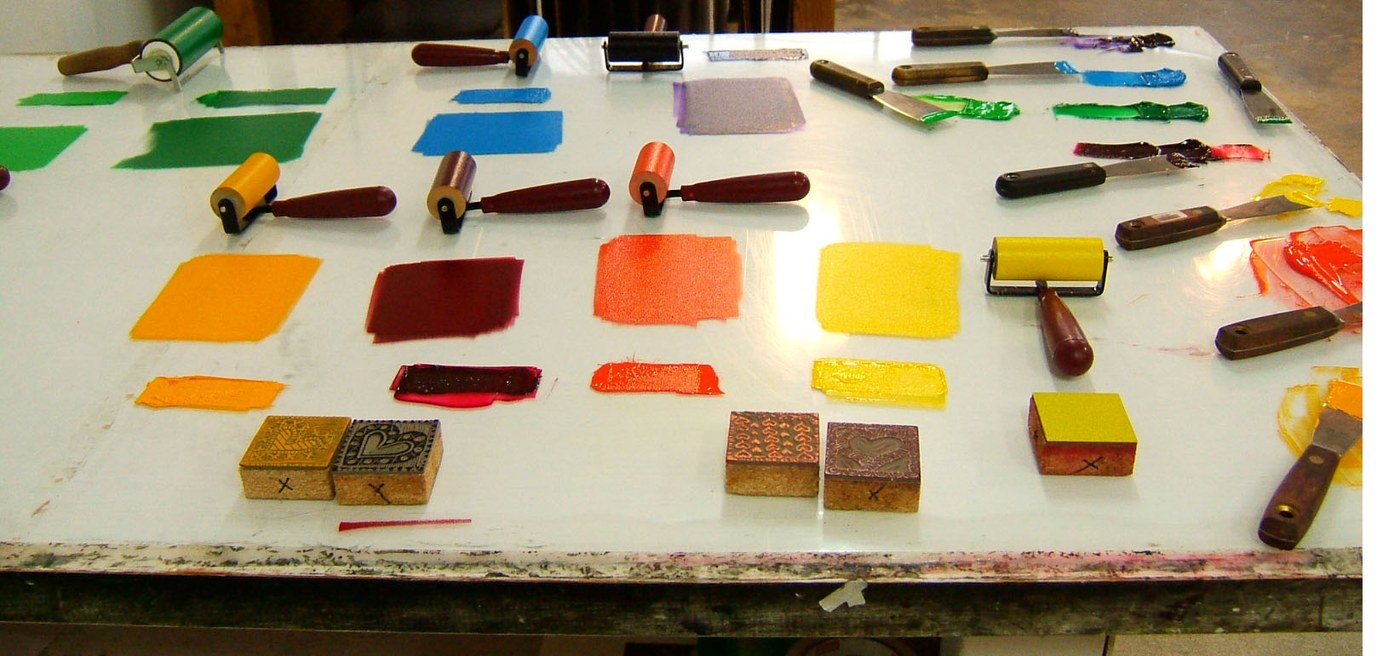
The fix is to stop fighting the metal and match it. Replace the water carrier with an oil varnish — linseed oil boiled until it thickens — and the ink now wets metal readily, because oil and metal are chemically friendlier than water and metal.
Two more properties follow, and both are essential. The ink must be stiff and tacky, like a thin paste rather than a liquid, so it stays where the roller puts it and does not run into the counters of the letters. And it must dry by a chemical change rather than by soaking in: boiled linseed oil takes up oxygen from the air and polymerises into a solid film, which is why the printed sheet does not smear the moment it is touched, and why the ink is still black on a page five hundred years later.
Painters had known this varnish for a generation. Printing borrowed it.
Hướng dẫn
Watch water ink fail on metal
Watch water ink fail on metal
Mix lampblack or soot into water with a little gum, and brush it onto three surfaces: unglazed wood, paper, and a piece of clean polished metal.
Expect it to sit evenly on the wood and paper, and to bead and streak on the metal.
Now press a sheet against the inked metal and look at the impression.
Record what you see. This failure is why Gutenberg could not simply borrow the ink that already existed, and it is a wetting problem, not a pigment problem.
Vật liệu cho bước này:
 Bột màu đen muội đèn50 g
Boil the oil into a varnish
Boil the oil into a varnish
Heat linseed oil gently and hold it hot, outdoors or under strong extraction, until it visibly thickens and strings from a stirring rod. Cool a drop on a cold plate to judge the body.
Expect it to become noticeably more viscous and slightly darker.
You are partially polymerising the oil — building longer molecules, which raises the tack and shortens the drying time.
Hot oil is a serious fire risk. Never fill the pot more than a third, keep a lid to hand to smother it, never add water, and do this outside on a stable heat source. Oily rags self-heat and can ignite — spread them flat to dry or drown them.
Vật liệu cho bước này:
 Dầu lanh500 ml
Công cụ cần thiết:
 Nhiệt kế
Grind the pigment in, and find out why grinding matters
Grind the pigment in, and find out why grinding matters
Mull lampblack into the cooled varnish on a slab with a muller or a flat stone, working it repeatedly.
Compare a barely-stirred sample with a thoroughly ground one by drawing both down on paper with a card edge.
Expect the ground ink to be denser, blacker and smoother at the same pigment loading.
Grinding does not make the pigment smaller so much as it separates clumps and wets each particle in oil. Unwetted agglomerates scatter light and look grey, and they also print as specks.
Tune the tack and see what it controls
Tune the tack and see what it controls
Make three inks: thin, medium and stiff, by varying how far you boiled the varnish or by thinning a portion.
Ink a metal surface with each and take an impression.
Expect the thin ink to flood the letter shapes and fill in enclosed counters, and the very stiff ink to skip and to pluck fibres off the paper.
There is a working window in between, and printers moved within it by season — stiffer in summer heat, softer in a cold shop. The ink is not a fixed recipe; it is adjusted to the conditions like a sourdough.
Prove it dries by reaction, not by drying
Prove it dries by reaction, not by drying
Put one inked sample in a sealed jar with as little air as possible, and leave an identical one in open air. Test both by touch every few hours.
Expect the open sample to set hard while the sealed one stays tacky far longer.
Nothing evaporated — the film took up oxygen and cross-linked. That is why a printed sheet becomes permanently dry rather than merely sticky, why the ink film sits on the surface rather than soaking through, and why the reverse of a page does not show through.
It also explains the oily-rag fire warning in step 2: the same reaction, in a crumpled rag, generates heat with nowhere to go.
History & Context
History & Context
Printing borrowed it from painting. The oil varnish that made metal type printable was already in use by Netherlandish painters, who had adopted oil binders for their depth and slow working time. Gutenberg's workshop did not discover a new chemistry so much as recognise that a painter's medium solved a printer's wetting problem. Most invention looks like this — a solution carried across a boundary rather than made from nothing.
The proof is still legible. Surviving copies of the 42-line Bible show a dense, glossy black that later centuries struggled to match, partly because the ink carried a high proportion of pigment and, analysis suggests, notable amounts of copper and lead. Whether that was deliberate or an artefact of the materials to hand is still argued. What is not in doubt is that the film has survived five and a half centuries without fading — a durability specification nobody wrote down and everybody met.
Why lampblack, of all pigments. Carbon is chemically inert, does not fade in light, is opaque in thin films, and is free — it is soot. Nearly every black in this corpus, from vine black to India ink, is the same element collected differently. For a material that must be legible for centuries, unreactive matters more than beautiful.
The idea generalises to every printing process that followed. Match the ink's chemistry to the plate's surface and to the drying you need: stiff oil paste for letterpress and offset, thin solvent inks for gravure and flexography that dry by evaporation at speed, UV inks that cross-link under a lamp in milliseconds. The lithography blueprint in this batch takes the principle further still, using an ink that adheres to grease and refuses water — the entire image is decided by ink chemistry rather than by shape.
Honest limits. Oil inks are slow: sheets had to be hung or interleaved, and set-off — one sheet marking the back of the next — was a constant hazard. They yellow slightly with age, most visible in whites and pale tints. And boiling linseed oil is genuinely dangerous, which is why varnish-making became a separate trade rather than something every printer did in the back of the shop.
Vật liệu
6- Tạm thời
- 500 mlTạm thời
- 1 tờTạm thời
- 2 lítTạm thời
- 100 gTạm thời
- 25 tờTạm thời
Công cụ yêu cầu
3- Tạm thời
- Tạm thời
- Tạm thời
Vật liệu bản thiết kế liên kết

Bản thiết kế này làm ra

CC0 Phạm vi công cộng
Bản thiết kế này được phát hành theo CC0. Bạn tự do sao chép, sửa đổi, phân phối và sử dụng cho bất kỳ mục đích nào mà không cần xin phép.
Hỗ trợ nhà sáng tạo bằng cách mua sản phẩm qua bản thiết kế, nơi họ nhận Hoa hồng nhà sáng tạo do nhà bán hàng đặt, hoặc tạo phiên bản mới và kết nối trong bản thiết kế riêng để chia sẻ doanh thu.