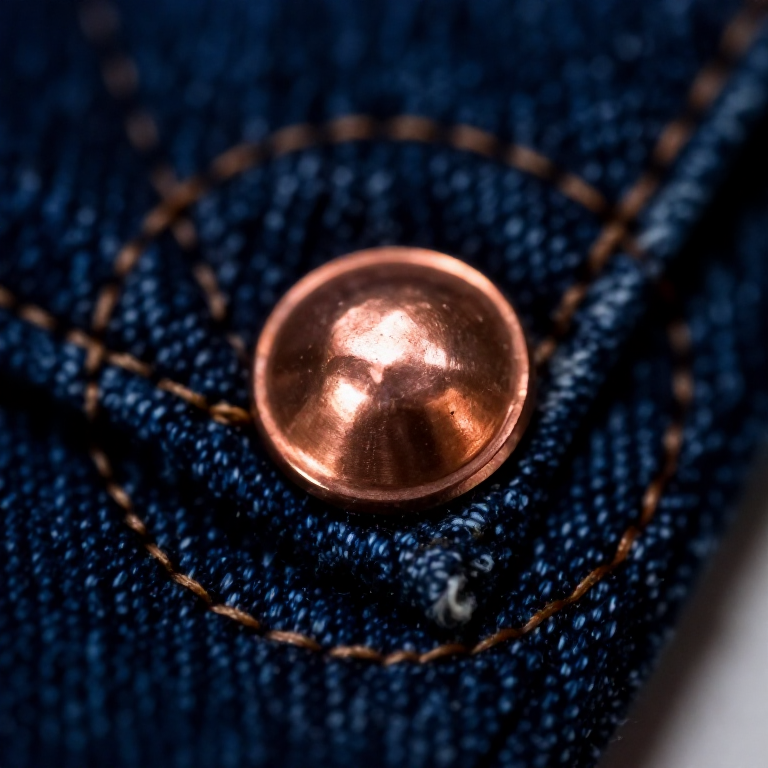


Riveted Work Trousers
Working trousers did not wear out in the middle of the cloth. They failed at the pocket corners, every time, because that is where a hand hooks in and pulls and where four layers of fabric meet a single stitch.
Jacob Davis put a copper rivet through the corner. Not stronger thread, not more stitching — a metal fastener that carries the load the seam could not. The stitch no longer has to hold; it only has to close the seam. That is a load-path change, and it is the entire patent.
US Patent 139,121, granted 20 May 1873, "Improvement in Fastening Pocket-Openings". The inventor is Jacob W. Davis, a tailor in Reno, Nevada; Levi Strauss & Co. is co-assignee, because Davis had asked Strauss to fund the filing after his customers kept asking for the reinforced pairs he had been making by hand.
Hướng dẫn
Find the failure before you design for it
Find the failure before you design for it
Look at a worn pair of work trousers. The holes are at the pocket corners and the fly base, not in open cloth. Reinforce where it breaks, not everywhere.
Read US 139,121 and note how narrow the claim is
Read US 139,121 and note how narrow the claim is
Davis claims rivets at the pocket openings — not the trousers, not the fabric, not the cut. A narrow, specific claim is what made it defensible for seventeen years.
Choose a heavy cotton twill
Choose a heavy cotton twill
Use denim or duck of 10 oz or heavier. Light cloth tears around a rivet instead of being held by it — the rivet must be the strongest thing, but not by too much.
Vật liệu cho bước này:
 Vải bò2 mét
Cut the pattern with generous seam allowances
Cut the pattern with generous seam allowances
Cut fronts, backs, pockets and waistband. Allow extra at the pocket corners — a rivet needs material around it or it simply pulls through.
Sew the pockets on with a flat-felled seam
Sew the pockets on with a flat-felled seam
Fold the raw edge inside and stitch twice. This encloses the edge so nothing frays under the load the rivet is about to concentrate.
Vật liệu cho bước này:
 Chỉ cô tông50 mét
Công cụ cần thiết:
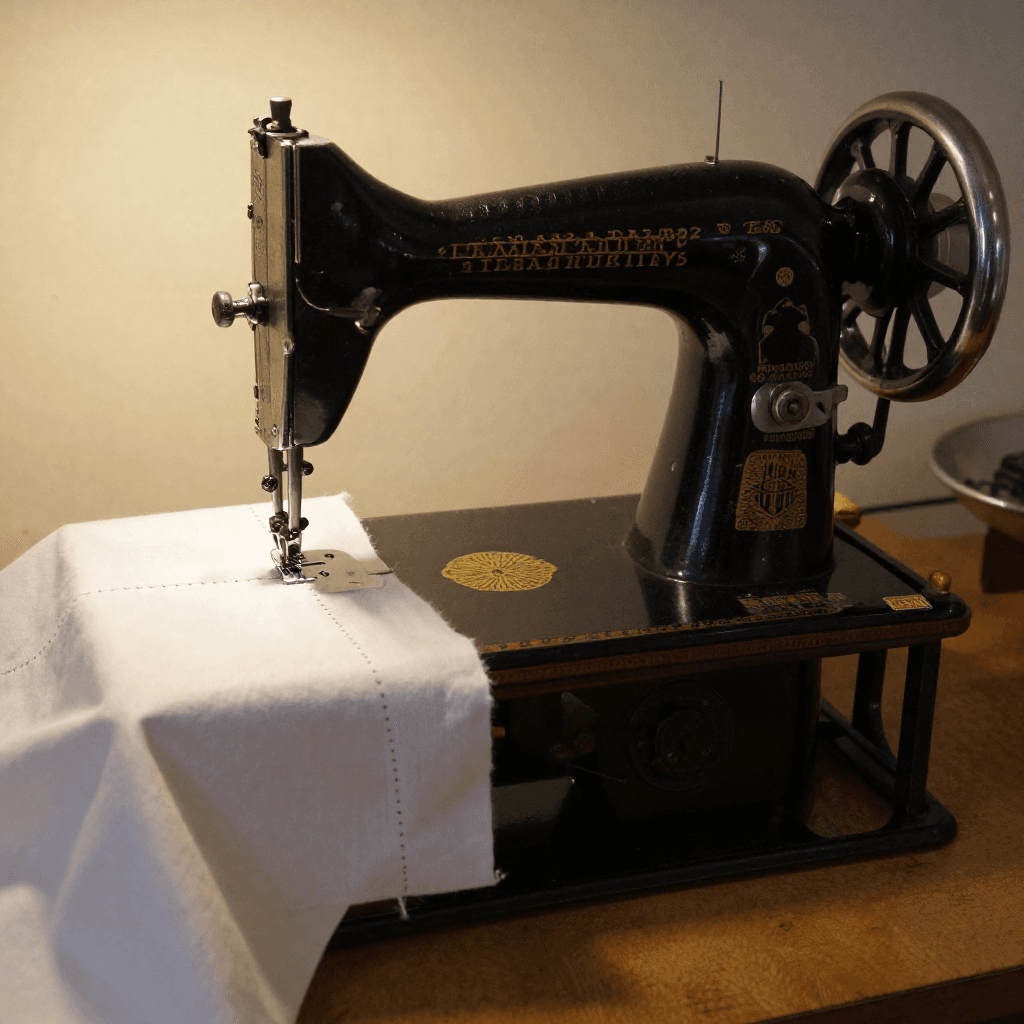
 Máy khâu
Mark the rivet positions at the stress points
Mark the rivet positions at the stress points
Mark both top corners of each pocket. Place the rivet so it catches EVERY layer, including the trouser body — a rivet through the pocket alone does nothing.
Công cụ cần thiết:
 Thước kẻ
Punch the holes, do not drill or cut them
Punch the holes, do not drill or cut them
Use a leather punch to make a clean round hole. A slit made with a knife becomes a tear the moment the fabric is loaded.
Công cụ cần thiết:
 Bộ đục lỗ da
Size the hole to the rivet shank exactly
Size the hole to the rivet shank exactly
The shank should be a firm push fit. Too large and the rivet works loose; too small and punching it through damages the weave around it.
Set a copper rivet and burr
Set a copper rivet and burr
Push the rivet through, slide the burr down the shank, and peen the end over. Copper because it is soft enough to deform cold and will not rust into the cloth.
Vật liệu cho bước này:
 Đinh tán đồng12 cái
Công cụ cần thiết:
 Búa tán đinh
Peen evenly, all the way round
Peen evenly, all the way round
Work round the head with light taps rather than flattening it in one blow. A lopsided head grips on one side and lets go on the other.
Bar-tack where a rivet cannot go
Bar-tack where a rivet cannot go
Use a dense zigzag at the fly base and belt loops. Rivets that sit against a saddle or a chair scratch everything — that complaint is why the crotch rivet was eventually dropped from production jeans.
Load-test a scrap seam to destruction
Load-test a scrap seam to destruction
Make a riveted sample and a stitched sample and pull both apart. Note WHERE each fails — the riveted one should tear cloth, not lose its fastener.
Wash the finished garment once before wearing
Wash the finished garment once before wearing
Heavy cotton shrinks, and it shrinks around fixed metal. One wash settles the fabric against the rivets before the trousers are fitted to a body.
Inspect the corners after a month of wear
Inspect the corners after a month of wear
Check whether the cloth has begun to wear against the rivet head. That is the real long-term failure mode, and it tells you if your hole size was right.
Compendium — the tailor who could not afford the filing fee
Compendium — the tailor who could not afford the filing fee
The patent. US 139,121, "Improvement in Fastening Pocket-Openings", granted 20 May 1873. Google Patents lists the inventor as Jacob W. Davis of Reno, Nevada; Levi Strauss & Co. of San Francisco is co-assignee, not co-inventor — a distinction worth keeping straight, because the invention is routinely credited to Strauss alone. Davis was a Latvian-born tailor who had been reinforcing customers' trousers with rivets since about 1870. He wrote to Strauss, his fabric supplier, proposing they patent it together, because the filing fee of 68 dollars was more than he could raise.
What the rivet actually does. A stitched seam distributes load along a line of thread, and at a pocket corner that line turns a right angle through several layers. The thread at the corner therefore carries a stress concentration and fails first. A rivet replaces that line with a single stiff mechanical fastener passing through every layer, so the load transfers into the fabric body rather than into the thread. The failure mode changes from a seam bursting to fabric slowly abrading — much slower, and visible long before the garment fails.
The material choice is not decorative. Copper work-hardens little, deforms cold under a hammer, and does not corrode into cotton the way iron does — an iron rivet in a damp work garment stains and eventually rots the cloth around it. Softness matters too: the rivet must be easier to deform than the fabric is to tear, which is why the hole size and the shank fit are specified so tightly in step 8.
What happened when the patent expired. The monopoly ran to 1890, and Levi Strauss & Co. produced riveted waist overalls exclusively for seventeen years. After expiry every rival adopted rivets immediately, which is why the design is now universal and generic. Two details did not survive: the crotch rivet, dropped after decades of complaints from wearers who sat near campfires or on saddles, and the exposed back-pocket rivets, which were covered and then removed after they scratched furniture and saddle leather. A patent that fixed one narrow failure ended up defining the most-produced garment in history.
Vật liệu
3- 2 métTạm thời
- 50 métTạm thời
- 12 cáiTạm thời
Bản thiết kế này làm ra
Blueprint liên quan
Các blueprint này chia sẻ kiến thức — kỹ thuật, vật liệu hoặc nguyên tắc
CC0 Phạm vi công cộng
Bản thiết kế này được phát hành theo CC0. Bạn tự do sao chép, sửa đổi, phân phối và sử dụng cho bất kỳ mục đích nào mà không cần xin phép.
Hỗ trợ nhà sáng tạo bằng cách mua sản phẩm qua bản thiết kế, nơi họ nhận Hoa hồng nhà sáng tạo do nhà bán hàng đặt, hoặc tạo phiên bản mới và kết nối trong bản thiết kế riêng để chia sẻ doanh thu.