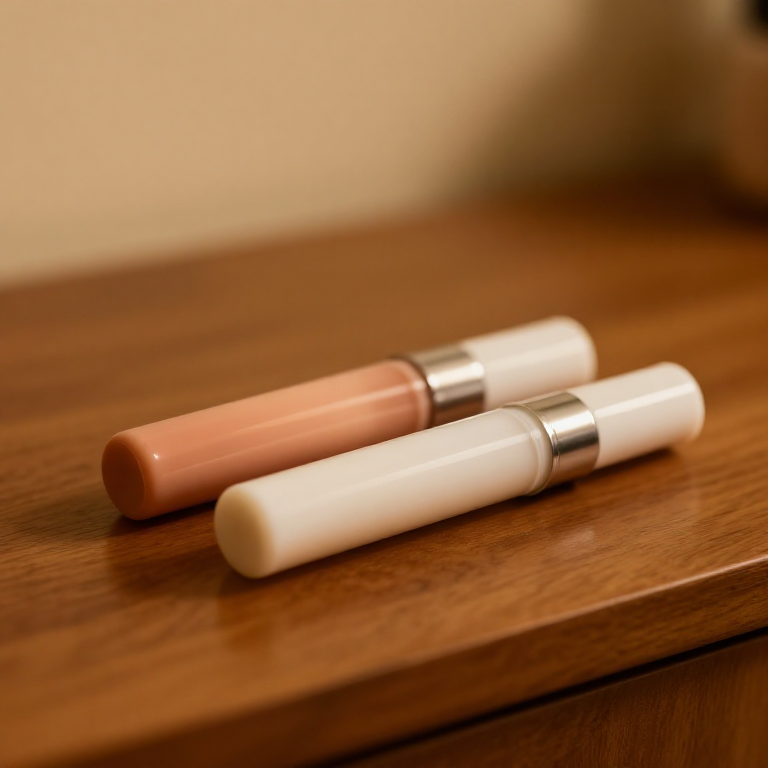


Stage Greasepaint
Stage lighting flattens a face. Gaslight and limelight did it worse than anything since — strong, low, and heavily yellow — and an unpainted actor read as a pale blank from the tenth row. Powder makeup could not hold a modelled shadow through a performance. Greasepaint could, because pigment carried in a fat sticks where it is put.
The formula is a wax-and-fat base with an opaque white mineral base tinted with earth pigments. The one number that matters is the melting point: below about 37 °C the stick softens on the skin and the makeup slides. Above it, the paint stays where the brush left it.
Everything in this build is a documented, non-toxic historical formulation. It is a chemistry exercise, a theatre-history exercise, and a lesson in why the earlier version of this product blinded people.
Hướng dẫn
Mix the white base by parts
Mix the white base by parts
Weigh out a documented white base: 75 g zinc oxide, 5 g kaolin, 20 g precipitated chalk — 750 : 50 : 200 in parts per thousand. Zinc oxide gives the opacity, kaolin the slip, chalk the body.
Vật liệu cho bước này:
 Kẽm oxit (không nano, không phủ)75 g
 Bột đất sét cao lanh5 g
 Phấn tự nhiên (cục thô)20 g
Công cụ cần thiết:
 Cân điện tử
Grind and sieve the powder blend
Grind and sieve the powder blend
Grind the three powders together in a mortar and pass them through a fine sieve. Any grit survives into the finished stick and drags across the skin.
Công cụ cần thiết:
 Cối và chày
 Rây mịn
Wear a dust mask while weighing powders
Wear a dust mask while weighing powders
Zinc oxide, kaolin and chalk are not toxic on skin, but no fine mineral dust belongs in your lungs. Weigh and grind in still air with a mask on.
Công cụ cần thiết:
 Khẩu trang N95
Weigh the wax base
Weigh the wax base
Weigh 40 g cocoa butter, 3 g beeswax and 7 g ceresine — the 80 : 6 : 14 base recorded for greasepaint sticks in the 1930 trade literature.
Vật liệu cho bước này:
 Bơ ca cao40 g
 Sáp ong dạng hạt3 g
 Sáp ceresin7 g
Melt the base in a double boiler
Melt the base in a double boiler
Melt the three waxes together over water, stirring until clear. Direct heat scorches cocoa butter and the smell stays in the product.
Công cụ cần thiết:
 Nồi cách thủy
Check the melting point is above 37 °C
Check the melting point is above 37 °C
Chill a drop on a cold spoon, then warm it and read the temperature at which it goes liquid. It must be above blood temperature. A base that melts below 37 °C turns greasy on the face and has to be powdered constantly to stay put.
Công cụ cần thiết:
 Nhiệt kế nhà bếp
Adjust the melting point with wax
Adjust the melting point with wax
Too soft, add a gram of beeswax or ceresine; too hard and it will not spread. Beeswax also gives the tack that lets setting powder cling — up to about a tenth of the base is the working guidance.
Stir the white base into the melt
Stir the white base into the melt
Add the powder blend to the molten wax a little at a time, stirring hard. Roughly equal weights of powder and base gives a paint stick; more base gives a sheer one.
Tint to a flesh shade by parts
Tint to a flesh shade by parts
For the shade recorded as No. 6 yellowish flesh, tint 88 parts white base with 10.8 parts yellow ochre and 1.2 parts Armenian bole. Weigh the pigments; judging by eye in a hot melt is unreliable, because it dries lighter than it looks.
Vật liệu cho bước này:
 Bột màu thổ hoàng vàng (thô)11 g
 Đất bole đỏ (bole Armenia)1 g
Mill the paste smooth
Mill the paste smooth
Work the warm paste on a slab with a spatula or muller until no streaks of pigment remain. Milling, not stirring, is what disperses the colour evenly.
Cast into sticks
Cast into sticks
Pour the paste into paper tubes or a silicone mould and tap out the air. Let them set at room temperature — a fridge sets them fast and cracks the core.
Test the coverage under a strong lamp
Test the coverage under a strong lamp
Draw a stripe on the back of your hand and look at it under the brightest light you have. This is the test the product exists for: it has to still read as modelled colour under stage lighting, not vanish.
Patch test before any face use
Patch test before any face use
Test on the inside of the forearm and leave it 24 hours before going near a face. Homemade cosmetics are not sterile and pigments differ between suppliers.
Set with powder, remove with oil
Set with powder, remove with oil
Dust the applied paint with a translucent powder to kill the shine. Remove it with oil or cold cream, never soap — the base is a wax, and water simply moves it around.
History & Context
History & Context
Baudin's paste. The step from powder to grease is generally credited to Carl Baudin of the Leipzig State Theatre, who mixed a flesh-coloured paste of zinc, ochre and lard — reportedly to hide the join between his wig and his forehead. It is the same three-part logic as the formula above: opaque white mineral, earth pigment, fatty carrier.
Leichner, 1873. Ludwig Leichner was an opera singer with a chemistry background who set up a makeup business in Berlin in 1873 and produced the first commercially available greasepaint made for the stage. Its advantage over the old powder makeup was covering power and colour intensity, plus far more control in application. The firm collected exhibition medals from the Berlin trade exhibition of 1879 onward, and Leichner numbers became the standard shade language of European theatre.
The poison it replaced. Before zinc oxide, the white that did this job was ceruse — lead carbonate. It was used cosmetically for centuries and it is a cumulative poison: it damages skin, and chronic exposure attacks the nervous system. Mercury compounds were used as well. The move to zinc oxide is one of the clearest cases in cosmetic history of a pigment being replaced for toxicity rather than for looks, and it is why this blueprint is not age-gated while a lead-white version of it could never be published here at all.
Then the lights changed again. Early film stock was insensitive to red and hypersensitive to blue, so stage greasepaint photographed as a mask of the wrong tones, and film demanded its own formulations. Every later shift — panchromatic stock, colour film, television, LED stage lighting — moved the target again. The base chemistry has barely changed since 1930; what changes is the light the paint has to survive.
Vật liệu
9- Tạm thời
- Tạm thời
- Tạm thời
- 40 gTạm thời
- Tạm thời
- 7 gTạm thời
- Tạm thời
- Tạm thời
- 3 gTạm thời
Công cụ yêu cầu
6- Tạm thời
- Tạm thời
- Tạm thời
- Tạm thời
- Tạm thời
- Tạm thời
Bản thiết kế này làm ra

CC0 Phạm vi công cộng
Bản thiết kế này được phát hành theo CC0. Bạn tự do sao chép, sửa đổi, phân phối và sử dụng cho bất kỳ mục đích nào mà không cần xin phép.
Hỗ trợ nhà sáng tạo bằng cách mua sản phẩm qua bản thiết kế, nơi họ nhận Hoa hồng nhà sáng tạo do nhà bán hàng đặt, hoặc tạo phiên bản mới và kết nối trong bản thiết kế riêng để chia sẻ doanh thu.