

Pocket Micrometer
Palmer showed in 1848 that a screw could read a thousandth. Forty years later the problem was no longer can it be read but do two different machinists get the same number. They did not, because each squeezed the work differently.
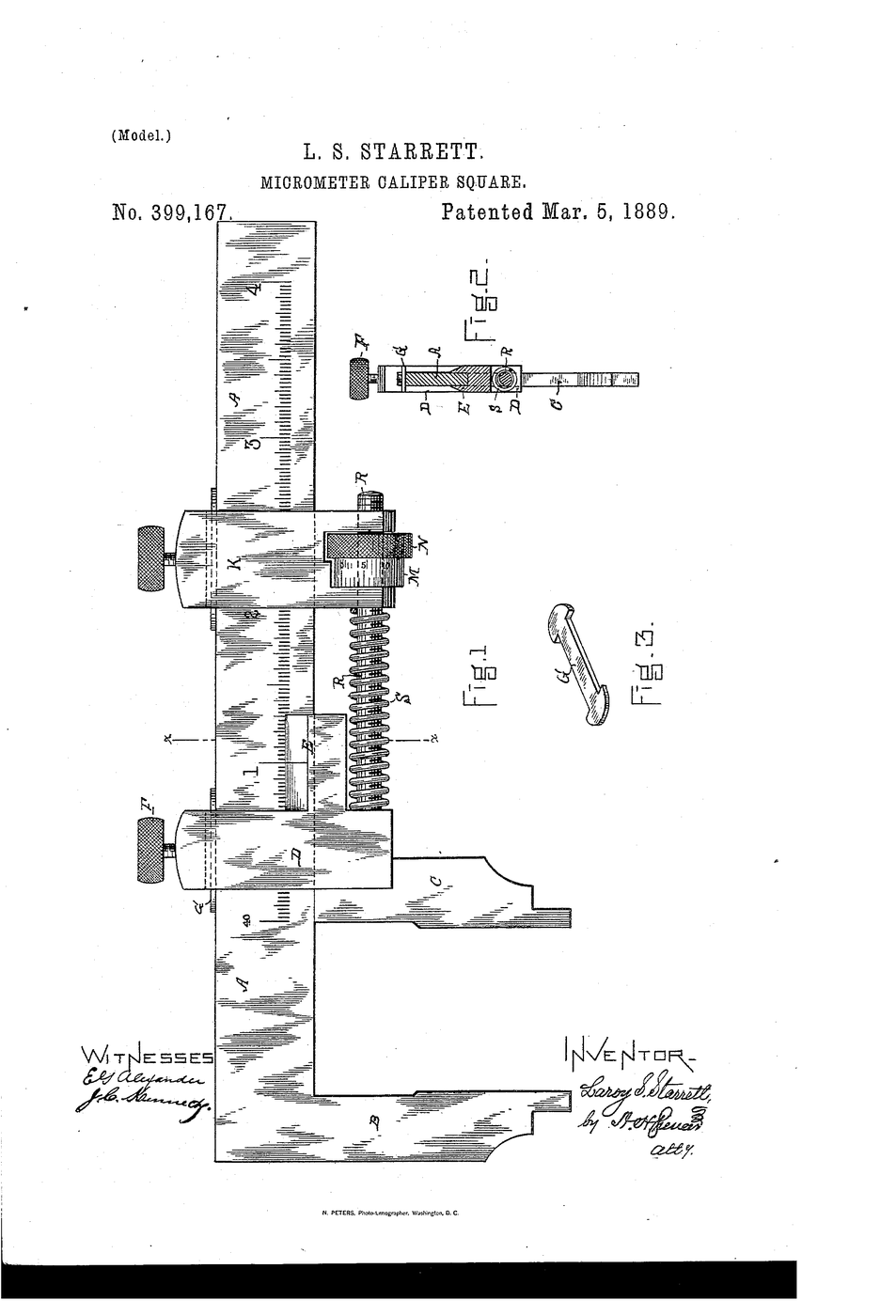
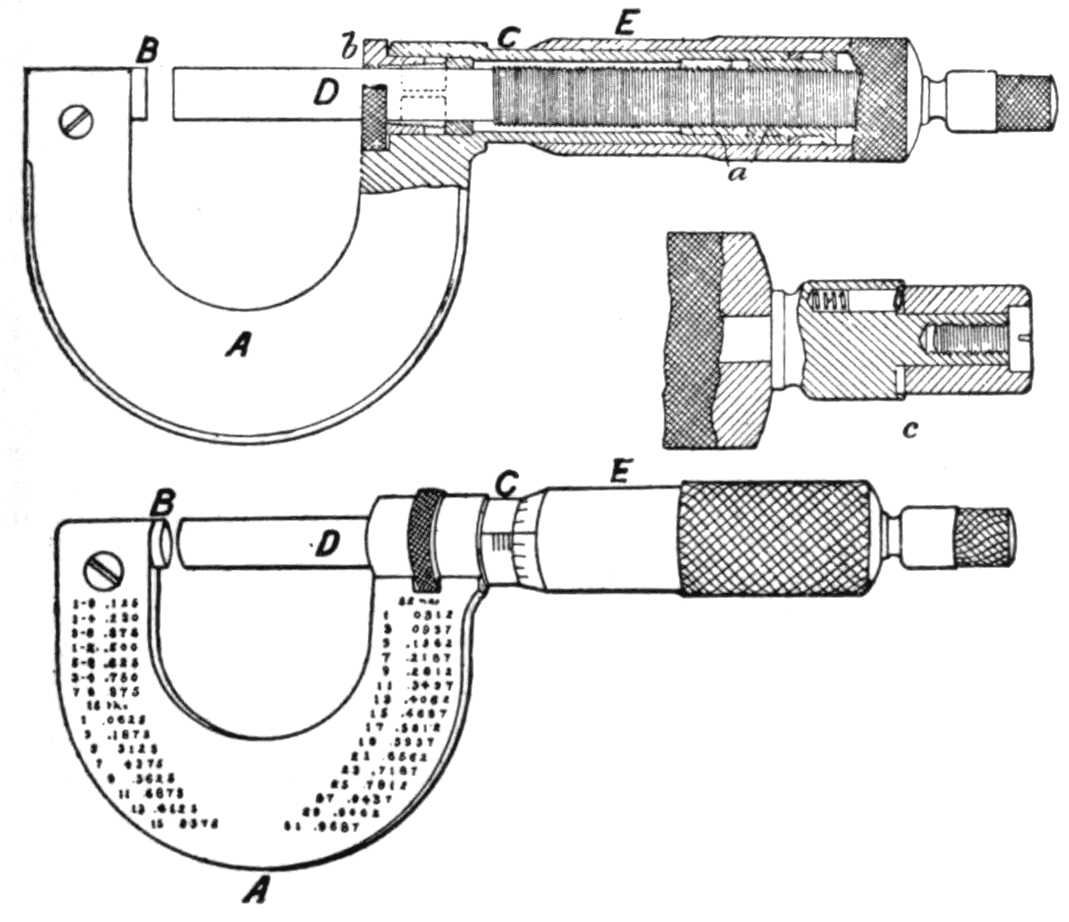
US 399,167, “Micrometer Caliper-Square”, Laroy S. Starrett of Athol, Massachusetts, filed 1 February 1888 and granted 5 March 1889. The patent combines a graduated beam with a micrometer-adjusted jaw — but the sentence that matters is the spiral spring which, in Starrett's words, “takes up all backlash and limits the force with which the movable jaw is pressed by the nut against the work”.
Constant measuring force. That is the invention. A measurement that depends on the strength of the hand holding the tool is not a measurement, it is an opinion.
Hướng dẫn
Read the claim before you build
Read the claim before you build
Starrett claims a spring that limits force and removes backlash. Write down why a measurement that varies with grip strength is worthless on a production line.
Measure a foil sheet gently
Measure a foil sheet gently
Measure one foil sheet with the micrometer, closing until you just feel contact. Record it.
Vật liệu cho bước này:
 Giấy nhôm1 tờ
Công cụ cần thiết:
 Panme
PanmeMeasure the same sheet hard
Measure the same sheet hard
Measure the same spot again, squeezing firmly. Record. The two numbers differ — on the same sheet, with the same instrument.
Vật liệu cho bước này:
Giấy nhôm1 tờCông cụ cần thiết:
PanmeQuantify the grip error
Quantify the grip error
Subtract. That difference is pure operator error, and it is often larger than the tolerance you are trying to hold.
Vật liệu cho bước này:
 Giấy kẻ ô ly1 tờ
Have three people measure one sheet
Have three people measure one sheet
Three people, one sheet, no instruction on how hard to squeeze. Record all three. This is the 1880s workshop.
Vật liệu cho bước này:
Giấy nhôm1 tờCông cụ cần thiết:
PanmeUse the ratchet or friction thimble
Use the ratchet or friction thimble
Now repeat with everyone closing on the ratchet until it slips. The spread collapses. That is Starrett's spring, in your hand.
Vật liệu cho bước này:
Giấy nhôm1 tờCông cụ cần thiết:
PanmeModel the spring with steel wire
Model the spring with steel wire
Wind a short coil from steel wire around the brass rod. Compress it — force rises with compression. A spring converts a squeeze into a known force.
Vật liệu cho bước này:
 Dây thép mạ kẽm0.2 mét
Công cụ cần thiết:
 Thanh đồng thau
Build a slip clutch from card
Build a slip clutch from card
Cut two card discs, press them together with the coil between, and turn one. Past a certain torque they slip. That is a friction thimble.
Vật liệu cho bước này:
Giấy kẻ ô ly1 tờCông cụ cần thiết:
 Kéo
KéoFind the backlash in the screw
Find the backlash in the screw
Close the micrometer, then reverse the thimble slightly. There is a dead zone before the spindle moves. That is backlash, the spring's other target.
Công cụ cần thiết:
PanmeAlways approach from one direction
Always approach from one direction
Measure the foil five times, always closing from open. The spread shrinks. Consistent approach beats a better instrument.
Vật liệu cho bước này:
Giấy nhôm5 tờCông cụ cần thiết:
PanmeCompare against a feeler leaf
Compare against a feeler leaf
Measure a 0.20 mm feeler leaf. It is a manufactured standard, so it tells you whether your instrument is honest.
Công cụ cần thiết:
Panme Bộ căn lá
Check the zero
Check the zero
Close the micrometer on nothing and read. If it does not read zero, every measurement you have taken today carries that offset.
Công cụ cần thiết:
PanmeMeasure a rod in three places
Measure a rod in three places
Measure the brass rod at three points along its length. A single measurement of a real object is almost always a lie about the whole.
Công cụ cần thiết:
PanmeThanh đồng thauHistory & Context
History & Context
US 399,167, “Micrometer Caliper-Square”, Laroy S. Starrett of Athol, Massachusetts, filed 1 February 1888, granted 5 March 1889. The patent describes a micrometer nut of 25 divisions working against fortieth-inch beam graduations to read thousandths.
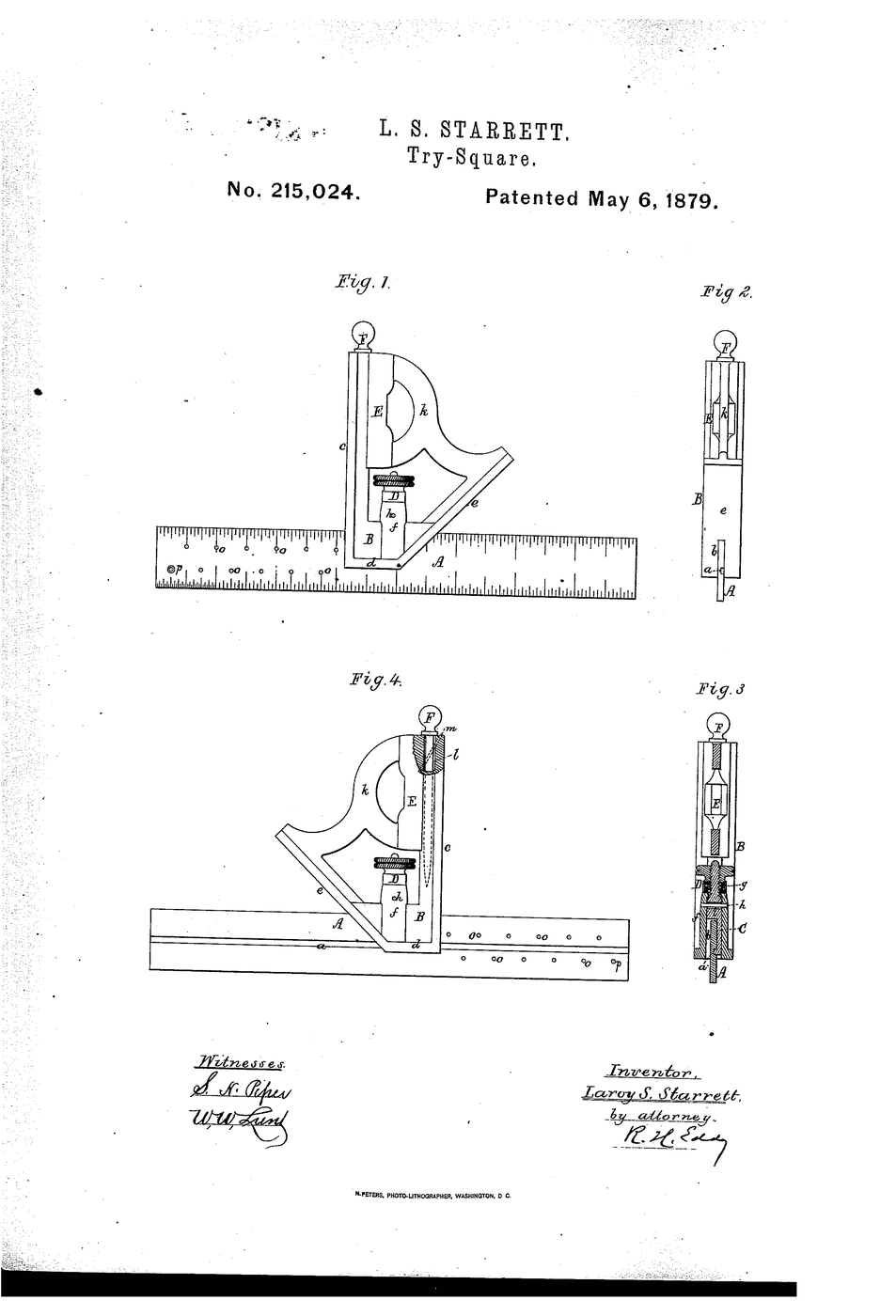
Starrett was a Maine farm boy whose first patent was a meat chopper. He founded the L. S. Starrett Company in Athol in 1880 and held roughly a hundred patents; his combination square, a separate blueprint in this library, is the other tool of his that every workshop still owns.
Why constant force is the real subject. Palmer's screw made the thousandth readable. It did not make it reproducible, because the reading depends on how hard the jaw is pressed — and soft materials compress measurably. Starrett's spring removes the operator's hand from the result. That is the difference between an instrument a craftsman can use and an instrument an industry can use, and it is why this patent belongs beside Palmer's rather than inside it.
The pattern repeats. Every instrument in this batch eventually meets the same problem — the human operating it — and every good answer is the same: remove the judgement. The ratchet, the reversal test, the go/no-go gauge and the projected shadow of the optical comparator are four versions of one idea.
Vật liệu
3- 9 tờTạm thời
- 1 tờTạm thời
- 0.2 métTạm thời
Vật liệu bản thiết kế liên kết

Blueprint liên quan
Các blueprint này chia sẻ kiến thức — kỹ thuật, vật liệu hoặc nguyên tắc

CC0 Phạm vi công cộng
Bản thiết kế này được phát hành theo CC0. Bạn tự do sao chép, sửa đổi, phân phối và sử dụng cho bất kỳ mục đích nào mà không cần xin phép.
Hỗ trợ nhà sáng tạo bằng cách mua sản phẩm qua bản thiết kế, nơi họ nhận Hoa hồng nhà sáng tạo do nhà bán hàng đặt, hoặc tạo phiên bản mới và kết nối trong bản thiết kế riêng để chia sẻ doanh thu.