NGHỆ THUẬT
LÀM ĐẸP VÀ SỨC KHỎE
THỦ CÔNG
VĂN HÓA VÀ LỊCH SỬ
GIẢI TRÍ
MÔI TRƯỜNG
THỰC PHẨM VÀ ĐỒ UỐNG
KỸ THUẬT NGƯỢC
KHOA HỌC
THỂ THAO
CÔNG NGHỆ
THIẾT BỊ ĐEO
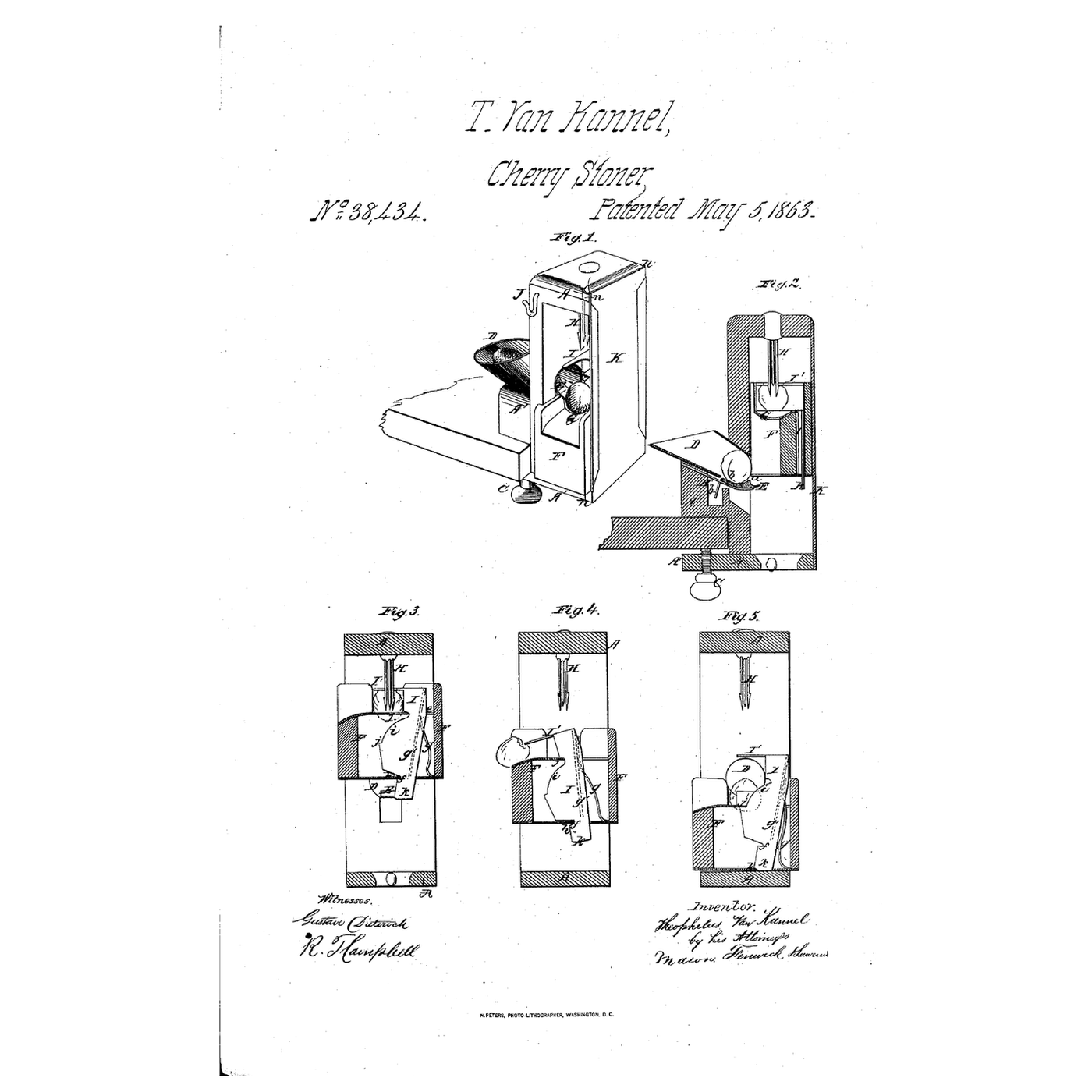


The Cherry Stoner: A Hopper, a Basin and a Fork of Needles
Cherries for pies, jam and bottling have to be stoned, one at a time, and a season's fruit is thousands of them.
Theophilus Van Kannel of Chester, Illinois, received US 38,434, dated 5 May 1863, for an "Automatic Cherry-Stoner" that improved on his own patent of 14 October 1862. Clamped to a table, it has a hopper that a rocking feeder lets out one cherry at a time into a basin on a sliding box. On the up-stroke a fork of barbed needles pushes the stone through the cherry and out through a hole in the basin; on the down-stroke a spring claw strips the stoned cherry off the fork and throws it out of the machine.
This rung works out the throughput and times stoning by machine and by hand.
Cơ bản
About 2 hours
Hướng dẫn
1
1
Strokes, cherries and minutes
Strokes, cherries and minutes
Đang tải sổ tay Jupyter…
2
2
Why so many cherries needed stoning
Why so many cherries needed stoning
Bottling fruit made a season's harvest worth preparing in bulk. The embedded blueprint shows the method.
3
3
Read US 38,434
Read US 38,434
Van Kannel's object is "to stone cherries by machinery adapted to this purpose, which is automatic in its operation, requiring no further manipulation than to put the cherries into a hopper and to keep the machine in motion". His earlier machine (patent of 14 October 1862) removed the cherries from the "barbed needles" with a spring finger-piece worked by the hand; now that piece, "which I now term a 'claw,' operates automatically".
A box A with jaws and a clamping screw holds the machine upright on a table edge. A conical-mouthed hopper D feeds a sliding box F; a curved rocking feeder E with a ridge and tongue lets out "only one cherry to be discharged at a time." Box F has a basin G with a hole in its bottom. The fork H "is made of five (or more or less) needles", fixed above in line with the hole, so as the basin rises "the fork H will thrust the stone through the cherry and through the basin, leaving the stoned cherry above or on the basin". The fork is barbed to hold the cherry, and the spring-claw I "separates the stoned cherry from the barbed fork H, and thrusts this cherry out of the machine in the downward stroke".
4
4
One stroke of the stoner
One stroke of the stoner
Không gian làm việc Blockly
Loading Blockly workspace...
5
5
Stone a kilo two ways
Stone a kilo two ways
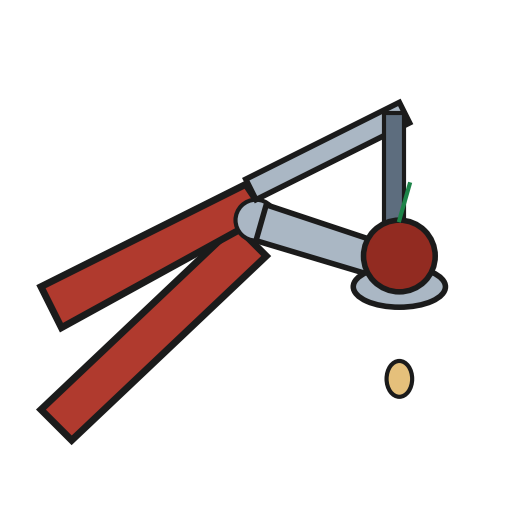
Weigh out two 500 g lots of cherries. Stone one lot by hand with a paper-clip loop or the tip of a knife, timing it with the stopwatch; stone the other with a cherry pitter, timing it too. Weigh the stones and the stoned fruit from each lot to see how much flesh each method loses, and count any cherries where the stone was missed.
Vật liệu cho bước này:
 Anh đào1 cái
Công cụ cần thiết:
 Dụng cụ bỏ hạt anh đào
 Cân nhà bếp điện tử
 Đồng hồ bấm giờ
 Xô
Xô6
6
A cherry pitter that misses
A cherry pitter that misses
Cherry pitter troubleshooting.
Flow
Loading...
7
7
History and honest limits
History and honest limits
**Theophilus Van Kannel** of Chester, Illinois, received US 38,434, dated 5 May 1863. His claims cover the curved spring-rocker feeding cherries one at a time, the automatic claw that discharges the stoned cherries, and the claw's sliding and vibrating action.
**Honest limits.** Cherry weight and stoning rates in the notebook are examples.
Công cụ yêu cầu
4- Tạm thời
- Tạm thời
- Tạm thời
- Tạm thời
Blueprint liên quan
Các blueprint này chia sẻ kiến thức — kỹ thuật, vật liệu hoặc nguyên tắc





CC0 Phạm vi công cộng
Bản thiết kế này được phát hành theo CC0. Bạn tự do sao chép, sửa đổi, phân phối và sử dụng cho bất kỳ mục đích nào mà không cần xin phép.
Hỗ trợ nhà sáng tạo bằng cách mua sản phẩm qua bản thiết kế, nơi họ nhận Hoa hồng nhà sáng tạo do nhà bán hàng đặt, hoặc tạo phiên bản mới và kết nối trong bản thiết kế riêng để chia sẻ doanh thu.