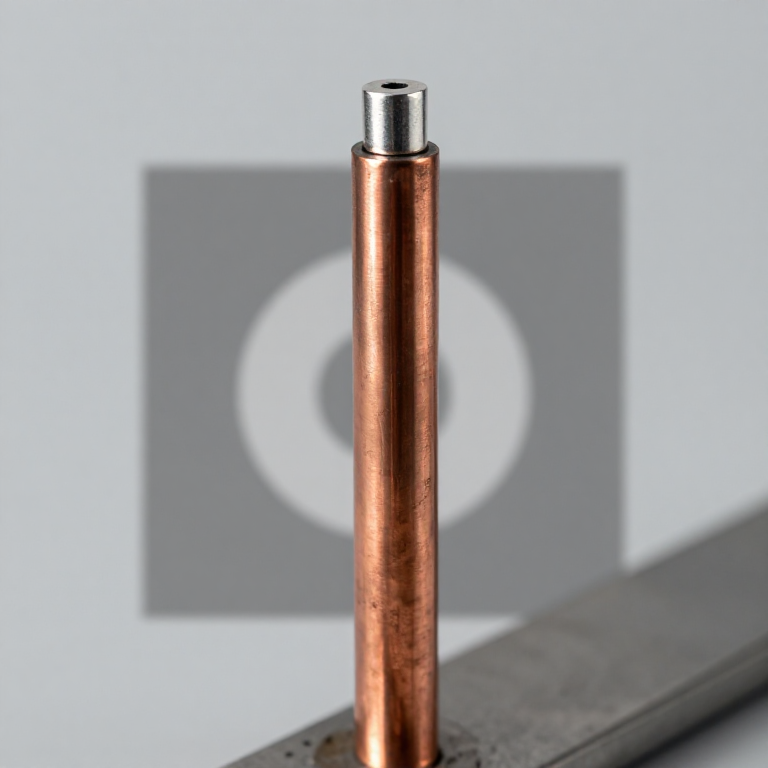


The Eddy Current Brake
Drop a magnet down a copper pipe and it takes several seconds to fall a distance it should cover in a fraction of one. Copper is not magnetic. Nothing is touching the magnet. It is falling through air.
What slows it is induction. A moving magnet means a changing magnetic field at every point in the pipe wall, and a changing field drives circulating currents in any conductor — eddy currents. Those currents are themselves magnets, and Lenz's law says their fields always oppose the change that made them. The magnet is therefore always being pushed by the field it just created, always in the direction that resists its motion.
Two consequences follow, and both are why this is used in real machinery. The braking force rises with speed, because faster motion means faster change means bigger currents — so the brake is self-regulating and reaches a terminal velocity. And it is entirely non-contact: nothing wears, nothing needs adjusting, and there is no friction material to overheat and fade.
It also has one absolute limitation that you will measure directly: it cannot hold anything still. Zero speed means zero change means zero current means zero force.
Hướng dẫn
Fall time, three tubes
Fall time, three tubes
Drop the same magnet down a copper tube, a plastic tube and an aluminium tube of similar size, timing each. Then time it falling the same distance in open air.
Repeat five times each.
Expect copper slowest, aluminium slower than plastic but faster than copper, and plastic indistinguishable from free fall.
Conductivity is the variable — not magnetism, since none of the three is magnetic.
Vật liệu cho bước này:
 Copper Tube1 cái
Công cụ cần thiết:
 Bar Magnet Set
 Stopwatch
Prove it is not magnetic attraction
Prove it is not magnetic attraction
Hold the copper tube still and bring the magnet up to it slowly. Then touch them together and try to lift the tube.
Expect no attraction at all.
A stationary magnet and a conductor do not interact. The force exists only while something is moving, which is the single most important fact about this brake and the one that rules out its use as a parking brake.
Measure the terminal velocity
Measure the terminal velocity
Mark the tube at intervals and time the magnet between successive marks.
Expect the intervals to be equal after the first — the magnet reaches a steady speed almost immediately and keeps it.
At terminal velocity the braking force exactly equals the weight.
You have measured the force without a force meter, because you know the magnet's mass.
Công cụ cần thiết:
 Tape Measure
 Digital Scale (0.01g)
Vary the magnet and the wall
Vary the magnet and the wall
Repeat the timing with two magnets stacked, then with a weaker magnet, then with a thicker-walled tube.
Plot fall time against each variable.
Expect a strong, faster-than-linear increase in braking with field strength, and a clear increase with wall thickness.
Braking depends on the square of the field, because the field both drives the current and acts on it — a rare case where the reason for a squared term is physically obvious.
Cut a slot and destroy the effect
Cut a slot and destroy the effect
Use a tube with a slot cut along its full length, or an equivalent split sleeve, and repeat the drop.
Expect the magnet to fall much faster.
The slot does not change the copper's conductivity — it breaks the circular path the eddy currents need.
This is exactly why transformer and motor cores are built from stacked, insulated laminations: to make eddy currents impossible in the first place.
Công cụ cần thiết:
 Hacksaw
Find where the energy went
Find where the energy went
Drop the magnet through the copper tube twenty times in quick succession, then feel the tube.
Expect it to be perceptibly warm.
Gravitational potential energy did not vanish — it became electrical current, and the current became heat in the copper's resistance.
Every brake converts motion into heat. The unusual thing here is that it happens inside a solid object that nothing is rubbing against.
Công cụ cần thiết:
 Infrared Thermometer
Compendium — where this is used, and why it never works alone
Compendium — where this is used, and why it never works alone
Lenz's law is a statement about conservation, not a separate rule. If induced currents reinforced the change that created them, a small disturbance would grow without limit and you would have energy from nothing. The minus sign in Faraday's law is therefore not a convention — it is required by conservation of energy, and every eddy-current phenomenon is a direct demonstration of that.
Real applications, and why they choose it. Roller-coaster and high-speed-train brakes use eddy currents because there is nothing to wear out and nothing to fade when hot — a friction brake dissipating the energy of a full train repeatedly will overheat, and an eddy brake simply cannot. Gym machines and rowing ergometers use them because resistance rises with effort automatically. Bandsaws and circular saws use them for fast, contactless blade braking. Electricity meters of the old spinning-disc type used an eddy-current drag magnet as their calibrated brake, and the smooth, steady rotation of that disc is entirely this effect. Metal detectors and coin-validation machines run the idea backwards, inducing eddy currents deliberately and listening for the response to identify the metal.
🔴 The limitation is absolute and it defines the engineering. Force falls to zero at zero speed, so an eddy-current brake can slow a vehicle beautifully and cannot stop it or hold it. Every real installation therefore pairs it with a friction brake for the last few km/h and for parking. Anyone proposing an eddy brake as a complete braking system has missed the one thing this blueprint measures in step 2.
The mirror image of the same physics. Because eddy currents waste energy as heat, transformers, motors and generators are built from thin laminations, insulated from each other, specifically to prevent them — the step-5 slot, industrialised. And induction hobs deliberately maximise the same losses, dumping energy as heat into the pan. The same equations describe a brake, a defect and a cooker, and which one you have depends entirely on whether you wanted the heat.
Safe practice. Strong neodymium magnets are genuinely dangerous objects: they snap together hard enough to shatter and to blood-blister or break a fingertip, they wipe cards and damage phones and hard drives, and they must be kept well away from anyone with a pacemaker or implanted device. Handle one at a time, keep them apart with spacers, and never let a child play with small ones — swallowed magnets that attract across loops of intestine are a surgical emergency.
Vật liệu
1- 1 cáiTạm thời
Công cụ yêu cầu
6- Tạm thời
- Tạm thời
- 1 vendor sell this, none ship to you yetTạm thời
- Tạm thời
- Tạm thời
- Tạm thời
Vật liệu bản thiết kế liên kết
Blueprint liên quan
Các blueprint này chia sẻ kiến thức — kỹ thuật, vật liệu hoặc nguyên tắc

CC0 Phạm vi công cộng
Bản thiết kế này được phát hành theo CC0. Bạn tự do sao chép, sửa đổi, phân phối và sử dụng cho bất kỳ mục đích nào mà không cần xin phép.
Hỗ trợ nhà sáng tạo bằng cách mua sản phẩm qua bản thiết kế, nơi họ nhận Hoa hồng nhà sáng tạo do nhà bán hàng đặt, hoặc tạo phiên bản mới và kết nối trong bản thiết kế riêng để chia sẻ doanh thu.