NGHỆ THUẬT
LÀM ĐẸP VÀ SỨC KHỎE
THỦ CÔNG
VĂN HÓA VÀ LỊCH SỬ
GIẢI TRÍ
MÔI TRƯỜNG
THỰC PHẨM VÀ ĐỒ UỐNG
KỸ THUẬT NGƯỢC
KHOA HỌC
THỂ THAO
CÔNG NGHỆ
THIẾT BỊ ĐEO
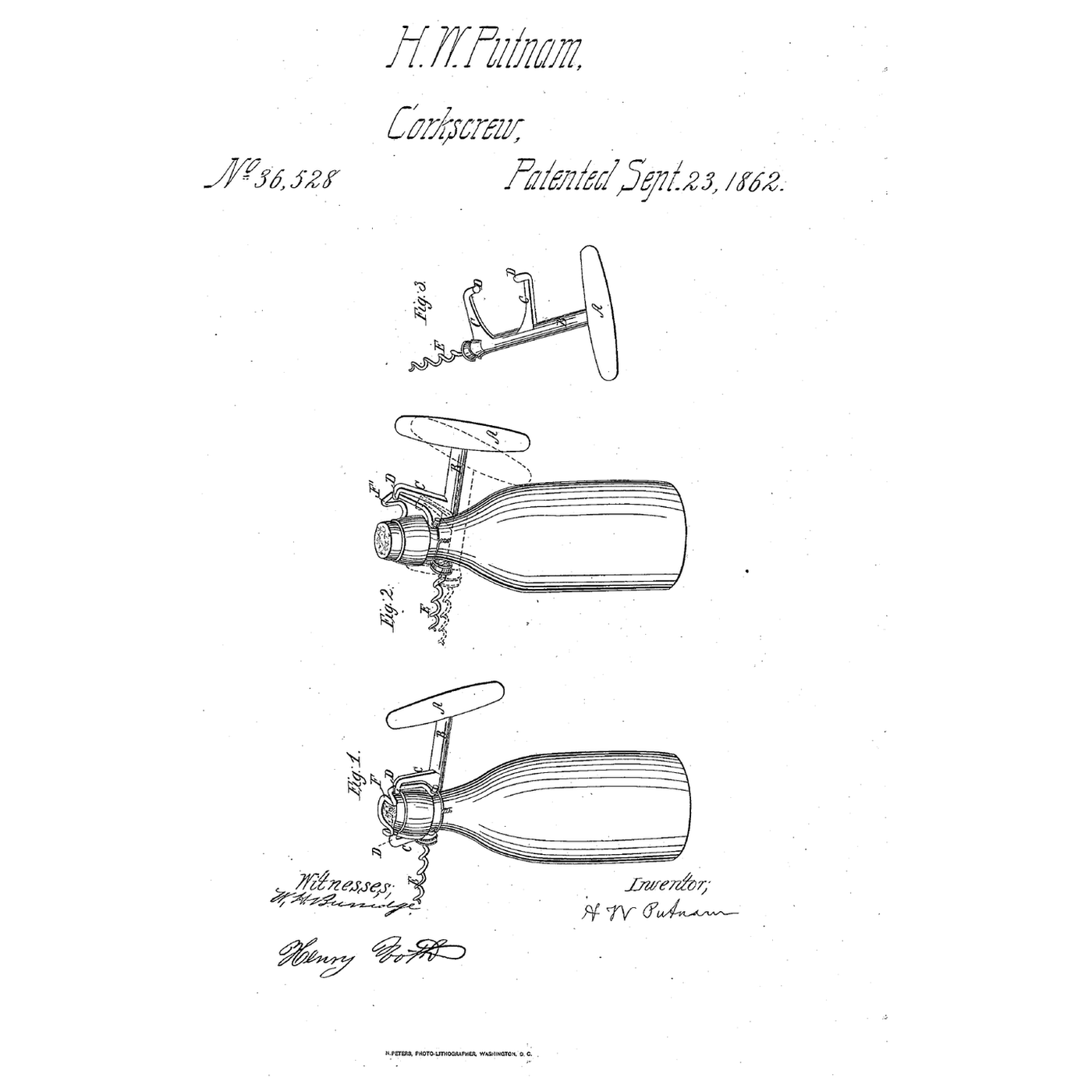


The Key and Corkscrew: Throw the Wire Fastener Off, Then Draw the Cork
A wire fastener that holds a cork down against the gas is hard to push onto the cork, and hard to push off, with the fingers alone; and the cork still has to be drawn afterwards.
H. W. Putnam of Cleveland, Ohio, received US 36,528, dated 23 September 1862, for "a combined key and corkscrew in one instrument for securing and releasing my patent bottle cork-fastener and for drawing the cork": a handle and shaft with two arms at right angles whose ends turn inward as nibs, far enough apart for the bottle's neck to pass between them, and an ordinary corkscrew at the shaft's end. The neck is the fulcrum for the key.
This rung works out the force of the key about the neck, with a work check, then makes the key and corkscrew from rod and flat bar, fastens a corked bottle with a wire fastener and throws it off.
Trung cấp
About 4 hours
Hướng dẫn
1
1
The neck as the fulcrum
The neck as the fulcrum
Đang tải sổ tay Jupyter…
2
2
Why the neck works as the fulcrum
Why the neck works as the fulcrum
The embedded blueprint works out the lever law. Putnam's key turns about the bottle's neck, so a short push on the handle moves the fastener with a larger force.
3
3
Read US 36,528
Read US 36,528
"Fig. 3 represents the combined key and corkscrew. A is the handle. B is the shaft or bar. C C represent arms projecting from the shaft B in lines parallel with each other and at right angles to the shaft. The ends of these arms are turned inward toward each other, forming the nibs D D. The arms are far enough apart to allow the neck of the bottle to pass between them, and the distance between the points of the nibs is equal to or greater than the thickness of the cork. In the end of the shaft B is placed an ordinary corkscrew, E."
"Now by turning the key a little forward it is released, and the screw can be used as an ordinary corkscrew for drawing the cork. In replacing to its former position (seen in Fig. 1) the instrument is changed to the opposite side of the neck of the bottle, as indicated by the dotted lines in Fig. 2. In both cases the neck of the bottle becomes the fulcrum for the key."
4
4
Make the key and throw a fastener off
Make the key and throw a fastener off
**Handle and shaft.** Cut 10 cm of hardwood handle stock and drill it across the middle. Cut 12 cm of 6 mm mild steel rod, pass one end through the handle and peen it over a washer.
**Arms and nibs.** Cut 20 cm of 20 × 3 mm mild steel flat bar and bend it into a U whose legs are the arms, wide enough apart for the bottle's neck to pass between them. Bend the last centimetre of each leg inward as a nib, with the nibs' points at least as far apart as the cork is wide. Silver-solder the U's base across the shaft near its far end, the arms at right angles to it.
**Corkscrew.** Wind 2 mm steel wire into an open helix round a 6 mm rod, file its end to a point, and silver-solder its straight end into a hole drilled in the shaft's end.
**Fastened bottle.** Pour chilled soda water into a clean beer bottle and press a cork in. Twist a wire ring tight round the neck below the lip and bend a wire bail, hinged on the ring, that swings over the top of the cork and holds it.
**Test.** Wearing safety glasses, pass the neck between the arms with the nibs over the bail, and turn the key a little forward: the bail is thrown back off the cork. Draw the cork with the corkscrew. Put the cork back and use the key from the other side of the neck to swing the bail on again.
Vật liệu cho bước này:
 Phôi gỗ cứng làm cán1 cái
 Thanh thép mềm0.12 mét
 Vòng đệm phẳng1 cái
 Thanh thép dẹt0.2 mét
 Dây thép0.4 mét
 Bộ que hàn bạc (mềm/vừa/cứng)1 cái
 Chất trợ chảy1 cái
 Chai bia màu hổ phách1 cái
 Nước có ga (chai còn nguyên nắp)1 cái
 Nút bần1 cái
 Dây thép mạ kẽm0.5 mét
Công cụ cần thiết:
 Cưa sắt
 Giũa (giũa tay)
 Ê tô bàn nguội
 Đèn khò propan
 Búa
Búa Máy khoan pin
 Bộ mũi khoan
 Kìm mỏ tròn
 Kìm mỏ dẹt
 Kìm cắt
 Kính bảo hộ trong suốt
 Găng tay da bảo hộ
5
5
A key that slips, bends or will not throw the fastener
A key that slips, bends or will not throw the fastener
Key and corkscrew troubleshooting.
Flow
Loading...
6
6
History and honest limits
History and honest limits
**H. W. Putnam** of Cleveland, Cuyahoga County, Ohio, received US 36,528, dated 23 September 1862. The key was for his own patent bottle cork-fastener, shown at F embracing the top of the cork and at F′ thrown back. His claim is the arms C C and nibs D D combined with a corkscrew.
**Honest limits.** A hand-bent wire bail on a beer bottle of re-corked soda water stands in for his patent fastener, whose exact form this rung does not reproduce, and flat bar and rod for his key. The notebook ignores friction; its forces and lengths are examples. Your thrown-off fastener is the result.
Vật liệu
11- 1 cáiTạm thời
- 0.12 métTạm thời
- 1 cáiTạm thời
- 0.2 métTạm thời
- 0.4 métTạm thời
- Tạm thời
- 1 cáiTạm thời
- Tạm thời
- Tạm thời
- 1 cáiTạm thời
- 0.5 métTạm thời
Công cụ yêu cầu
12- Tạm thời
- Tạm thời
- Tạm thời
- Tạm thời
- Tạm thời
- 1 vendor sell this, none ship to you yetTạm thời
- Tạm thời
- Tạm thời
- Tạm thời
- Tạm thời
- Tạm thời
- Tạm thời
Bản thiết kế này làm ra
Blueprint liên quan
Các blueprint này chia sẻ kiến thức — kỹ thuật, vật liệu hoặc nguyên tắc



CC0 Phạm vi công cộng
Bản thiết kế này được phát hành theo CC0. Bạn tự do sao chép, sửa đổi, phân phối và sử dụng cho bất kỳ mục đích nào mà không cần xin phép.
Hỗ trợ nhà sáng tạo bằng cách mua sản phẩm qua bản thiết kế, nơi họ nhận Hoa hồng nhà sáng tạo do nhà bán hàng đặt, hoặc tạo phiên bản mới và kết nối trong bản thiết kế riêng để chia sẻ doanh thu.