NGHỆ THUẬT
LÀM ĐẸP VÀ SỨC KHỎE
THỦ CÔNG
VĂN HÓA VÀ LỊCH SỬ
GIẢI TRÍ
MÔI TRƯỜNG
THỰC PHẨM VÀ ĐỒ UỐNG
KỸ THUẬT NGƯỢC
KHOA HỌC
THỂ THAO
CÔNG NGHỆ
THIẾT BỊ ĐEO
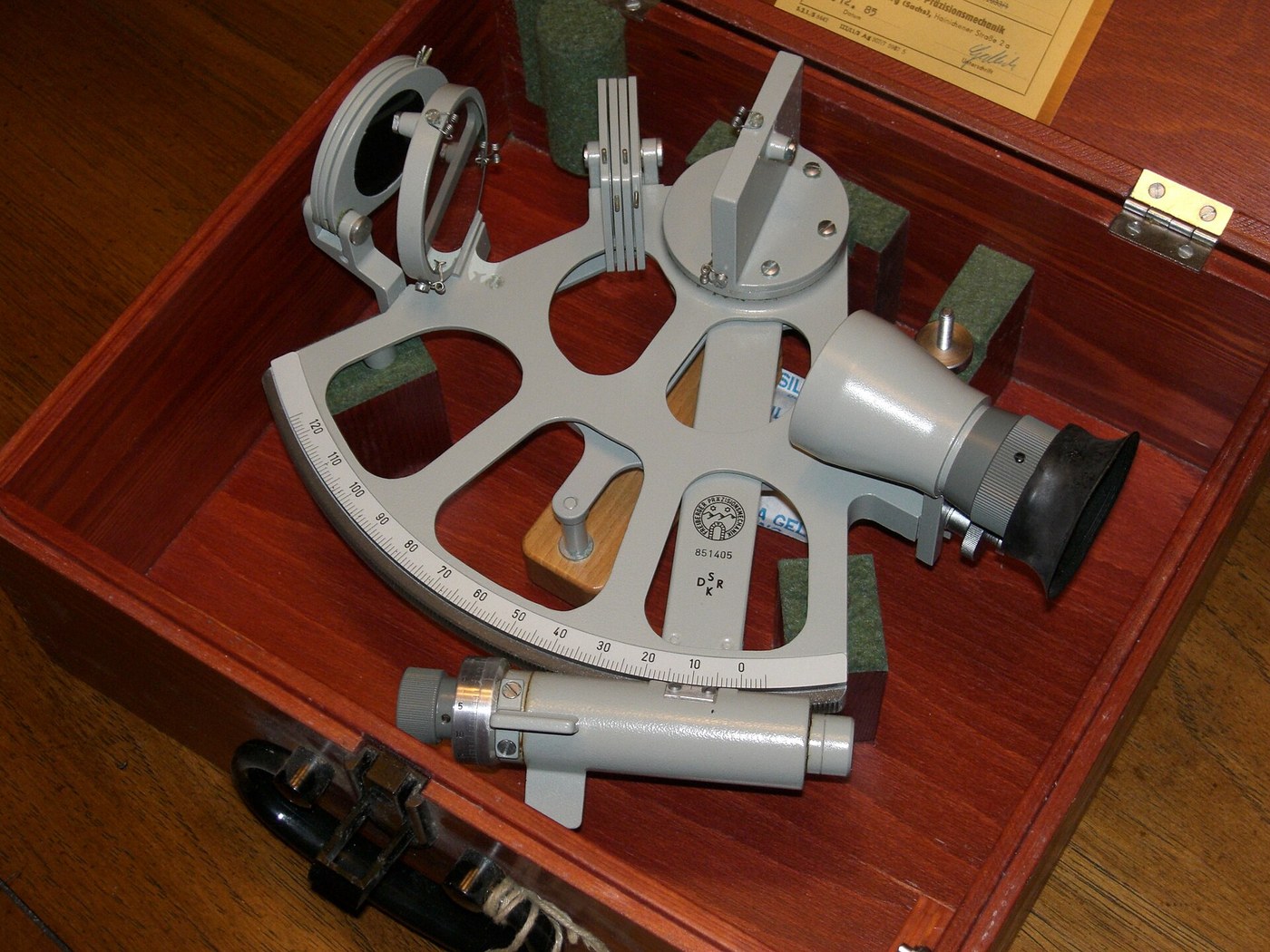


The Noon Sight: Latitude from the Sun
Dead reckoning drifts. To stop it drifting you need a position from something outside the boat, and for four centuries the most reliable one available was the sun at noon.
It is the simplest of all astronomical sights because it needs no accurate clock. Measure the sun's greatest altitude as it crosses your meridian, and your latitude follows from that one angle and a table of the sun's declination. Longitude needed a chronometer and waited two hundred years; latitude needed only a sextant and patience.
The sextant blueprint builds the instrument. This one is about taking the sight properly — the corrections that turn a raw angle into a true altitude, and the several ways a perfectly good instrument gives a confidently wrong answer.
Nâng cao
1 day
Hướng dẫn
1
1
NEVER look at the sun without a proper shade
NEVER look at the sun without a proper shade
Use the sextant's index and horizon shades, swung in BEFORE you bring the sun into the field, and take them out only as the sun dims near the horizon.
A sextant concentrates and directs sunlight into your eye and will cause permanent retinal damage in less time than it takes to realise. This is not a caution to be balanced against convenience. Check every shade for cracks before use, and never improvise one from smoked glass or exposed film.
2
2
Find and remove the index error
Find and remove the index error
Set the sextant to zero, look at the horizon, and see whether the reflected and direct images line up. If they do not, read the discrepancy — that is your index error, and it is SUBTRACTED if the reading is 'on the arc' and added if 'off'.
Measure it at the start of every session, not once a year: the error changes with temperature and with any knock. It is a constant offset, so it never averages out and it shifts every sight in the same direction. An unmeasured index error is the most common reason a careful navigator is consistently a few miles out.
3
3
Start early, and follow the sun up to its peak
Start early, and follow the sun up to its peak
Begin observing ten to fifteen minutes before your estimated local noon, and keep adjusting as the altitude rises. Record the HIGHEST reading, not the reading at any particular clock time.
Local noon is not 1200 on any clock, and the sun hangs almost still near its peak — which is exactly what makes the sight forgiving. You are looking for the turning point, so keep going until the altitude clearly begins to fall, then take the maximum you saw.
Công cụ cần thiết:
 Đồng hồ bấm giờ
4
4
Bring the sun down to the horizon, and rock the sextant
Bring the sun down to the horizon, and rock the sextant
Bring the sun's lower limb down until it just kisses the horizon, then rock the instrument gently side to side: the sun should swing like a pendulum and just touch at the bottom of its arc.
Rocking is how you know the sextant is vertical. Held tilted, you are measuring a slanted angle that is always LARGER than the true altitude, which puts your latitude out in a consistent direction. Use the lower limb by convention and record which limb you used, because the semi-diameter correction depends on it.
5
5
From sextant altitude to latitude
From sextant altitude to latitude
Đang tải sổ tay Jupyter…
6
6
Know what a noon sight cannot give you
Know what a noon sight cannot give you
It gives latitude and nothing else. You have narrowed your position to a line of latitude thousands of miles long.
Combined with a dead reckoning longitude that is good enough, that is a usable position — and it is precisely how ocean passages were made for four hundred years. But be clear which half is measured and which half is reasoned, because when they disagree with the depth sounder it is almost always the reasoned half that is wrong.
Công cụ yêu cầu
1- Tạm thời
Blueprint liên quan
Các blueprint này chia sẻ kiến thức — kỹ thuật, vật liệu hoặc nguyên tắc

CC0 Phạm vi công cộng
Bản thiết kế này được phát hành theo CC0. Bạn tự do sao chép, sửa đổi, phân phối và sử dụng cho bất kỳ mục đích nào mà không cần xin phép.
Hỗ trợ nhà sáng tạo bằng cách mua sản phẩm qua bản thiết kế, nơi họ nhận Hoa hồng nhà sáng tạo do nhà bán hàng đặt, hoặc tạo phiên bản mới và kết nối trong bản thiết kế riêng để chia sẻ doanh thu.