NGHỆ THUẬT
LÀM ĐẸP VÀ SỨC KHỎE
THỦ CÔNG
VĂN HÓA VÀ LỊCH SỬ
GIẢI TRÍ
MÔI TRƯỜNG
THỰC PHẨM VÀ ĐỒ UỐNG
KỸ THUẬT NGƯỢC
KHOA HỌC
THỂ THAO
CÔNG NGHỆ
THIẾT BỊ ĐEO

The Savonius Rotor: Two Hollow Vanes, Any Wind, Always Starts
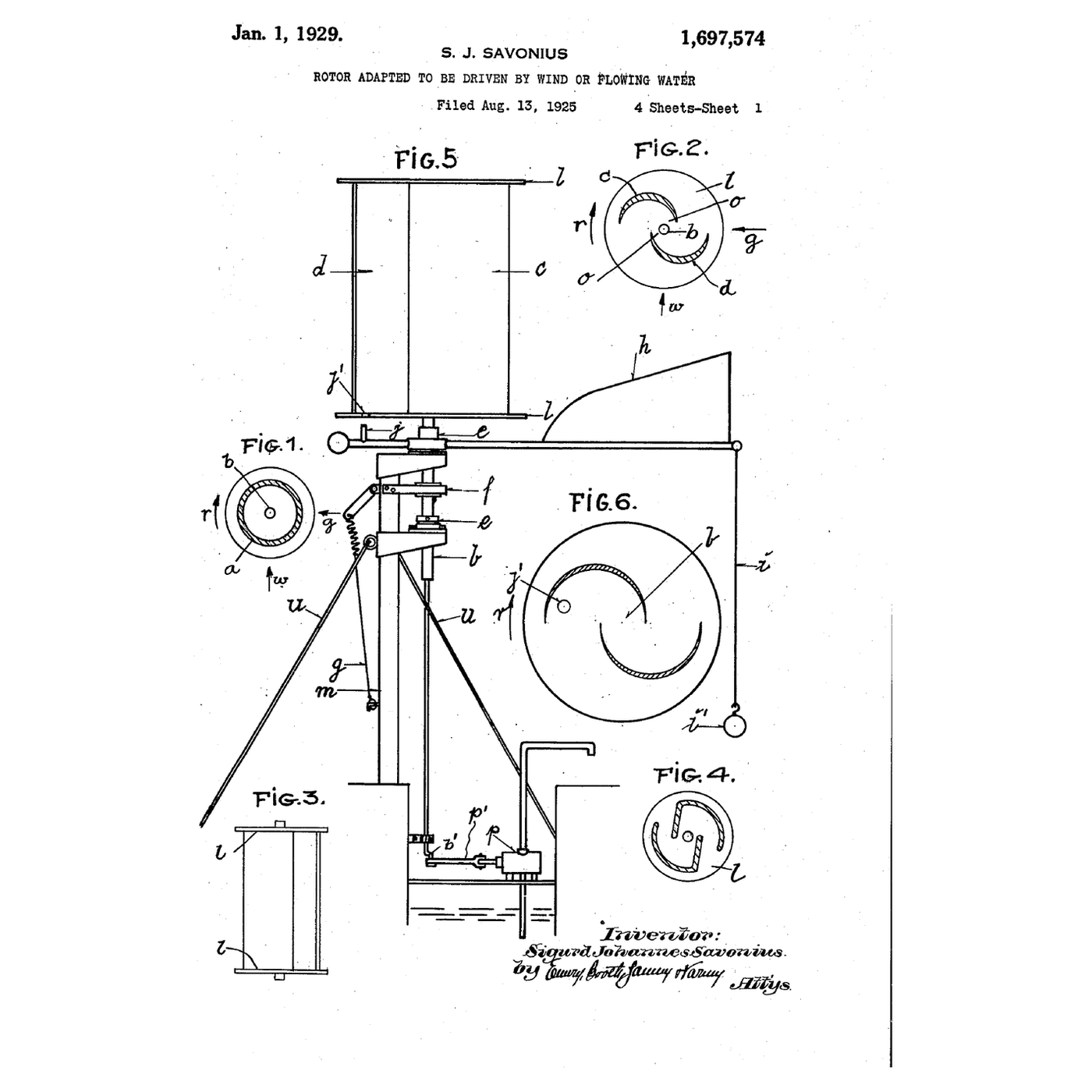
Cut a cylinder in half lengthwise, slide the halves apart so they overlap, and stand them on a vertical shaft: that is the rotor Sigurd Savonius of Finland patented in 1924–29. The wind pushes harder on the hollow of one vane than on the back of the other, and air flowing through the overlap from one hollow into the other helps it along.
It turns in wind from any direction without steering, starts itself in the lightest breeze, and gives strong torque at low speed — for pumping water, ventilating, or driving a current meter. It is also slow and inefficient, because it is pushed by drag.
This rung works out the drag machine's ceiling and builds a Savonius rotor from a PVC pipe, measuring its torque with a string brake.
Cơ bản
About 4 hours
Hướng dẫn
1
1
Read Savonius's overlap
Read Savonius's overlap
US 1,697,574, 'Rotor Adapted to be Driven by Wind or Flowing Water', Sigurd J. Savonius. The vanes are *"hollow-shaped"* and *"overlapping"*, so that the space between them forms an air passage *"from the hollow side of the vane d, to the hollow side of the other vane c"*. His text compares it with the rotating cylinder then being studied at the Aerodynamische Versuchsanstalt in Göttingen, which it cites.
The overlap is the detail that separates a Savonius rotor from two cups on a stick.
2
2
The drag machine's ceiling
The drag machine's ceiling
Đang tải sổ tay Jupyter…
3
3
Build it from a PVC pipe
Build it from a PVC pipe
Cut a 300 mm length of 110 mm PVC pipe in half lengthwise with a saw. Cut two plywood end discs 240 mm across. Screw the two half-pipes between the discs, hollow faces opposite, each shifted towards the centre so they **overlap by about a fifth of a half-pipe's width**, leaving the air passage Savonius describes.
Run a threaded-rod shaft through the centre of both discs, held by nuts, and carry it vertically in two skateboard bearings in a plywood frame.
Vật liệu cho bước này:
 Ống PVC1 cái
 Tấm gỗ dán1 tờ
 Ty ren1 cái
 Vòng bi ván trượt2 cái
 Vít máy12 cái
Công cụ cần thiết:
 Máy khoan pin
 Bộ mũi khoan
 Mỏ lết
 Thước kẻ
 Dao cắt ống
4
4
Measure torque with a string brake
Measure torque with a string brake
Wrap fishing line once round the shaft. Tie one end to the spring scale fixed to the frame, and hang a small weight on the other end, so the line rubs on the turning shaft as a brake. The braking torque is **(weight − scale reading) × shaft radius**.
Put the rotor in front of the box fan. Start with a light weight: the rotor spins fast. Add weight step by step, reading the speed with the tachometer and the scale each time, until it stalls. Power = torque × angular speed.
Turn the rotor to face the wind at a different angle: it does not care. Start the fan at its lowest setting with the rotor stopped: it starts by itself. Those two facts are why Savonius rotors exist.
Vật liệu cho bước này:
 Dây câu (đơn sợi)1 cuộn
 Vật nặng1 bộ
Công cụ cần thiết:
 Quạt hộp (nhiều tốc độ)
 Máy đo gió cầm tay
 Máy đo tốc độ vòng quay
 Lực kế (cân lò xo)
 Thước cặp điện tử 6 inch
5
5
History and context
History and context
**US 1,697,574, 'Rotor Adapted to be Driven by Wind or Flowing Water', Sigurd J. Savonius; filed 13 August 1925 (Serial 49,985), claiming a Finnish filing of 12 December 1924; granted 1 January 1929.** The title names water as well as wind: the same rotor turns in a current.
**Honest limits.** Low efficiency — a drag machine cannot beat the notebook's ceiling by much. Heavy for its power, because the whole swept area is solid vane. Its torque pulses twice per turn, which is why many are built as two stages twisted 90° apart, or with helical vanes.
Vật liệu
7- 1 cáiTạm thời
- 1 tờTạm thời
- 1 cáiTạm thời
- Vòng bi ván trượtHoa hồng 10%2 cáiTạm thời
- 12 cáiTạm thời
- 1 cuộnTạm thời
- 1 bộTạm thời
Công cụ yêu cầu
10- 1 vendor sell this, none ship to you yetTạm thời
- Tạm thời
- Tạm thời
- Tạm thời
- Dao cắt ốngHoa hồng 10%Tạm thời
- Tạm thời
- Tạm thời
- Tạm thời
- Tạm thời
- Tạm thời
Blueprint liên quan
Các blueprint này chia sẻ kiến thức — kỹ thuật, vật liệu hoặc nguyên tắc
The Betz Limit: Why No Rotor Takes More Than 16/27 of the Wind
bởi Volt
Năng lượng
22
0
0
0
0
0
Electricity From the Wind: The Cube Law and a Rotor on a Dynamo
bởi Volt
Năng lượng
28
0
0
0
0
0
Building a Persian Windmill — The First Machine Powered by Wind
bởi Emma
Cơ học
83
0
0
0
0
0
Robinson Cup Anemometer
bởi Karen
MÔI TRƯỜNG
43
0
0
0
0
0
CC0 Phạm vi công cộng
Bản thiết kế này được phát hành theo CC0. Bạn tự do sao chép, sửa đổi, phân phối và sử dụng cho bất kỳ mục đích nào mà không cần xin phép.
Hỗ trợ nhà sáng tạo bằng cách mua sản phẩm qua bản thiết kế, nơi họ nhận Hoa hồng nhà sáng tạo do nhà bán hàng đặt, hoặc tạo phiên bản mới và kết nối trong bản thiết kế riêng để chia sẻ doanh thu.