NGHỆ THUẬT
LÀM ĐẸP VÀ SỨC KHỎE
THỦ CÔNG
VĂN HÓA VÀ LỊCH SỬ
GIẢI TRÍ
MÔI TRƯỜNG
THỰC PHẨM VÀ ĐỒ UỐNG
KỸ THUẬT NGƯỢC
KHOA HỌC
THỂ THAO
CÔNG NGHỆ
THIẾT BỊ ĐEO
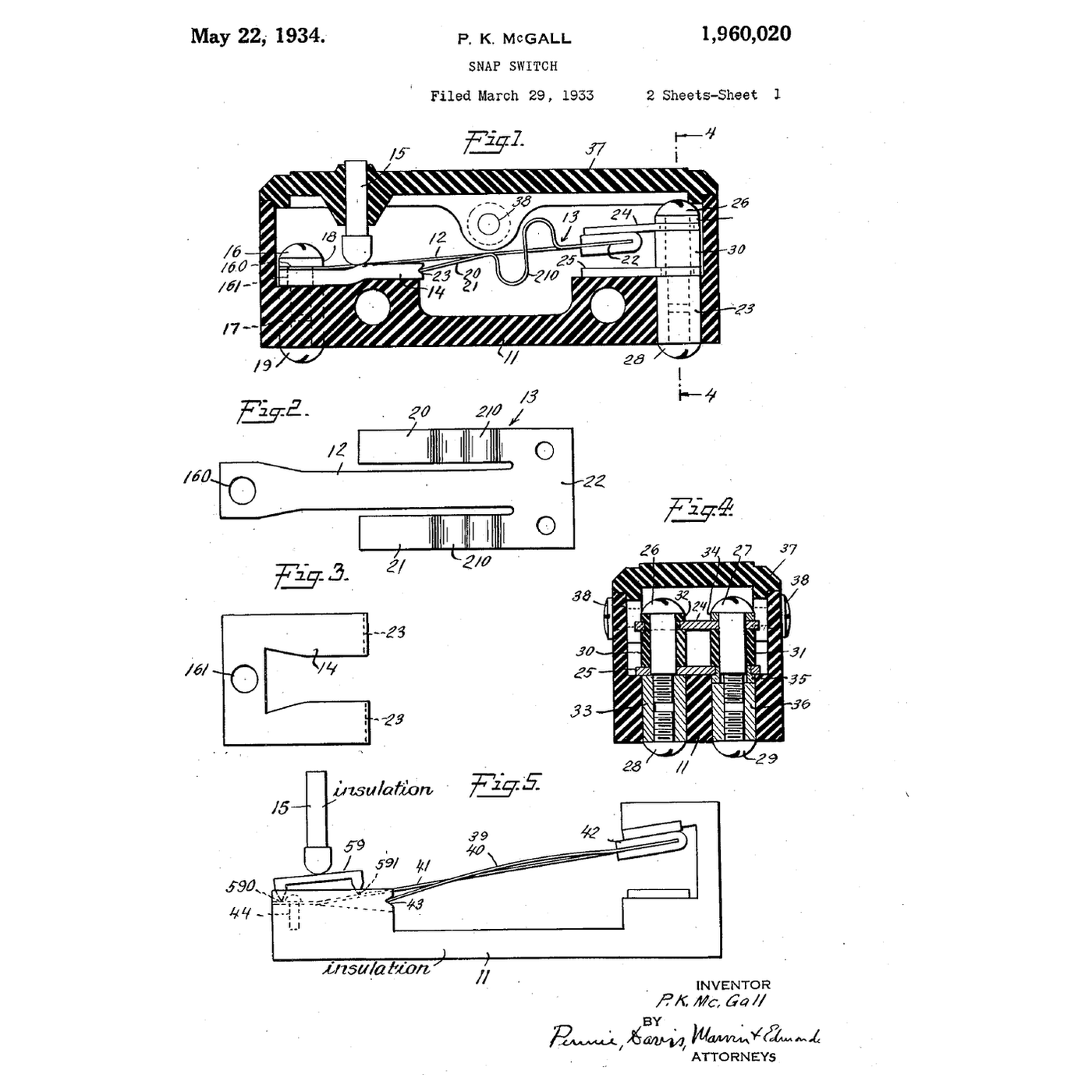


The Snap-Action Switch: A Spring That Jumps Past Its Own Centre
A contact that opens slowly draws an arc that eats it away; one that wavers at the edge chatters. A snap-action switch cannot do either: its contact is held by springs arranged over-centre, so a small, slow push on the plunger builds up to a point and then the contact jumps from one stop to the other in a few milliseconds.
Philip Kenneth McGall of Orange, New Jersey, working for C. F. Burgess Laboratories, filed US 1,960,020, *Snap Switch*, on 29 March 1933; it was granted 22 May 1934. A thin beryllium-copper leaf spring is held in tension by two side strips in compression, pivoted near the middle of the leaf; silver contacts at the free end move between two stops. It became the "micro switch" found in machines, appliances and mice.
This rung models the snap-through force, shows why the lower stop sits above dead centre, and makes a snap switch from spring steel.
Trung cấp
About 3 hours
Hướng dẫn
1
1
The drooping force and the speed of the snap
The drooping force and the speed of the snap
Đang tải sổ tay Jupyter…
2
2
Read McGall's switch
Read McGall's switch
Fig. 1 of US 1,960,020 shows the switch in section: a base 11 of wood, hard rubber or Bakelite; the thin leaf spring 12 bolted at one end over a thick metal shim 14; two parallel spring strips 20 and 21, joined to the leaf's free end by a U-shaped stirrup 22 and pivoted in notches in the shim; and a plunger 15 pressing the leaf near its anchored end.
What the specification specifies: the leaf "preferably is a thin beryllium copper strip" (or phosphor bronze); the strips are in longitudinal compression, putting the leaf in tension; contacts "preferably made of silver … which minimizes the damage resulting from arcing"; "the bottom contact 25 is placed above the neutral or dead-center position" so the arm returns when released; and the leaf is widened ahead of its anchorage so it does not fatigue there.
3
3
Make a snap switch from spring steel
Make a snap switch from spring steel
Cut a strip of thin spring steel 60 mm long and 12 mm wide. Cut a slot 3 mm wide down its middle for 40 mm, leaving the two outer legs and a solid end. Bend the centre tongue slightly so that, when you clamp the solid end and push the tongue's tip back into line with the legs, the legs bow — now they are in compression and the tongue is in tension, as in McGall's switch.
Clamp the solid end to a plywood base with a machine screw. Set two machine-screw stops either side of the free end, the lower one just above the point where the strip flips over, and solder a wire to the strip and to each stop.
Press slowly near the clamped end with a spring scale: the force rises, then the free end jumps to the lower stop with a click. Release it and it jumps back. Wire the lower stop through a buzzer: it sounds cleanly, with no chatter, however slowly you press. Note the operating force and compare with the notebook's curve.
Vật liệu cho bước này:
 Băng thép lò xo1 cái
 Tấm gỗ dán1 cái
 Vít máy4 cái
 Còi áp điện1 cái
 Thiếc hàn chì1 cái
 Vi công tắc (cần gạt)1 cái
Công cụ cần thiết:
 Mỏ hàn
 Lực kế (cân lò xo)
 Ê tô bàn nguội
 Găng tay da bảo hộ
 Nguồn điện một chiều
4
4
A switch that chatters or will not reset
A switch that chatters or will not reset
Snap switch faults.
Flow
Loading...
5
5
History and honest limits
History and honest limits
**Philip Kenneth McGall** filed **US 1,960,020** on 29 March 1933, assigned to C. F. Burgess Laboratories of Madison, Wisconsin; it was granted 22 May 1934. The company Micro Switch was formed later in the 1930s, and the name came to stand for the small snap-action switch itself.
**Honest limits.** The notebook's two-spring model shows the snap-through and the role of the stops; McGall's real geometry, with a leaf in tension and strips pivoted near its middle, has a different force curve with the same character. Spring steel strip has sharp edges: wear gloves when cutting and bending it.
Vật liệu
6- 1 cáiTạm thời
- 1 cáiTạm thời
- 4 cáiTạm thời
- 1 cáiTạm thời
- 1 cáiTạm thời
- Tạm thời
Công cụ yêu cầu
5- Tạm thời
- Tạm thời
- Tạm thời
- Tạm thời
Blueprint liên quan
Các blueprint này chia sẻ kiến thức — kỹ thuật, vật liệu hoặc nguyên tắc



CC0 Phạm vi công cộng
Bản thiết kế này được phát hành theo CC0. Bạn tự do sao chép, sửa đổi, phân phối và sử dụng cho bất kỳ mục đích nào mà không cần xin phép.
Hỗ trợ nhà sáng tạo bằng cách mua sản phẩm qua bản thiết kế, nơi họ nhận Hoa hồng nhà sáng tạo do nhà bán hàng đặt, hoặc tạo phiên bản mới và kết nối trong bản thiết kế riêng để chia sẻ doanh thu.