

The Suspension Bridge
Every other kind of bridge fights bending. An arch fights it in compression, a truss splits it into pushes and pulls, a beam simply endures it. A suspension bridge does something else: it hangs the deck from a cable that is in pure tension, and steel in pure tension is the cheapest strength there is. That is why suspension bridges hold the long-span record and always have.
The shape the cable takes is a physics question with a precise answer, and it is not the answer most people give. A cable hanging under its own weight alone takes a catenary. A cable carrying a deck of uniform weight per horizontal metre — which is what a real bridge is — takes a parabola. The two curves look almost identical and are not the same equation.
The horizontal pull in the cable is H = wL²/8d: load per metre times span squared, over eight times the sag. Read it and the design falls out. Halve the sag and you double the tension, so shallow cables need taller towers or heavier steel. And the entire horizontal pull, at both ends, has to go into an anchorage — a suspension bridge is trying to pull its own ends together, permanently.
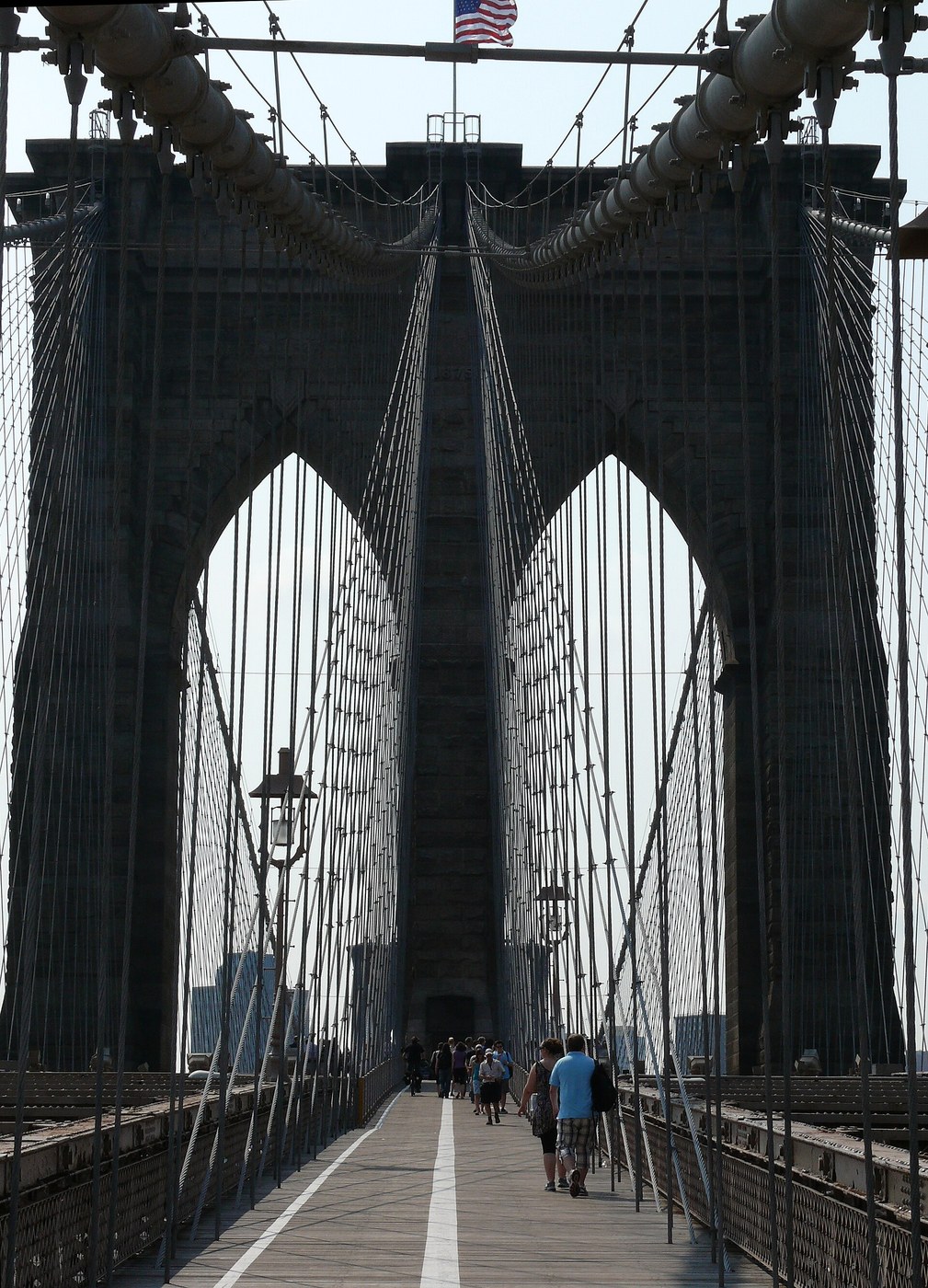
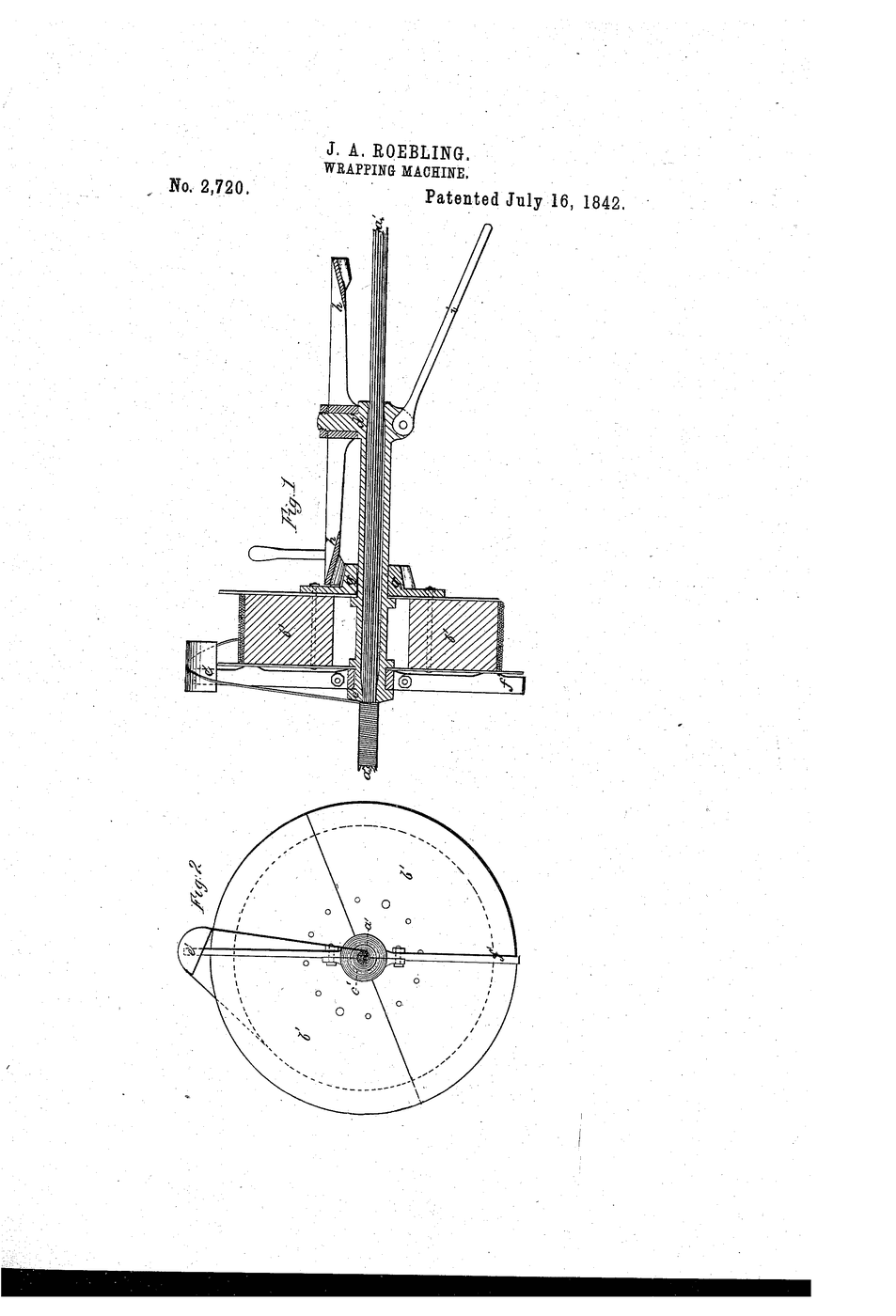
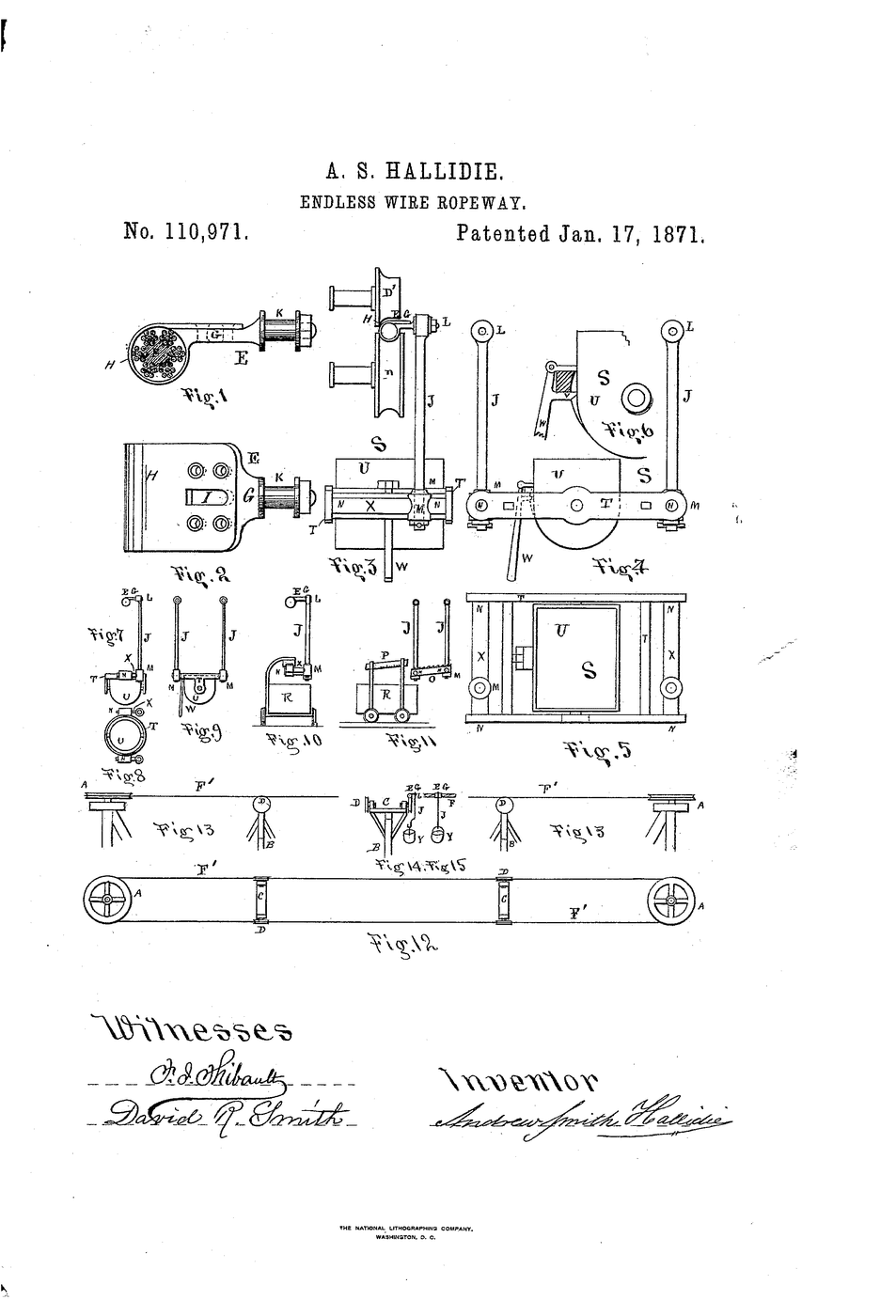
John A. Roebling made it buildable. His wire rope patent — US 2,720, 16 July 1842 — laid wires helically around a common axis without twisting the individual wires, each under uniform tension. He then worked out how to spin the cable in place, wire by wire across the gap, instead of making it on the ground and lifting it. The Brooklyn Bridge opened on 24 May 1883 with a main span of 1,595.5 feet, by far the longest in the world.
Hang a cable, measure the sag, predict the tension, then check it with a spring scale.
Hướng dẫn
Hang a bare cable and trace a catenary
Hang a bare cable and trace a catenary
Fix two eye bolts a measured span apart on a board and hang a light chain or cord between them. Tape graph paper behind it and trace the curve.
Measure the sag at mid-span.
This is a catenary — the shape of a cable loaded only by its own weight, distributed along its own length.
Vật liệu cho bước này:
 Bu lông có vòng2 cái
 Giấy kẻ ô ly1 cái
Công cụ cần thiết:
 Thước dây cuộn
Load it horizontally and get a parabola
Load it horizontally and get a parabola
Hang identical weights from the cable at equal horizontal spacing — not equal spacing along the cable. Use at least eight. Trace the new curve on the same paper.
Compare the two traces.
Expect the loaded curve to be visibly flatter near the towers and rounder at mid-span. It is a parabola, and it is the shape a real bridge cable takes because a deck weighs the same per horizontal metre everywhere.
Công cụ cần thiết:
 Cân nhà bếp điện tử
Predict the tension, then measure it
Predict the tension, then measure it
Compute the horizontal tension from H = wL²/8d, using total hung load per unit span for w, the span L and the measured sag d.
Now put a spring scale in line with the cable at one anchorage and read the actual pull.
Expect agreement within a few per cent, with the scale reading slightly higher — it measures the cable tension along the sloping cable, which is H divided by the cosine of the end slope.
Công cụ cần thiết:
 Lực kế (cân lò xo)
 Máy tính bỏ túi
Trade sag against tension
Trade sag against tension
Keep the load and span fixed. Shorten the cable to halve the sag, and measure the tension again. Then lengthen it to double the sag and measure again.
Plot tension against 1/sag.
Expect a straight line: halving the sag doubles the tension.
Sag is the free design variable and it is bought with tower height. A typical main span runs at a sag of roughly a tenth of the span, and that ratio is an economic compromise between steel in the cable and concrete in the towers.
Công cụ cần thiết:
Lực kế (cân lò xo)Spin a cable in place
Spin a cable in place
Instead of hanging one thick cord, run a single fine wire across the span, round a shoe at the far anchorage and back, over and over, keeping every pass at the same tension. Bind the resulting bundle into a round cable.
Compare its strength and sag against a single cord of similar total section.
Even tension across every wire is the entire trick. A slack wire carries nothing until its neighbours have already stretched, so an unevenly spun cable is only as strong as its tightest few wires — which is precisely what Roebling's 1842 patent claims to prevent.
Vật liệu cho bước này:
 Dây thép20 mét
Hang a deck, then make it misbehave
Hang a deck, then make it misbehave
Hang a light card or thin ply deck from the cable on hangers. Set a fan blowing steadily across it and watch.
Expect a flat, flexible deck to twist and flap, and the motion to build rather than settle. Now add diagonal stays from the towers down to the deck, or a stiffening truss along it, and repeat.
The motion should largely disappear.
Vertical strength was never the problem. Torsional stiffness is.
Vật liệu cho bước này:
 Ván ép bạch dương Baltic1 gói
History & Context
History & Context
Hanging bridges are ancient — rope and vine spans across Himalayan and Andean gorges, and the Inca Q'eswachaka over the Apurímac, still rewoven from grass every year. What they lacked was a deck that stayed level and a cable that did not rot. The nineteenth century supplied both. Thomas Telford's Menai Bridge of 1826 used wrought-iron eyebar chains, not wire; chains and wire cables ran in parallel for decades, and chains lost because a wire cable can be built up from small, individually testable elements.
Roebling's contribution has three parts and only one is the patent. US 2,720 of 16 July 1842 covers laying wires helically around a common axis, each under uniform tension, without twisting the individual wires. Second, he worked out aerial spinning: running the wire across the gap in place, pass after pass, so no cable ever has to be manufactured and then lifted. Third, and least famous, he understood wind. Roebling had watched Charles Ellet's Wheeling bridge destroy itself in 1854, and he stayed the Brooklyn Bridge with diagonals radiating from the towers — visibly, in the pattern everyone photographs — precisely so that the deck could not do what Wheeling's had done.
The Brooklyn Bridge was finished by a family and by fraud recovered from. John Roebling died of tetanus in 1869 from an injury during surveys. His son Washington Roebling was disabled by caisson disease in 1871, and Emily Warren Roebling ran the work on site for over a decade, learning enough engineering to defend it to the board. During construction a contractor supplied rejected wire; Washington's response was to calculate what the bad wire cost in strength and add extra wires to compensate, rather than to try to remove it. The bridge opened 24 May 1883 with a main span of 1,595.5 ft.
🔴 Popular-record correction: Tacoma Narrows did not fail by resonance. The 1940 collapse is taught in physics classes as a wind gust matching a natural frequency, and that explanation is wrong. The failure mode was aeroelastic flutter — a self-excited oscillation in which the deck's own twisting motion changes the airflow in a way that feeds more energy into the twisting, at a wind speed far below anything resonant. A steady wind, not a periodic one, was enough. The engineering lesson is not "avoid a frequency" but "a bluff, torsionally soft deck extracts energy from steady wind", which is why modern long-span decks are shallow aerofoil boxes tested in wind tunnels.
The honest limits. The anchorages are the hidden half of the cost — the whole horizontal pull has to be transferred into rock or into a block of concrete heavy enough to resist it, and on soft ground that block is often the most expensive object on the site. Suspension bridges are flexible by nature, which suits road traffic and suits heavy rail very badly, so almost no modern rail crossing uses one. The main cable is effectively unreplaceable, so corrosion inside it — where it cannot be seen — is the long-term threat, and modern bridges dry their cables with pumped air. And for spans below roughly 300 m a cable-stayed bridge is usually cheaper, because it needs no anchorage at all: the stays balance against each other through the tower.
Vật liệu
4- 2 cáiTạm thời
- 1 cáiTạm thời
- 20 métTạm thời
- Tạm thời
Công cụ yêu cầu
4- 1 vendor sell this, none ship to you yetTạm thời
- Tạm thời
- Tạm thời
- Tạm thời
Vật liệu bản thiết kế liên kết


Blueprint liên quan
Các blueprint này chia sẻ kiến thức — kỹ thuật, vật liệu hoặc nguyên tắc
CC0 Phạm vi công cộng
Bản thiết kế này được phát hành theo CC0. Bạn tự do sao chép, sửa đổi, phân phối và sử dụng cho bất kỳ mục đích nào mà không cần xin phép.
Hỗ trợ nhà sáng tạo bằng cách mua sản phẩm qua bản thiết kế, nơi họ nhận Hoa hồng nhà sáng tạo do nhà bán hàng đặt, hoặc tạo phiên bản mới và kết nối trong bản thiết kế riêng để chia sẻ doanh thu.