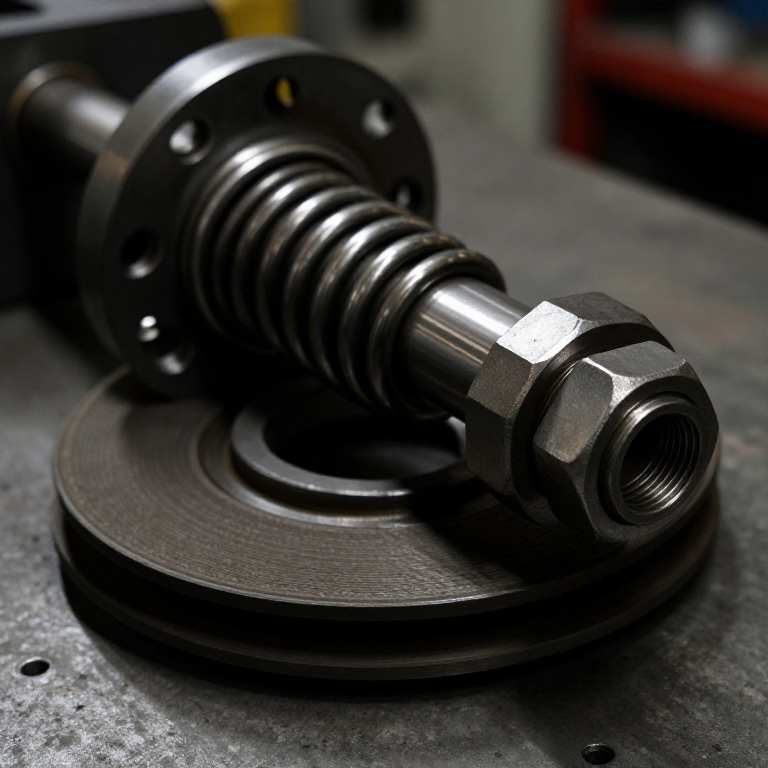


Torque Limiter
Hướng dẫn
Build the friction stack
Build the friction stack
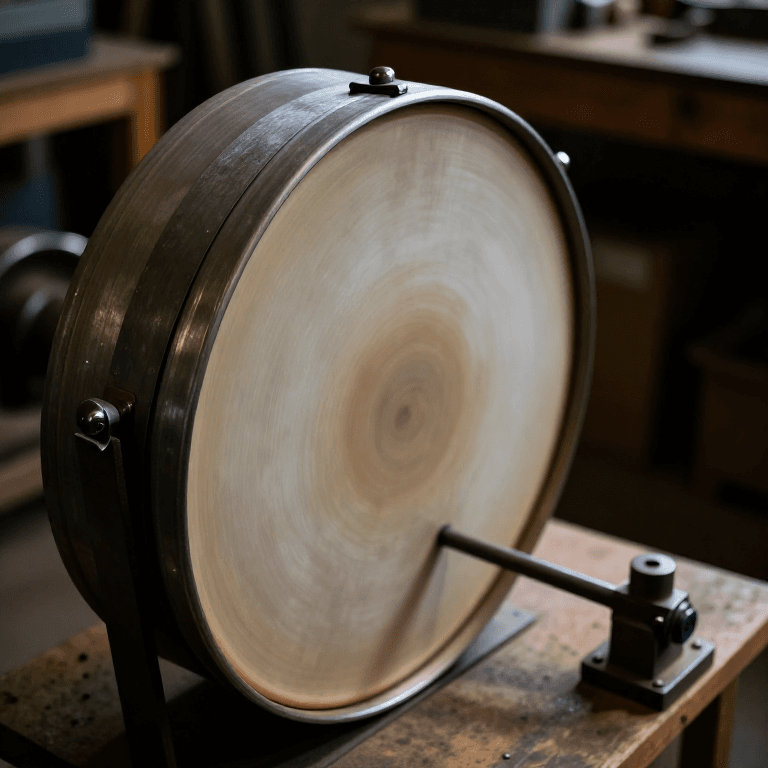
Two driving faces, one driven plate between them.
- Cut two 90 mm flanges and one 90 mm centre plate from 18 mm ply faced with 6 mm aluminium.
- Bore all three 8.0 mm.
- Key the two outer flanges to the shaft with M5 cup point set screws × 2.
- Leave the CENTRE plate free to rotate on the shaft, and fit the output sprocket or pulley to it.
- Face the centre plate with leather or cork on both sides.
Why a facing material. Metal on metal has a friction coefficient that changes with surface finish, temperature and the slightest trace of oil, so the slip torque wanders. Leather, cork or a woven lining is far more stable, and a stable coefficient is the whole point of a device whose job is to slip at a KNOWN torque.
Two friction faces rather than one doubles the torque for the same spring force, because both sides of the centre plate carry it. Multi-plate limiters simply extend that idea.Vật liệu cho bước này:
 Ván ép bạch dương Baltic1 tờ
 Thanh nhôm dẹt1 cái
 Vít định vị đầu lõm2 cái
 Thanh nhôm tròn1 cái
Công cụ cần thiết:
 Máy cưa lọng
 Máy khoan pin
 Bộ mũi khoan
 Bộ lục giác
 Bộ giũa
 Thước cặp điện tử 6 inch
Add the spring and the adjusting nut
Add the spring and the adjusting nut
The spring sets the clamping force; the nut sets the spring.
- Fit a compression spring behind the outer flange, over the shaft.
- Thread the shaft end M10, or fit a captured M10 hex nut and washer to compress the spring.
- Add a locknut so the setting cannot drift.
- Mark a scale on the shaft or hub so spring compression can be measured and repeated.
Mark the scale before you calibrate. A torque limiter whose setting cannot be recorded and returned to is not a safety device — it is an adjustable mystery. Commercial limiters have a graduated collar for exactly this reason.
Use a spring whose working range you can actually measure. A very stiff spring reaches its limit in a fraction of a turn, making the setting almost impossible to control by hand.Vật liệu cho bước này:
 Bộ lò xo nén1 bộ
 Vòng đệm phẳng4 cái
 Đai ốc lục giác2 cái
Công cụ cần thiết:
Bộ lục giácThước cặp điện tử 6 inch Ê tô bàn nguộiBộ giũa
Calibrate it — three settings, measured
Calibrate it — three settings, measured
An uncalibrated limiter protects nothing in particular.
- Clamp the shaft so it cannot turn.
- Wrap a cord round the output plate at a known radius and hang weights until it slips.
- Torque = weight × radius. Record it against the spring compression.
- Tighten the nut by a measured amount and repeat.
- Repeat once more, then plot torque against spring compression.
Công cụ cần thiết:
Thước cặp điện tử 6 inchBộ lục giácÊ tô bàn nguộiTest the failure it is for — and the one it is not
Test the failure it is for — and the one it is not
Know both what it protects and what it does not.
- Set the limiter to a modest torque and drive the output against a gradually increasing load. It slips smoothly at the set point.
- Let it slip for thirty seconds, then stop and feel the friction faces.
- Now jam the output SUDDENLY at speed and observe.
- Compare what happened in the two cases.
Công cụ cần thiết:
Máy khoan pin Đồng hồ bấm giờThước cặp điện tử 6 inch
Choosing the weak link, and history
Choosing the weak link, and history
Designing in a deliberate weak point is a mature engineering habit and it appears everywhere: the electrical fuse, the pressure relief valve, the shear pin, the crumple zone. In each case the designer decides in advance what will fail, so that the failure is cheap, safe and predictable rather than random and expensive.
Where friction limiters are standard: agricultural power take-off shafts, where a baler or mower can hit a stone; conveyor drives; machine tool feeds; and the packaging machinery whose jams would otherwise bend a screw conveyor. All are places where overloads are routine rather than exceptional, so a device that resets itself is worth far more than one that must be replaced.
Against the shear pin: the limiter slips and recovers with no parts consumed and no downtime, but its torque drifts as the linings wear or get contaminated. The shear pin fails at a precise, repeatable load determined by a known cross-section of a known material, but the machine stops dead until someone fits a new pin. Resettable and approximate against absolute and single-use — and which is right depends entirely on how often you expect the overload and how bad an unnoticed drift would be.
The dangerous failure mode to know about: a friction limiter that has been slipping repeatedly gets hot, glazes its linings and can end up transmitting LESS torque than intended — or, if contaminated and then dried, considerably more. Both are silent. Re-calibrating periodically is part of using one properly.
Vật liệu
7- Tạm thời
- 1 cáiTạm thời
- 2 cáiTạm thời
- 1 cáiTạm thời
- 1 bộTạm thời
- 4 cáiTạm thời
- 2 cáiTạm thời
Công cụ yêu cầu
8- 1 vendor sell this, none ship to you yetTạm thời
- 1 vendor sell this, none ship to you yetTạm thời
- Tạm thời
- Tạm thời
- Tạm thời
- Tạm thời
- Tạm thời
- Tạm thời
Blueprint liên quan
Các blueprint này chia sẻ kiến thức — kỹ thuật, vật liệu hoặc nguyên tắc
CC0 Phạm vi công cộng
Bản thiết kế này được phát hành theo CC0. Bạn tự do sao chép, sửa đổi, phân phối và sử dụng cho bất kỳ mục đích nào mà không cần xin phép.
Hỗ trợ nhà sáng tạo bằng cách mua sản phẩm qua bản thiết kế, nơi họ nhận Hoa hồng nhà sáng tạo do nhà bán hàng đặt, hoặc tạo phiên bản mới và kết nối trong bản thiết kế riêng để chia sẻ doanh thu.