
Morgan Traffic Signal
The first traffic signals had two positions: stop and go. Nothing else. The instant one direction was told to stop, the other was told to proceed — and the vehicles already inside the junction had nowhere to be.
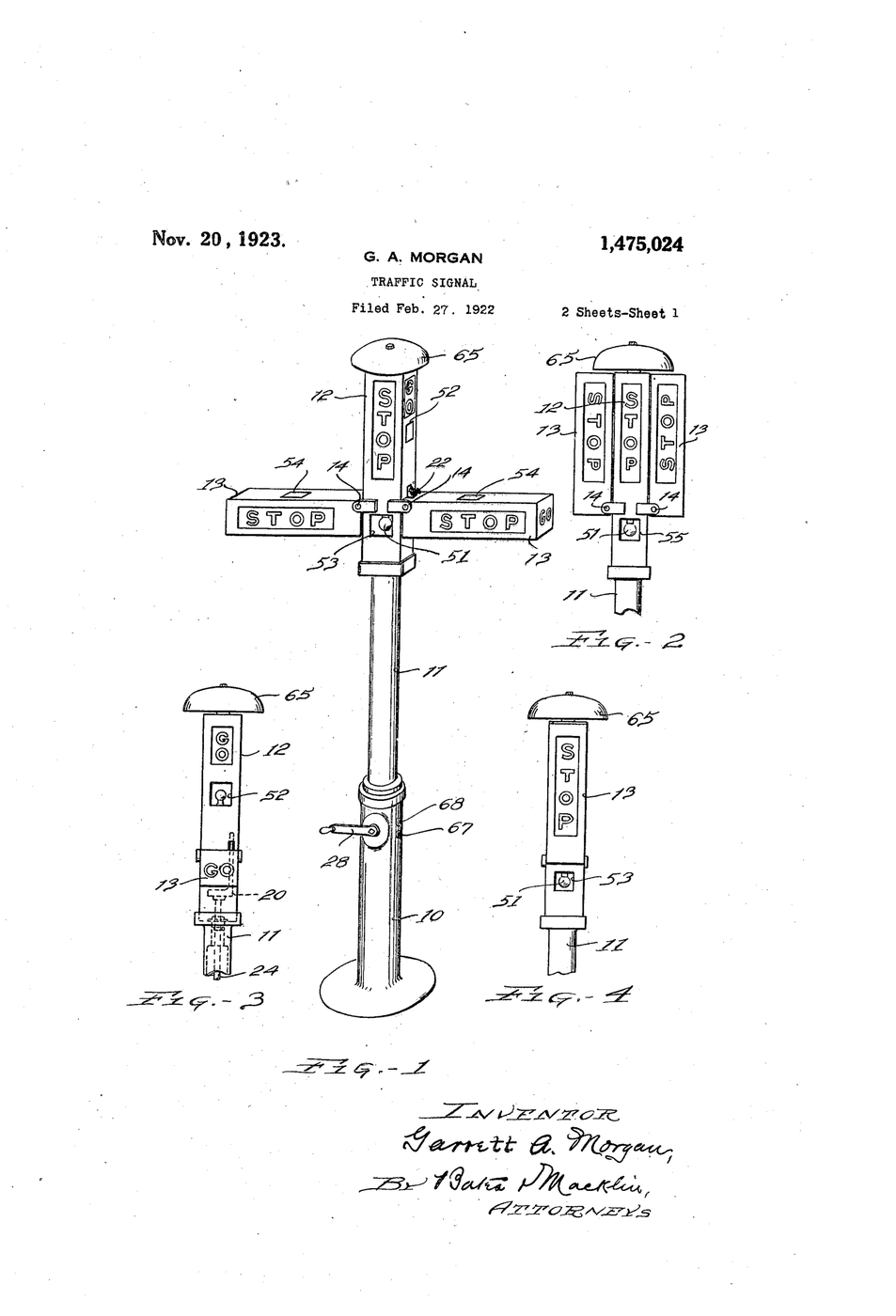
Garrett Morgan's patent adds a third position that stops everybody. A half-mast setting where both arms are raised, holding all directions while the intersection empties. It is not a warning light and it was not yellow; it is a clearance interval, and it is the reason a modern signal has three states rather than two.
Morgan filed on 27 February 1922 and was granted US 1,475,024 on 20 November 1923. He had witnessed a bad collision at a Cleveland junction. The mechanism is a hand-cranked mast with two pivoting arms, a worm gear and a bell — buildable on a bench, and the logic it encodes is still in every controller cabinet on the road.
Hướng dẫn
Read US 1,475,024 and count the positions
Read US 1,475,024 and count the positions
Find the three settings in the drawings. Two are the obvious stop and go; the third raises both arms at once and is the actual subject of the patent.
Model the failure the patent fixes
Model the failure the patent fixes
Draw a crossroads and move two counters through it, switching instantly from one direction to the other. The collision is unavoidable — the junction is never empty at the moment of handover.
Work out how long clearance must last
Work out how long clearance must last
Time = junction width divided by vehicle speed. A slow vehicle already committed needs the whole crossing. This number is why the interval cannot be arbitrarily short.
Công cụ cần thiết:
 Thước kẻ
Build the mast
Build the mast
Mount a vertical square post on a stable base. Everything pivots from it, so it must not rack when the arms swing.
Vật liệu cho bước này:
 Tấm gỗ cứng1 cái
Công cụ cần thiết:
 Cưa tay
Make two signal arms that read from both sides
Make two signal arms that read from both sides
Cut two arms lettered STOP and GO on each face. A signal legible from one approach only is worse than none.
Vật liệu cho bước này:
 Bộ giấy bìa nhiều màu4 tờ
Hinge the arms at right angles to each other
Hinge the arms at right angles to each other
Pivot one arm to face each roadway, mounted 90° apart so each governs its own direction independently.
Fit a worm and wheel to the crank
Fit a worm and wheel to the crank
A worm drive gives large reduction and will not back-drive — the arms cannot be blown or knocked out of position, which is a safety property, not a convenience.
Vật liệu cho bước này:
 Thanh thép mềm1 cái
Cut a cam that sequences the three positions
Cut a cam that sequences the three positions
Profile a disc so one turn drives: north-south go, all-stop, east-west go, all-stop. The cam IS the timing logic.
Make the all-stop position mechanically unavoidable
Make the all-stop position mechanically unavoidable
Shape the cam so the sequence cannot skip from one green to the other. If clearance can be bypassed by cranking fast, you have rebuilt the two-state signal.
Fit a bell that rings before every change
Fit a bell that rings before every change
Trip a striker off the cam just ahead of each transition. Morgan's patent includes an audible warning because a driver looking elsewhere still gets the message.
Add the night setting
Add the night setting
Provide a position that leaves all arms half-mast permanently — the equivalent of a modern all-way flashing red for quiet hours.
Run the full cycle by hand and watch for overlap
Run the full cycle by hand and watch for overlap
Crank slowly through a complete revolution. At no point should two conflicting GO faces be showing — check every intermediate angle, not just the detents.
Test with counters on a drawn junction
Test with counters on a drawn junction
Move vehicles through under your own signal. Introduce a slow one that enters just before the change and confirm the clearance interval gets it out.
Deliberately shorten the clearance and see it fail
Deliberately shorten the clearance and see it fail
Recut or block the cam so all-stop lasts half as long, and repeat the test. Watching the conflict reappear is the point of building it.
Compendium — the third position
Compendium — the third position
The patent. Garrett A. Morgan filed on 27 February 1922 and was granted US 1,475,024, "Traffic Signal", on 20 November 1923. Morgan, the son of formerly enslaved parents, was a Cleveland businessman and inventor who also devised the safety hood of 1914 — the breathing device he used personally in the 1916 Cleveland waterworks tunnel rescue. He is said to have decided on the traffic signal after seeing a serious collision between a car and a horse-drawn carriage at a junction.
What is actually claimed — and what is not. Morgan did not invent the traffic light. Electric signals existed before him; a gas-lit signal stood outside the Houses of Parliament in 1868, and Cleveland itself had an electric red-green signal from 1914. What Morgan patented is the T-shaped hand-cranked mast whose distinguishing feature is a THIRD position raising both arms simultaneously, halting all traffic so the intersection can clear. Getting this distinction right matters: the claim as often repeated is too broad and the real one is more interesting.
Why an all-stop interval is not optional. A junction has physical extent, so a vehicle that has legally entered needs time to leave. Switch instantly and you create a window in which one driver has right of way and another is lawfully still inside the box. Every modern signal encodes the same answer — the amber change interval plus the all-red clearance interval — and those durations are computed from junction width, approach speed and reaction time, exactly the quantities you measured in step 3. Morgan's mechanism made clearance a mechanical certainty rather than an operator's judgement.
What happened to it. Morgan sold the rights to General Electric, reportedly for 40,000 dollars. The hand-cranked mast was superseded within a decade by automatic electric signals, and the modern amber phase descends from other lineages as well as his. What survived is the logic: three states, not two, and a mandatory interval belonging to no one. The worm drive is worth a second look too — choosing a non-back-drivable gear so the display cannot be knocked out of position is a small piece of safety engineering done properly.
Vật liệu
3- 1 cáiTạm thời
- Tạm thời
- 1 cáiTạm thời
Blueprint liên quan
Các blueprint này chia sẻ kiến thức — kỹ thuật, vật liệu hoặc nguyên tắc

CC0 Phạm vi công cộng
Bản thiết kế này được phát hành theo CC0. Bạn tự do sao chép, sửa đổi, phân phối và sử dụng cho bất kỳ mục đích nào mà không cần xin phép.
Hỗ trợ nhà sáng tạo bằng cách mua sản phẩm qua bản thiết kế, nơi họ nhận Hoa hồng nhà sáng tạo do nhà bán hàng đặt, hoặc tạo phiên bản mới và kết nối trong bản thiết kế riêng để chia sẻ doanh thu.